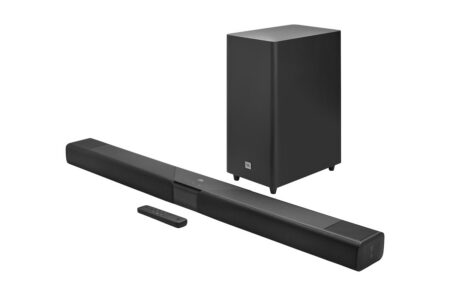
STEREO GUIDE test verdict
The Yamaha True X Surround 90A impressed in our test. It proved to be a premium soundbar through and through, featuring Dolby Atmos, Auro-3D, beam technology, and powerful home theater sound. Surprisingly, it is also well-suited for pure music playback. As a bonus, the rear speakers come with built-in batteries, allowing them to be used as mobile Bluetooth speakers independently of the soundbar.
Pros
- Equally suitable for home theater and music playback
- Wireless subwoofer with contoured bass response
- Amazingly good height channels thanks to beam arrays
- Detachable rears double as mobile Bluetooth speakers
Cons
- Operation can be a bit cumbersome in places
- Factory channel levels are not optimally adjusted
-
Tonal balance / transparency9.3
-
Bass / Dynamics9.6
-
Room9.4
-
Usability / Connectivity9.4
-
Price/Performance9.5
Yamaha is one of the manufacturers that first seriously considered the soundbar concept for home theater. While many competitors focused on providing better TV sound for a long time, the Japanese company was already working on real spatial imaging using DSP technology, virtual speakers, and reflected sound fields. The legendary YSP-5600 was a milestone in this regard a few years ago.
With the new Yamaha True X Surround 90A, Yamaha is now picking up right where they left off. The system combines Dolby Atmos, DTS:X, Auro-3D, wireless rear speakers, and completely redesigned beam technology into one of the most technically ambitious soundbar concepts on the market. The goal is high: to provide the most authentic home theater experience possible without a traditional speaker installation.
And indeed, the True X Surround 90A differs significantly from typical soundbars in many ways. This starts with the basic setup. Yamaha doesn’t just deliver a single soundbar here, but a complete 5.1.2 system with a wireless subwoofer and two wireless rear speakers. As a result, the entire package feels more like a compact alternative to a classic home theater setup than an ordinary TV sound solution.


Sophisticated technology behind the slim housing
Despite its living-room-friendly dimensions, the soundbar itself is packed with an amazing amount of technology. At just under 1.18 meters wide, it fits well visually with TVs from around 55 inches, but remains pleasantly discreet at only about seven centimeters high. Yamaha uses a total of three tweeter domes for the front and center. For the midrange, the Japanese company relies on two specially developed oval speaker drivers for the front channels and two more for the center. These are designed to provide sufficient diaphragm surface area and power handling despite the flat design. At least 100 watts are available to drive each of these three channels.
The whole setup is complemented by two sophisticated beam arrays for the height channels. On each side of the flat housing, under a grille, there are six upward-firing height speakers, each driven by separate 2.5-watt power amplifiers.
This beam technology is the actual heart of the True X Surround 90A. On the top of the soundbar, six small full-range speakers work on each side, controlled individually via the DSP. Through minimal time delays, Yamaha bundles the sound specifically toward the ceiling. Reflection creates a virtual sound source there, giving the impression of real height speakers.

In practice, this works much more precisely than with many Atmos soundbars that only use simple up-firing speakers. The height imaging feels more concrete, stable, and, above all, better integrated. Instead of a diffuse background of effects, a credible impression of height is actually created. Particularly interesting: Yamaha allows you to adjust not only the angle but also the focus of the beam projection depending on the room height and listening position. This makes the system much easier to adapt to different living rooms than many competing models.
Streaming and features
The True X Surround 90A integrates Yamaha’s MusicCast platform and supports numerous streaming services such as Spotify Connect, Tidal Connect, or Qobuz. Additionally, AirPlay 2 and Bluetooth are available.
In everyday use, Spotify Connect and streaming via Roon worked comfortably and stably. On the other hand, the direct Qobuz integration within the MusicCast app seems less successful, as it is functionally quite basic.
Yamaha offers a sensible selection of connections. In addition to HDMI eARC, there is an additional HDMI input, plus an optical digital input, network connection, and USB port for updates.


Wireless rear speakers with a clever concept
The Yamaha WS-X3A surround speakers also stand out from the usual soundbar crowd. Yamaha integrates batteries here, so the rear speakers can either be operated permanently on their charging bases or used flexibly in the room. At the same time, they can be used as mobile Bluetooth speakers independently of the home theater.
This might seem like a lifestyle feature at first, but it actually proves practical in everyday life. Sound-wise, the compact speakers are also a positive surprise. Despite their small size, the WS-X3As reproduce surround effects with astonishing fullness and tonal consistency. The rear channels blend cleanly into the overall picture and create no audible gaps between the front and background soundscapes.
Surprisingly mature subwoofer
The Yamaha SR-X90A wireless subwoofer looks relatively compact at first glance. Its performance in the listening room is all the more surprising. Yamaha uses what they call Symmetrical Flare Port technology here, which is designed to reduce airflow noise and make the bass sound cleaner. The 17 cm woofer has 100 watts at its disposal.
In fact, the woofer plays remarkably controlled. Instead of the typical soundbar drone, it delivers dry, surprisingly deep-reaching bass with good structure. Particularly important: even in action-packed film scenes, the low end remains controlled enough not to mask voices and mids. This is exactly where many soundbar subwoofers perform much worse.


Setup and operation: lots of comfort, minor weaknesses
Overall, the setup is straightforward. The wireless connection between the soundbar, subwoofer, and rear speakers worked stably and reliably in our test. Another positive feature is the front display, which provides an unusual amount of information. In addition to volume and inputs, the Yamaha also shows signal formats, decoders, and even channel information. This is something you’d expect more from large AV receivers than from compact soundbars.

Additionally, a classic remote control, the MusicCast app for iOS or Android, and a full on-screen menu are available. The latter is especially helpful because it allows you to individually adjust numerous parameters. Fortunately, Yamaha allows separate level control for practically all channels, which is by no means a given in the soundbar sector.
However, the menu structure isn’t quite perfect. Some important settings for the beam technology can only be made via the TV menu, while others are only available via the app. A more consistent structure would have made operation easier here.


Music listening test: surprisingly much HiFi for a soundbar
Perhaps the biggest surprise of the Yamaha True X Surround 90A is its music playback. Many soundbars impress initially with effects and spatiality but quickly sound artificial or fatiguing during longer music sessions. Yamaha achieves much more here.
Even in pure stereo mode, the system sounds not only surprisingly balanced but also mature. Voices have volume and naturalness, instruments are cleanly separated, and the stage detaches itself clearly from the housing. Acoustic recordings and vocals in particular benefit from the overall neutral tuning.
However, the test also showed that the factory settings are not optimally chosen. Out of the box, the subwoofer played a bit too dominantly, while voices seemed slightly recessed. After correcting the center and bass levels, however, the playback immediately gained balance and transparency. Dialogues became clearer, voices more natural, and the bass much better integrated.
But the Yamaha gets really exciting with its DSP programs. This is where the manufacturer’s decades of experience are particularly evident.
Surround: AI and Auro-3D in the listening test
Yamaha’s new Surround:AI technology permanently analyzes the audio signal and dynamically adjusts the spatial representation to the content and scenes. This sounds like a typical marketing term at first, but in practice, it works surprisingly convincingly.
The stage grows significantly beyond the physical width of the soundbar and simultaneously gains audible height and depth. At the same time, the representation remains pleasantly stable and free from the artificial coloration known from many aggressive DSP programs. Instead of a spectacular effect show, a large, open soundstage with credible spatiality is created.
The integration of Auro-3D is particularly interesting. Yamaha is actually a pioneer in the soundbar sector here. The Auro-Matic upmixer, in particular, harmonizes excellently with music. Concert recordings, live albums, or acoustic productions gain significantly in atmosphere and spatial scale without losing their naturalness. Voices especially benefit from the airy, open presentation.
What is particularly remarkable is how unobtrusively the virtualization works. The soundstage feels larger and more immersive without instruments being artificially distributed in the room or tonally colored. Very few soundbars manage this balance really convincingly.
Dolby Atmos and home theater: a large sound dome without a forest of speakers
With movies, the True X Surround 90A finally plays out its full home theater strengths. The combination of beam technology, real rear speakers, and cleanly integrated height channels creates an unusually cohesive surround field. And let’s not forget: the properly implemented SR-X90A wireless subwoofer provides a solid low-end foundation for serious special effects in action movies.
Dolby Atmos material in particular benefits from the precise height imaging. Rain, flight noises, or atmospheric effects actually have a vertical dimension instead of mere diffuseness. At the same time, movements in the room feel homogeneous and seamless. The transitions between front, rear, and height channels are surprisingly fluid.
Despite the pronounced spatiality, speech intelligibility remains pleasingly high. Even action-packed scenes retain structure and clarity. Dialogues don’t get lost but remain cleanly anchored in the room. This is exactly what distinguishes the Yamaha from many spectacularly tuned soundbars that create impressive effects but lose precision in the process.
Added to this is an amazing dynamic reserve. For its relatively compact design, the True X Surround 90A plays remarkably confidently and with high power handling. Even larger living rooms can be filled with sound without the soundstage becoming compressed or strained early on.
Conclusion: one of the most exciting premium soundbars on the market
The Yamaha True X Surround 90A is currently one of the most interesting premium soundbars technically and sonically. Yamaha combines enormous DSP experience with real home theater expertise and surprisingly serious HiFi qualities.
The beam technology in particular clearly sets the system apart from many competing models. The height imaging feels more precise and credible than with many competitors. On top of that, you get an amazingly controlled subwoofer, convincing rear speakers, and a spatial representation that actually reminds you of classic surround systems.
Minor weaknesses in the factory settings and menu logic don’t change that much. Properly set up, the True X Surround 90A delivers a large, precise, and at the same time surprisingly natural soundstage. Purist music lovers in particular can expect a very natural stereo reproduction from Yamaha by soundbar standards. As a bonus, there are the wireless rear speakers, which can also be used as mobile Bluetooth speakers thanks to their batteries. The KEF XIO can’t keep up with this flexibility. However, it is also excellently suited for those who expect particularly natural, high-resolution music playback from a soundbar. If you don’t want to spend over 2,000 euros for your soundbar and subwoofer, you should take a listen to the Sonos Arc Ultra with the Sonos SUB 4.
You can find more alternatives in our STEREO GUIDE soundbar best list
Technical data: Yamaha True X-Surround 90A
- Manufacturer’s suggested retail price: 2,500 euros
- Dimensions (W x H x D): Soundbar: 118 x 8.5 x 14.3 cm, Subwoofer: 24.1 x 37.8 x 41.4 cm, Rear Speaker: 8.8 x 22 x 8.8 cm
- Weight: Soundbar: 11 kg, Subwoofer: 12.7 kg, Rear Speaker: 1.0 kg
- Special features: AirPlay 2, Bluetooth 4.2 (SBC/AAC), 1 x HDMI (eARC), 1 x HDMI, USB-A (Service), TOSLINK, RJ45 Ethernet, WLAN, Roon Ready, Spotify Connect, Tidal Connect
- More at: yamaha.com