STEREO GUIDE verdict
The smallest party speaker in Sony’s new ULT Tower series boasts 300 watts, a 23-cm woofer, a light show, and karaoke features. In our test, the ULT Tower 5 impressed with astonishing depth and, by party speaker standards, natural-sounding vocals—but in normal living rooms, its bass can quickly become too much of a good thing.
Pros
- Exceptionally deep and powerful bass for its size
- Balanced mids and crisp highs
- Excellent app with 10-band EQ, lighting, DJ, and karaoke features
- USB-C audio, RCA, and XLR inputs and outputs
Cons
- The ULT 2, in particular, tends to rumble in certain rooms
- Not easy to move even with four handles
- IPX4 rating applies only when the unit is positioned vertically
-
Tonal balance / transparency8.6
-
Bass / Dynamics9.3
-
Usability / Connectivity9.3
-
Price/Performance9.3
Sony’s new ULT Tower 5 is the smallest of three new tower speakers in the ULT Power Sound series. But it doesn’t feel small at all. That’s true of its dynamic lighting, but especially of the bass, which goes deep into the basement even without ULT Boost. And that’s exactly where the new party box had to prove itself: in a large basement room, where we could crank it up to the limit without having to worry about the neighbors.
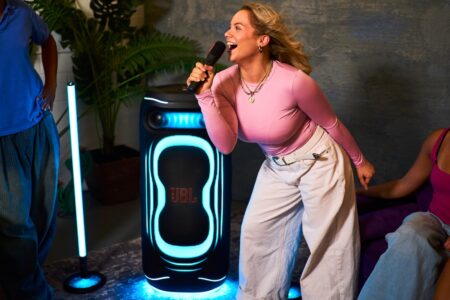
A comparison with the JBL PartyBox Club 120 is particularly obvious. Both started at around 400 euros, are similar in size and weight, and combine battery operation with a light show, an app, and karaoke features. In terms of sound, however, they have different priorities.
New Look: The Smallest Tower Packs a Big Punch
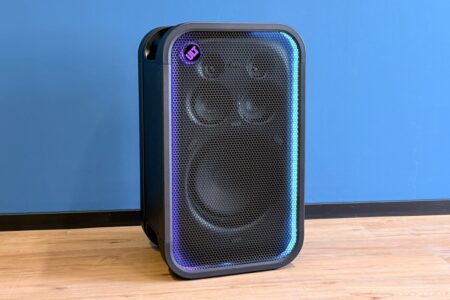
Visually alone, the new generation of ULT towers represents a major step forward for Sony. The ULT Tower 5 looks more modern and distinctive than the brand’s earlier party speakers. The wraparound light frame, the large illuminated ULT logo, and the clean, structured design make it highly recognizable. The choice of materials and build quality also leave a very good impression for this price range.
At 35.8 centimeters wide, 53.4 centimeters tall, and 28 centimeters deep, the Sony remains relatively compact. However, its 12.7 kilograms still make it a bit of a lift. To help with this, Sony has included a total of four recessed handles on both sides, at the top and bottom. This is handy when two people are loading it, but if you’re on your own, you’ll have to carry the speaker with both hands across your body. The fold-out, trolley-style handle on the comparable JBL PartyBox Club 120 makes it easier for one person to transport.
Rubber feet on the bottom and on the right side of the enclosure allow for either upright or horizontal placement. The electronics adjust the sound output based on the speaker’s orientation. In terms of sound quality, however, we would prefer the vertical position: In this setup, one of the two tweeters projects sound diagonally to the left, while the other projects to the right. This distributes the high frequencies more evenly throughout the room and makes the soundstage appear wider.
This does not produce true stereo sound. The two tweeter channels are too close together, and both share the same low-midrange driver. If you want a robust stereo soundstage, you can wirelessly pair two ULT Tower 5 speakers as left and right channels.

23-cm woofer and 300 watts: Sony’s formula for deep bass
Beneath the sturdy front grille sits a newly developed round woofer with a diameter of 23 centimeters. Above it are the two 6-cm tweeters angled to the sides. There is no separate midrange driver; the large woofer must therefore handle not only the bass but also the low and midrange frequencies. On closer inspection, it is actually a powerful low-midrange driver.
For added depth, Sony relies on a flow-optimized bass reflex duct called ULT DUCT. Power is provided by a specially tuned amplifier, which the manufacturer states has an output power of up to 300 watts. The large ULT button lets you select from four sound profiles: FLAT, ULT 1, ULT 2, and LIVE. Additionally, a 10-band equalizer is available in the Sony Sound Connect app.
Operation: The ULT control is always at the top
The best control concept is also the speaker’s visual hallmark. A textured rotary ring for volume control surrounds the illuminated ULT symbol. Pressing the center cycles through the sound modes; the changing color of the icon indicates the selection. Because the control is located in a corner of the enclosure, it remains at the top and easily accessible whether the speaker is standing upright or lying flat.
This is easier than providing a separate control for each function, and it’s easy to figure out even in the dim light of a party. You can set which of the four settings the button cycles through when pressed right in the app. For example, if you only use FLAT and ULT 1, you can disable ULT 2 and LIVE in the app and save yourself the trouble of unnecessary clicking.


Connections: Partybox Meets Compact DJ Gear
Sony doesn’t limit the ULT Tower 5 to Bluetooth. A stereo RCA input accepts the analog signal from an external player or DJ mixer. Even more unusual in this class are an XLR input and an XLR output. These allow you to connect more professional DJ equipment or loop the signal through to additional speakers.
USB-C transmits digital audio directly from a smartphone or computer. The USB-A port plays music from a flash drive and can charge a mobile device. There is a 6.3-mm jack for a wired microphone. Bluetooth 5.3 supports not only SBC and AAC but also Sony’s higher-quality LDAC codec. Two identical speakers can be used as a stereo pair; Party Chain uses Auracast to synchronize music and lighting across up to 100 compatible Sony speakers.
The ports are protected behind a cover on the back. However, the included power cable does not use a standard connector. This custom design is likely due to the need for waterproofing, but it makes replacing the cable while on the go unnecessarily complicated. The IPX4 protection rating applies only when the cover is properly closed and the speaker is positioned upright. The speaker is not waterproof, but it is protected against splashes at a garden party.


Sound Connect: One app is all you need
Good news: Unlike some older Sony party speakers, you no longer need the additional Fiestable app. The Sony Sound Connect app brings together sound, lighting, and party features in one place. Even its home screen can be partially customized. If you prefer to switch between ULT modes exclusively on the speaker itself, you can remove that option from the main menu.
The 10-band equalizer allows for much more precise adjustments than the three standard controls for bass, mids, and treble. With a speaker that delivers such powerful bass, this is more than just a gimmick: even a small adjustment in the problematic bass range can make the difference between a powerful sound and a boomy one.
The light show can also be controlled through the app. Sony offers programs such as BEAT, WAVE, and MELLOW. In the Party Pad menu, under “Sampler,” you’ll find effects like Phaser and Robot. Under “Isolator,” you can swipe across a touchpad to adjust individual frequency ranges and create effect transitions.
For karaoke, the system offers echo, key control, a voice changer, and vocal removal. These features let you adjust the key to match your own vocal range or reduce the vocal track in many recordings. Microphone volume, echo, and key can also be adjusted directly on the speaker for quick access.
Battery: 20 hours and a useful power-saving mode
Sony promises up to 20 hours of battery life. This figure applies when ULT mode is enabled, the volume is set to a moderate level, and the backlight is turned off; naturally, battery life will be shorter during party use with high volume and the backlight on. A 10-minute quick charge is said to provide an additional 100 minutes of playback.
STAMINA is the name of the power-saving mode. It primarily reduces the bass, thereby extending playtime. With small Bluetooth speakers, such adjustments often result in a thin sound that’s barely suitable for music. The ULT Tower 5 delivers so much low-end punch that even STAMINA mode still leaves plenty of body and rhythm. This mode is therefore perfectly suitable for background music.


Sony ULT Tower 5 Sound Test: Even the “FLAT” Setting Sounds Awful
The large basement room at FAZ Kaufkompass—where I oversee the “Party Boxes” category—usually serves as a laundry room for washing machine tests. But with its solid floor and equally sturdy walls, it also proved to be the ideal place to really let the ULT Tower 5 loose.
With “INFERNO” by HEDEGAARD from our Extreme Bass test selection, the Sony clearly demonstrated the difference between depth and mere punch. Many party speakers emphasize the upper bass because it sounds fast and powerful right away. The ULT Tower 5 goes deeper, thereby conveying a greater sense of scale. At the same time, FLAT remains the most balanced choice across all settings for mixed music playlists.
This is exactly where the JBL PartyBox Club 120 sets itself apart. It emphasizes the upper bass more, making kick drums hit harder and giving the beats a particularly infectious rhythm. On Depeche Mode’s “Enjoy the Silence,” the JBL therefore has more forward drive right from the start. The Sony counters this with a stronger foundation: its bass goes deeper and has more rich, deep substance.
ULT 1 or ULT 2? Depth vs. Punch
The ULT 1 really shines in the deep bass range. When placed freestanding or outdoors, this can be impressive, as the Sony produces a bass foundation you’d expect from a much larger speaker. In normal living spaces, it’s best to proceed with caution. Walls amplify the low frequencies, and room corners do so even more dramatically. What sounds powerful in a large basement room can easily be too much of a good thing in the living room.
ULT 2 places greater emphasis on the lower bass, aiming to create a physical sensation of kick and rhythmic punch. This can be fun with simple dance beats. With more complex music and at higher volumes, however, the sound becomes muddy. Basslines lose definition, individual beats blend into one another, and in certain rooms, the sound starts to boom more quickly. ULT 2 is therefore not inherently a “better” mode, but rather an effect suited to the right recording, setup, and atmosphere.
Even the 23-cm low-midrange driver can’t defy the laws of physics. With bass-heavy music and very high volume levels, the protection circuit audibly kicks in to prevent excessive cone excursion. At that point, the bass no longer increases proportionally with the set volume. By focusing more on the lower midrange, JBL secures a bit more usable headroom. The Sony trades some of that for genuine low-end depth. That’s an understandable priority—and, in our view, a very appealing one.

Natural voices instead of the harsh sound of a PartyBox
The real surprise lies above the bass range. We were already impressed by Sony’s smaller ULT models—from the ULT Field 1 to the ULT Field 5 and the ULT Field 7—with their balanced midrange and treble reproduction. The ULT Tower 5 continues this family sound, but adds a little more disco flair.
Even with audiophile recordings like Anette Askvik’s “Liberty,” the vocals remained pleasantly full-bodied and natural. The two tweeters reproduced the atmospheric details with clarity and relative finesse, without unnecessarily accentuating sibilance. Despite the wide dispersion pattern, a single speaker did not produce a true stereo image; however, listeners positioned to the side of the central axis still experienced a balanced soundstage.
“Till Tomorrow” by Yello and Till Brönner confirmed that impression. The highs sounded lively and clean enough to bring out the brilliance of the trumpet clearly yet unobtrusively. Vocals and instruments remained better balanced than is typical of many party speakers designed for maximum show effect.
Compared to the smaller ULT Field speakers, the tower brings the presence and treble slightly more to the forefront. This works well for use at a party, but remains less excessive than with the JBL PartyBox Club 120. Depending on the recording and setup, the JBL can sound comparatively cold and at times harsh. The Sony only starts to sound a bit rough when bass-heavy music is played very loudly and the speaker is pushed to its limits.
Sony ULT Tower 5 or JBL PartyBox Club 120?
Although they are in the same price range, these two PartyBoxes pursue different sound profiles. The JBL PartyBox Club 120 has a particularly rhythmic sound thanks to its pronounced low-midrange and lively response. It retains a bit more headroom at extreme volume levels and is easier to move on its own thanks to its central folding handle.
The Sony ULT Tower 5 counters with deeper bass, more natural vocals, and less harsh high frequencies. Its variety of connections—including RCA, USB-C audio, and XLR inputs and outputs—is remarkable for 400 euros. If you’re looking for maximum punch and straightforward one-handed operation, JBL is likely the way to go. If you want more depth, more refined vocals, and more flexible DJ connectivity, the Sony offers the more exciting package.
Conclusion and Alternatives: Great value for the money—sometimes even too much bass
Many party speakers use heavy low-end emphasis to create the illusion of size. The Sony ULT Tower 5 doesn’t need such tricks. Even in FLAT mode, its 23-cm woofer produces a deep, dark, and physically palpable foundation. At the same time, vocals sound surprisingly natural and the highs are crisp without becoming unnecessarily sharp. As a result, the smallest new ULT Tower combines party fun and hi-fi qualities more convincingly than many of its direct competitors.
Its greatest strength is also its most important caveat: The bass requires proper placement. Keeping it away from walls—and especially from room corners—is essential; the ULT 1 and, in particular, the ULT 2 should be used strategically indoors. If you follow these rules, for 400 euros you’ll get a high-quality, durable, and incredibly versatile party speaker with a light show, karaoke, DJ connections, and genuine bass depth.
The JBL Partybox Club 120 counters with greater clarity and an extra dose of freshness. And it sounds clearer and more transparent because the bass—which is more “fast” than deep—doesn’t mask as many details in the midrange. Its biggest advantage, however, is the trolley-inspired design with a telescoping handle and wheels.
You can find more alternatives in our best Bluetooth speaker list
Technical Specifications: Sony ULT Tower 5
- Manufacturer’s suggested retail price: 400 euros
- Dimensions (W x H x D): 35.8 × 53.4 × 28 cm
- Battery life: up to 20 hours, according to the manufacturer
- Fast charging: 10 minutes for up to 100 minutes of playback
- Weight: 12.7 kg
- Color: Black
- Special features: Bluetooth 5.3, analog inputs (RCA input, XLR input, XLR output, USB-A, USB-C audio, 6.3-mm microphone input), Stereo pairing, Party mode via Auracast, app control, LED party light
- For more information, visit: www.sony.com