STEREO GUIDE verdict
The JBL PartyBox Encore 2 is a party all-rounder built squarely for fun and versatility. It impresses with surprisingly high output, lively dynamics, and punchy bass. At the same time, the tuning is clearly geared toward effects. The extensive feature set—wireless mic, light show, and app—makes it a flexible solution for karaoke, small events, and spontaneous parties.
Pros
- Can play very loud and powerful for its weight class
- Easy to carry
- Wireless microphone, built-in power supply
- App with lots of sound and lighting effects for parties
Cons
- Slightly bloated upper bass
- Relatively harsh vocal reproduction
-
Tonal balance / transparency8
-
Bass / Dynamics8.3
-
Usability / Connectivity9.8
-
Price/Performance9.4
As the second generation of the popular series, the JBL PartyBox Encore 2 fills an interesting niche. It’s clearly more versatile than a classic Bluetooth speaker, yet more compact and flexible than the big PartyBox models. Within the JBL family, it sits above simple portable speakers but below larger systems like the PartyBox 320 or 520, which are primarily designed for maximum volume and covering large areas. The Encore 2 scores with its mix of mobility, integrated light show, and the included microphone, making it especially appealing for karaoke.
Compared to its predecessor, the standout change is the updated connectivity with Bluetooth 5.4 and Auracast, making it easier to link multiple speakers. App control has also been expanded further, integrating lighting and sound control even more comprehensively. On top of that, the AI Sound Boost with AI support—already familiar from recent JBL Bluetooth speaker reviews—has made it on board.
Alternatives outside the JBL world often focus either more on sound quality or on volume and party features, but rarely on the combination of both. That’s exactly where the Encore 2 shines: it’s not a specialist in just one discipline, but a versatile entertainer that brings music, interaction, and visual effects together.

Technology and features: Solid foundation with a focus on dynamics
Inside is a classic two-way system, consisting of a 13.5 cm (5.25″) woofer/midrange driver and two 2 cm (0.75″) tweeters. Output power is 100 watts RMS, which is more than enough for the compact design to fill larger rooms or smaller outdoor scenarios.
According to the manufacturer, the frequency response ranges from 40 Hz to 20 kHz, meaning the PartyBox Encore 2 reaches comparatively deep into the bass. The sound concept is supported by what JBL calls AI Sound Boost. As with the Charge 6 or Xtreme 4, this technology uses artificial intelligence to analyze the signal in real time to reduce distortion. With this AI solution, JBL aims to ensure the clearest possible playback even at higher volumes.
Power comes from a lithium-ion battery of the JBL Battery 200 type (7.4 V/4,722 mAh), which can deliver up to 15 hours of runtime depending on use. Practical: with the speaker switched off, the battery charges relatively quickly in 3.5 hours. Optionally, a replacement battery (around €60) can be inserted via a tool-free flap on the rear panel to extend playtime.


Practical connectivity options
The connections—protected from moisture and dirt by a rubber cover above the battery compartment—also show the Encore 2’s flexibility. The illuminated connection panel includes an AUX input and a USB-C port for music playback from storage media in FAT16 or FAT32 formats. With the speaker switched on, you can charge a smartphone or tablet via USB like with a power bank. There’s also an input for microphone and guitar (condenser mics only make sense with an external preamp due to the lack of phantom power). The latter has gain and level controls, so the speaker is even suitable for small live setups.
That also makes the JBL PartyBox Encore 2 a good speaker for musicians who practice with backing tracks or play-along recordings. The backing music is fed in via Bluetooth or AUX, while vocals or an instrument are mixed in live via the inputs. Especially for guitarists or singers working with karaoke versions without vocals, it’s a practical all-in-one solution. I’d like to highlight the variable pitch here, which lets you adapt the tempo of backing tracks to your voice.
Another highlight is Auracast support. This wireless standard lets you pair multiple compatible speakers. That way, the Encore 2 can be used either as a stereo pair with a second compatible Bluetooth speaker or as part of a larger system.


Karaoke and microphone: A well-thought-out detail for real-world use
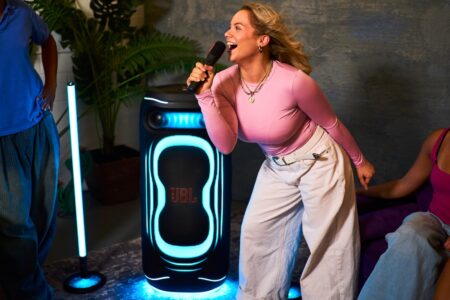
A key element of the PartyBox Encore 2 is the included wireless microphone with a range of up to 30 meters. Pairing happens automatically after switching on, so no additional setup is needed—a clear plus for spontaneous use.
Also practical is the included holder, which can be flexibly attached to the back of the bass-reflex cabinet using a rubber strap—either on the left or right. This keeps the microphone safely secured and always within easy reach.
In use, the karaoke function proves surprisingly versatile. You can continuously add echo to the voice, while a second control adjusts the microphone level independently of the music volume. This lets you place vocals precisely in the mix—from subtle in the background to clearly up front. For karaoke or announcements, it’s a practical and well-executed solution.


Controls and app: Full control over sound and light
Control is handled directly on the device or via the JBL PartyBox App for Android and iOS. The Encore 2 is not compatible with the standard JBL One app, unlike its bigger siblings Club 120, Stage 320 or PartyBox 520. The controls on the top let you quickly access basic functions such as volume, playback, or light control.
The app significantly expands the feature set. You can not only control playlists, but also adjust sound settings via presets or a 7-band equalizer, trigger sound effects like horns or “hands-up” calls, and configure the light show. The latter reacts dynamically to the music and provides the right visual backdrop with various modes and effects.
In everyday use, the app proves a useful addition because it gives access to all functions without having to stand right next to the device. That’s especially handy once the party is already underway.
If—like it often happened to me in the test with the iPhone despite up-to-date software—the JBL PartyBox app doesn’t connect reliably or functions drop out, it’s worth checking Low Power Mode. If it’s active, iOS can restrict background processes and Bluetooth communication. The fix is simple once you’ve found it after a few failed attempts like I did: disable the iPhone’s Low Power Mode—after that, the connection is usually stable. 
Sound test of the PartyBox Encore 2
Given its comparatively compact dimensions, the small party speaker puts on an almost spectacular show. It can not only play very loud, it also sounds very lively and reproduces dynamic jumps without the compression typical of smaller Bluetooth speakers.
However, the very lively spectacle—especially with tracks from rock, pop, or hip-hop—won’t fool trained ears into missing JBL’s tried-and-true trick: the Americans emphasize the upper bass to deliver a proper punch, especially with electronic beats. The sound is staged in a very mood-boosting way and is perfect for getting people onto the dance floor.
You can easily hear the effect with tracks like “Enjoy the Silence” from Depeche Mode’s Remixes 81>04. Even then, though, it’s noticeable that differentiation in the lower octaves isn’t quite as strong as its ability to hold level. And naturally, bass extension can’t keep up with larger PartyBoxes. That becomes even clearer when listening to acoustic instruments like plucked double bass or real kick drums.


Fun-focused tuning
This is rarely relevant in typical use, but the fun-focused tuning with the bloated bass is clearly noticeable even with electronic pop. Depending on the recording and your taste in music, you can add the bass boost in two stages on top. That intensifies the effect, making the PartyBox sound even more impressive—or even more over-the-top—depending on the setting and genre.
But when you consider how compact the speaker is, how loud it can play, and how much pressure it can generate at low frequencies—up into absurdly high SPL territory—this approach feels quite consistent. The crisp treble also works well at parties, even if it lacks a bit of smoothness. The sound presets don’t fundamentally change this effects-driven character either. The same goes for the vocal reproduction, which can sometimes lean toward sharpness.
At least the impressive dynamic range for its size is convincing, letting music audibly breathe even if tonal accuracy can’t fully keep up. That means acoustic instruments don’t sound entirely authentic tonally, but they can still impress with intensity and attack. This also makes the PartyBox Encore 2 interesting for users who want to play accompaniment instruments for practice or smaller live uses.
Conclusion and alternatives: JBL PartyBox Encore 2
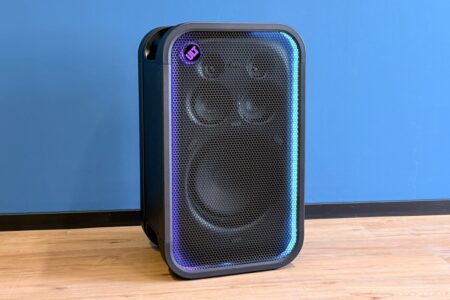
The JBL PartyBox Encore 2 doesn’t win you over with standout performance in any single discipline. What sets it apart is its overall successful—and highly practical—mix. That starts with connectivity, which makes it ideal for karaoke nights or live performances, includes the great feature set with the included wireless microphone, and extends to its decidedly powerful, party-ready sound. And all of that at a price that’s quite affordable by JBL standards. Sure, for the same money you can get much larger party speakers, such as Sharp’s XParty Street Beat (PS-949), but you shouldn’t forget that for many users, mobility and flexibility in use are what really matter. And in that respect, few can match JBL—especially not with a comparable feature set. With its flexible top handle, compact dimensions, and manageable weight, it’s easy to carry.
You can find more alternatives in our best Bluetooth speaker list
JBL PartyBox Encore 2: Technical specifications
- Manufacturer’s suggested retail price: 350 Euro
- Dimensions (W x H x D): 38.5 x 38.5 x 35 cm
- Weight: 9.15 kg
- Battery life up to 15 hours
- Battery charging time: approx. 3.5 hours
- Special features: Bluetooth 5.4, splash-proof to protection class IPX4, 2-stage Bass Boost, built-in power supply, jack input (mic/instrument), replaceable battery
- More at: jbl.com