STEREO GUIDE test verdict
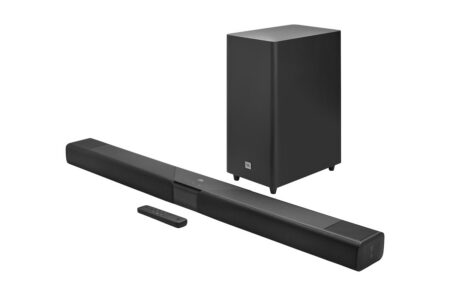
In our test, the JBL Bar 800MK2 proved to be a powerful Dolby Atmos soundbar with clever battery-powered rears, expansive spatial sound, and a high-volume-stable, rich, but not overly tight subwoofer.
Pros
- Very good spaciousness for this price range
- Versatile set with detachable rears
- Powerful Wireless Subwoofer
- Automatic room calibration
Cons
- Somewhat soft bass reproduction
- Soundbar cannot handle as much volume as the subwoofer
-
Tonal balance / transparency8.6
-
Bass / Dynamics8.8
-
Room9
-
Usability / Connectivity9.5
-
Price/Performance9.8
With the JBL Bar 800MK2, JBL is launching the second generation of its successful mid-range soundbar. The basic concept remains the same: a comparatively slim Dolby Atmos soundbar with detachable battery-powered rear speakers and a powerful subwoofer. This home cinema set, offered at a list price of 680 Euros, proves to be a more affordable version of the larger Bar 1300, whose first generation we tested a few years ago. Compared to its direct predecessor, the Bar 300, JBL has technically expanded the second generation of the soundbar and added numerous features.
The new Bar 800MK2 operates as a 7.1-channel system with a wireless 10-inch subwoofer and two detachable surround speakers that can be easily removed from the sides of the soundbar for true rear surround. JBL thus remains true to its concept of offering home cinema surround as uncomplicated as possible without permanent speaker cabling.
Slim Soundbar with a Clever Surround Concept
Visually, the JBL Bar 800MK2 remains pleasantly inconspicuous. At just under 1.16 meters wide and only 5.2 centimeters high, it fits easily in front of most TVs without obscuring the picture. Behind the simple housing, however, lies a comparatively elaborate speaker setup.
The soundbar itself houses six so-called racetrack drivers measuring 4.4 x 8.0 centimeters, as well as two separate tweeters with a 2.5-centimeter diameter. The two detachable rear speakers each use their own racetrack chassis measuring 4.4 x 9 centimeters. A separate wireless subwoofer with a 10-inch driver is responsible for the low frequencies. JBL specifies the maximum total output at 780 watts. Of this, 400 watts are allocated to the soundbar itself, 300 to the subwoofer, and 2 x 40 watts to the small effect speakers.


The wireless rear speakers remain the special feature of the system. They magnetically attach to the left and right of the soundbar and are charged there simultaneously. For movie nights, they can be easily detached and positioned behind the listening position for true surround sound. A nice detail: JBL includes magnetically held caps to cover the connections. The integrated batteries provide power for up to ten hours of runtime. However, power can also be supplied via a USB-C port using a power adapter from accessory retailers. This also makes it possible, for example, during the upcoming FIFA World Cup in Canada, Mexico, and the USA, to play audio in broadcast mode via the detachable wireless speakers in another room – without worrying about empty batteries.


Dolby Atmos and MultiBeam 3.0
The JBL Bar 800MK2 supports Dolby Atmos and combines this with JBL’s proprietary MultiBeam 3.0 technology. JBL uses targeted reflections via side walls and room boundaries to create a wider and more spatial soundstage. In addition, the manufacturer promises improved dialogue intelligibility through PureVoice 2.0 and a new SmartDetails function, which is designed to bring out fine sound details more effectively.
Also interesting is the so-called “Night Listening” mode. In this mode, only the detachable rear speakers continue to play, while the soundbar and subwoofer are muted. This allows for relatively quiet TV viewing at night without having to completely forgo spatial reproduction.
Streaming, App, and Features
In addition to classic home cinema use, JBL also positions the Bar 800MK2 as a streaming system. Supported features include AirPlay 2 with multi-room audio, Google Cast, Spotify Connect, and Bluetooth 5.3. Network connectivity is established either via an Ethernet cable connection or Wi-Fi.
Control is handled by the JBL One App, available for iOS and Android, which allows you to manage sound modes, equalizers, and firmware updates. Automatic calibration and numerous detailed functions can also be set here.
The soundbar offers HDMI eARC, an additional HDMI input with Dolby Vision and HDR10+ passthrough, as well as an optical input and Bluetooth audio.


Automatic Calibration and Flexible Adjustment
Like the recently tested Bar 300MK2, the JBL Bar 800 MK2 also features automatic room calibration. Unlike simpler soundbars, this one is a bit more elaborate because the system works with true wireless rear speakers.
For calibration, the two detachable surround speakers must first be disconnected from the soundbar. The JBL One App then guides you step-by-step through the process. The rear speakers are first positioned approximately at listening height and then placed behind the listening position. Using integrated microphones, the system plays several measurement signals, analyzes room reflections, and automatically adjusts the surround field and 3D reproduction to the acoustic conditions of the room.
Especially with Atmos systems that include virtual room components, this adjustment is useful, as seating position, wall distances, and room size can significantly influence the spatial effect.
The variable lip synchronization is also practically implemented. It can be conveniently adjusted between 0 and 250 milliseconds via the JBL One App. Alternatively, this also works directly via the included remote control, albeit a bit more cumbersomely via a key combination. Especially in combination with different televisions or players, this function can be important for cleanly synchronizing picture and sound.
Surprise during the test: Only the firmware update made the difference
A special feature only emerged during the joint test by STEREO GUIDE and LowBeats. After the listening session, my LowBeats colleague Raphael Vogt wanted to check how the JBL Bar 800MK2 sounds without the corrections of the automatic calibration. Good idea. However, unlike with Nubert, for example, the calibration cannot simply be deactivated. Therefore, we reset the entire system.
After that, something unexpected happened: The soundbar suddenly pulled new firmware from the network after the reset and then restarted completely. What was remarkable about this: Before the test began, we had explicitly searched for available updates in the JBL One App. However, no new software package was displayed there. Actually, the app – like many competitor systems – should automatically indicate new firmware after network setup.
After the restart, however, it quickly became clear that the new software made a noticeable difference. Not only were new functions added, but the sound tuning, which had previously been slightly in need of improvement, now sounded audibly more harmonious and balanced. Therefore, we decided to repeat the entire listening test.
New additions after the update included Roon support, including a voucher to try out the popular music server solution, which has recently been plagued by update problems (as we reported), as well as a display of the charge status of the detachable rear speaker batteries.


Flexible Home Cinema Solution Without Speaker Cables
The basic concept of the JBL Bar 800MK2 remains unusually practical in its second generation. The detachable rear speakers combine a true surround feeling with high everyday usability. At the same time, installation remains significantly simpler than with classic home cinema systems with separate speaker cables.
Whether JBL has made decisive progress in sound in addition to the new features is clarified in the detailed listening test in the LowBeats home cinema sound room in Worms.
Listening Test: Surprisingly Spatial, but with a Clear JBL Signature
In the listening test, the JBL Bar 800MK2 first clearly showed its typical JBL tuning. Even with the bass setting “3” out of a maximum of five levels, which according to the frequency response display in the app should actually correspond to a linear tuning, the subwoofer played audibly more powerfully and fully than one would neutrally expect. The bass sounded rich, soft, and slightly springy, but developed plenty of groove and playfulness. This worked very entertainingly, especially with pop, electronic music, or modern film soundtracks.
However, it quickly became clear that the woofer was tuned more for effect and punch than for maximum precision. Even at a medium setting, the low end tended to be slightly full. In action films and spectacular effects, this was quite enjoyable. Helicopters, explosions, or low-frequency Atmos effects were clearly better suited to the subwoofer than finely structured music recordings. With more complex bass lines, however, the low end occasionally seemed a bit soft, slightly boomy, and not always perfectly differentiated.
Interestingly, the subwoofer has significantly more volume reserves than the soundbar itself. If you turn the system up high, the woofer remains surprisingly composed, while the bar itself eventually audibly reaches its limits and sounds slightly more aggressive.
Surprisingly Strong Spatiality
The JBL, however, presented itself significantly stronger in terms of spatial imaging. The horizontal stage, in particular, was exceptionally wide and cohesive. The MultiBeam technology worked surprisingly convincingly in the LowBeats home cinema, creating a large, very expansive sound field.
Especially with docked rear speakers, the virtualization worked surprisingly well. In music tracks like “Welcome To The Pleasuredome” by Frankie Goes To Hollywood from the Limited Super Deluxe Edition of the album (Blu-ray Audio: 2025 Steven Wilson Atmos Mix), effects sometimes credibly detached behind the listening position. This was remarkably convincing for a soundbar in this class.
The actual height imaging of the Atmos effects, however, seemed somewhat more diffuse. Height information was distributed more broadly in the room, rather than appearing precisely localizable above the listening position. Individual height channels could be raised separately in the app, although this also affected the respective rear components. In addition, Dolby Atmos must be explicitly activated via the corresponding Dolby button.
Voices and Music: Still a Bit Dull Before the Update
In its original software state, the JBL generally played with a rather warm and pleasing tuning. Voices were clearly intelligible and never unpleasantly harsh, but there was a slight lack of brilliance and fine high-frequency resolution. Especially with music, the reproduction was therefore suitable for long-term listening, but occasionally also slightly lackluster.
Interestingly, we preferred music with docked rear speakers to completely separated surround reproduction, in contrast to film sound. The soundstage appeared more homogeneous and plastic.
Surprising Transformation After Firmware Update
However, things only became truly exciting after the complete reset and the subsequent automatically installed firmware update. Because after that, the sound tuning of the bar changed surprisingly significantly.
Suddenly, the JBL played audibly more brilliant, dynamic, and resolving. The stage gained significantly in both width and height. At the same time, the overall tuning seemed more homogeneous and coherent, especially in the interaction between the front system and rear speakers.
Rhythmically, the bar also noticeably improved. Music developed more drive and sounded livelier than before. The bass remained on the rich and soft side, but now integrated better into the overall picture.
However, the new tuning was not without side effects. Voices now sounded minimally tinnier and less warm in places than before the update. Overall, however, the new software version was clearly the better and more mature tuning in terms of sound.
Conclusion and Alternatives to the JBL Bar 800MK2
Ultimately, the JBL Bar 800MK2, with its smart rears and powerful, relatively volume-stable subwoofer, offered a solid performance for its price range under 900 Euros and also impressed with clever detailed solutions. For those who want to fill medium to larger rooms or experience special effects in action cinema with greater impact and spatiality, the extra expense for the otherwise equally successful, tonally similarly tuned Bar 300MK2 is undoubtedly worthwhile. In most multi-family homes, it would likely be difficult to fully appreciate the difference in bass – but in three-dimensional spatial representation, it certainly would be.
A direct competitor comes from Berlin: Slightly more expensive than the JBL Bar 800MK2 at list price is the 7.1.2 action set of the Teufel Cinebar 22, which we, however, only tested in the 5.1 basic version with a flat subwoofer.
Further alternatives can be found in our HiFi top list for soundbars
Technical Specifications JBL Bar 800MK2
- Manufacturer’s suggested retail price: 900 euros
- Dimensions (W x H x D): Soundbar: 85.4 x 5.2 x 12.8 cm, (116.3 x 5.2 x 12.8) cm (with attachable speakers), Rear Speaker: 16.9 x 5.2 x 12.8 cm each, Subwoofer 32.5 x 40 x 32.5 cm
- Weight: Soundbar: 5 kg without rears, Rear Speaker: 0.7 kg each, Subwoofer 8.1 kg
- Special features: 1 x HDMI eARC, 1 x HDMI, USB A, S/PDIF (optical), Bluetooth 5.3, AirPlay 2 with multi-room playback, detachable wireless rear speakers, wireless subwoofer included
- More at: jbl.com