STEREO GUIDE verdict
The WiiM Bar and Sub Pro impress with excellent speech intelligibility, finely detailed vocals, and seamlessly integrated, precise deep bass. The stereo soundstage remains compact, and the surround sound feels somewhat front-biased. Versatile streaming capabilities and the option to expand to a 5.1.2 setup round out the package.
Pros
- Excellent speech intelligibility
- Neutral, finely detailed vocal reproduction and excellent clarity
- Seamlessly integrated subwoofer with precise, deep bass
- Versatile streaming, multi-room capabilities, and expandability to 5.1.2
Cons
- Limited stereo soundstage width, somewhat center-heavy
- Even with a subwoofer, it’s not the loudest home theater
- No Apple AirPlay
-
Tonal balance / transparency8.9
-
Bass / Dynamics9
-
Spatial imaging8.8
-
Usability / Connectivity9.8
-
Price/Performance9.2
After the WiiM Sound smart speaker—equipped with touchscreen controls—had practically taken the multiroom world by storm, many industry insiders were speculating about which segments the young brand might target next to challenge market leaders like Sonos. The answer came in the form of the WiiM Bar—the only Dolby Atmos soundbar with touchscreen controls on the market that we’re aware of.
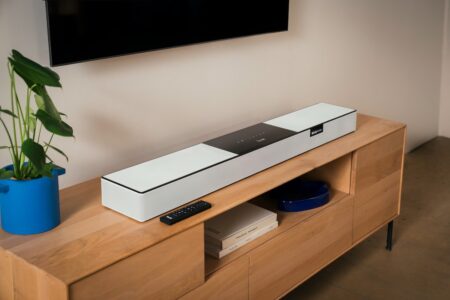
The round, central screen—which gives the otherwise very flat bar its distinctive humped shape—reminded us of various dashboards found in luxury cars. And indeed, when not being used for control purposes, it can display not only album covers but also VU meters and various clocks. In this way, the bar—which is otherwise finished in matte black or white—blends unobtrusively yet stylishly into the living room’s ambiance.
We had already seen the bar itself at HIGH END Vienna 2026 Let’s take a quick listen. For this test, we ordered the set that includes the WiiM Sub Pro. Not only does the powerful bass support complement the rather slim soundbar well for a true home theater experience, but we were also impressed by the WiiM Home app, which offers a particularly simple way to wirelessly integrate additional speakers and subwoofers into the surround sound setup. The German distributor lists a suggested retail price of 499 euros for the soundbar. The WiiM Sub Pro used here is available in the German WiiM store for 529 euros. This brings the total cost of the combination to 1,028 euros. In return, you get surround sound with dedicated tweeters for Dolby Atmos, surround sound generated by the soundbar, and powerful bass from the subwoofer.
A soundbar with depth and multiple drivers
The soundbar’s enclosure houses eight active drivers. Three mid-bass drivers and three tweeters face forward; two upward-firing full-range drivers handle the overhead sound. Four passive radiators support the low-frequency range. WiiM lists the soundbar’s maximum system power at 135 watts. According to the manufacturer, the 1.06-meter-wide soundbar weighs five kilograms.
The height channels utilize reflections off the ceiling. Accordingly, the upward-facing drivers should be able to radiate freely, and the ceiling should not be too highly absorbent. Wall mounts are included for placement on a TV stand or mounting beneath the screen.


Touchscreen Instead of Flying Blind
The round, 2.1-inch color touchscreen on the front is a real eye-catcher. Among other things, it displays album covers and playback information and allows you to access sources, equalizer settings, and saved favorites. Clock displays are also among the available display options. When listening to music, you can view this information right on the device.
The WiiM Home app handles setup, streaming management, and other audio settings. A remote control is also included. It connects via Bluetooth, charges via USB-C, and offers Alexa voice control at the touch of a button. To use it, you’ll need to sign in to Alexa through the app. You can also control the volume using your TV’s remote control via HDMI-CEC.
If you just want to quickly adjust the volume or change the source, you don’t have to do it via your smartphone, remote control, or touchscreen—you can use the touch-sensitive panels discreetly built into the top of the bar. They’re normally hidden, but light up when you bring your hand close to them.
Here’s what’s inside the WiiM Sub Pro from a technical standpoint
The WiiM Sub Pro handles the low frequencies with an 8-inch woofer and a Class D amplifier, for which WiiM specifies 250 watts of continuous power. With a lower cutoff frequency of 35 Hz, the subwoofer is supposed to go low enough for music, according to the manufacturer; however, this is a bit tight for action movies with heavy rumbling.
Weighing in at about 16 kilograms, the subwoofer is significantly heavier than the soundbar. It connects wirelessly via the WiiM Home app. Audio transmission can also be wireless within the WiiM system; in addition, the Sub Pro features an Ethernet port and a mono RCA input for devices with an analog subwoofer output, which makes perfect sense if you’re still running a conventional hi-fi system alongside your WiiM setup.


TV Audio Meets Streaming
HDMI eARC is the primary input for TV connections. Supported formats include Dolby Atmos, Dolby TrueHD, Dolby Digital Plus, DTS, and DTS:X. There is also an optical digital input and an analog stereo RCA input. A CD player or turntable with a suitable phono preamp can also be connected. WiiM also lists USB connection options.
The speaker connects to the home network via Wi-Fi 6E or Ethernet. Bluetooth is available for additional wireless connections. For music playback, the platform offers Spotify Connect, Tidal Connect, Qobuz Connect, Amazon Music Cast, Google Cast, as well as DLNA/UPnP and Roon, among other options. Using the WiiM Home app, you can group the soundbar with other compatible devices for multi-room music. The app also offers several options for integrating internet radio stations. The only thing we really missed in terms of connectivity here is the ability to stream via AirPlay.

The Powerful Multiroom App: WiiM Home
The WiiM Home app serves as the control center for setup, source selection, streaming, and sound tuning. Music services, internet radio, and your own music on the network all come together here. Spotify Connect, Tidal Connect, and Qobuz Connect also allow you to control the system directly from the respective provider apps. Google Cast, Amazon Music Cast, DLNA/UPnP, and Roon expand the possibilities. Favorite stations and playlists can be saved as presets, so your go-to music is always just a tap away. You don’t always need to use your smartphone to access playback, sources, and presets—the bar’s touchscreen also offers these control options.
With WiiM Radio, the app also offers its own Internet radio service, which organizes stations from around the world by genre, among other criteria. For Qobuz users, the Qobuz Radio feature is also available. Gapless playback ensures a seamless transition between tracks—particularly enjoyable for live albums or through-composed works, whose musical flow would suffer from forced pauses.
App-solutely versatile
Its capabilities extend beyond the living room. Multiple compatible devices can be grouped into multiroom groups or played back in different rooms with different music playlists. The app also manages the respective sound settings. The system is now cross-brand: In addition to WiiM components, compatible models from Audio Pro’s W Series and compatible streaming components from Pro-Ject can be integrated. This means that your choice of speakers for the home office or the patio doesn’t have to depend on the soundbar’s manufacturer logo.
For home theater use, the app also handles the assignment of compatible devices to the rear channels and the integration of the Sub Pro. With two additional surround speakers, the combination of the soundbar and subwoofer expands from the 3.1.2 set discussed here to a 5.1.2 system. Multi-room music and the addition of true movie audio channels are thus two different ways to use the same platform.


RoomFit in the App: Customization
The RoomFit automatic room correction system uses the smartphone’s microphone or a suitable external microphone for acoustic measurement. With the BAR, the left, right, and center channels are measured and corrected one after another. Unlike other systems, this works not only with iPhones but also with Android devices, whose microphones are less precisely calibrated. To do this, you need to measure the soundbar once in the near field, which allows for a rough calibration of the smartphone’s microphone.
The Sub Pro has its own RoomFit feature for the bass range. However, the current manufacturer’s instructions do not yet support joint calibration of the Bar and Sub Pro. The multi-band equalizer in the app, with numerous parametric functions, can be adjusted and activated in addition to the generated calibration curve, allowing you to further customize the clearly displayed correction curve to suit your own listening preferences.


WiiM Bar Audio Test: Solo Performance
In the music listening test, the WiiM Bar’s strengths are particularly evident with vocals. It reproduces vocals of all kinds with neutrality and fine resolution. Its good transparency makes it easier to discern details and individual elements of the recording. The soundstage comes across as clear and well-defined. The bar is somewhat restrained in the fundamental frequency range. As a result, voices and instruments take on a rather lean contour, and their physical fullness is slightly reduced. The neutral vocal reproduction and fine resolution are maintained, however.
In stereo, the Bar does a decent job of localizing individual sound sources. However, the spatial extension remains limited: the soundstage unfolds with only limited width and has little depth. The Bar renders the musical action clearly, but arranges it in a rather compact manner in front of the listener.
When watching movies with surround sound effects, including Dolby Atmos, the soundbar delivers an astonishingly wide and tall soundstage. However, the sound remains more front-focused—with an added sense of space—than one might expect from a fully enclosed soundstage with true rear speakers.
When watching TV, the outstanding speech intelligibility is striking. Dialogue stands out clearly and is easy to follow. The sound reproduction places the spoken word firmly at the center of the action.
A Dual Review: WiiM Bar and WiiM Sub Pro
This makes the Sub Pro all the more impressive, regardless of the source material. The transition between the soundbar and the subwoofer is seamless, which—especially with rhythmically driven music like rock, funk, disco, and groovy jazz—places it in an unexpectedly high league for audiophiles. The bass extends deep enough for music, sounds precise, and lends appropriately recorded albums a rich groove without slipping into boomy sound. The powerful low-frequency foundation and the slightly subdued fundamental tone remain recognizable as distinct characteristics of the tuning.
The Sub Pro also provides a precise, deep foundation for movies. Its excellent integration ensures that the soundbar and subwoofer function as a cohesive system; while the effects may not rumble quite as much as with other subwoofer combinations, they sound all the more realistic—especially with music. The listening impressions described here refer to this specific setup; expanding the system to a 5.1.2 configuration with rear speakers is an additional upgrade option.
This makes the system particularly well-suited for music and movie enthusiasts who appreciate clear vocals, controlled bass, and integration with the WiiM system. Those looking for a particularly wide stereo soundstage or a highly immersive surround sound experience should keep these limitations in mind when making their selection.
Conclusion and Market Environment for WiiM Bar
The combination of Dolby Atmos with discrete height channels and touchscreen controls is unique in the soundbar segment, so the WiiM Bar has virtually no competition. It delivers an astonishingly balanced and clear sound even without a subwoofer, though the bass in home theater audio is somewhat limited. It stands out from competitors like the Sonos Beam 2 thanks to true Atmos, the touchscreen, and slightly more refined high frequencies, but it doesn’t work any dynamic miracles.
In our view, the WiiM ecosystem’s range of features for streaming and app control is the best on the market, outperforming even established competitors like Sonos and Bluesound.
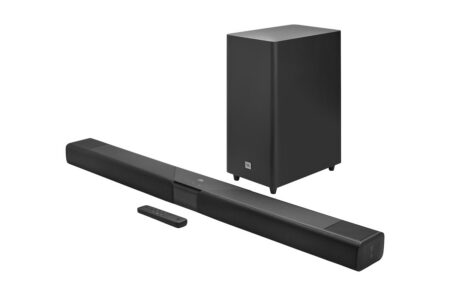
Anyone who, in addition to action movies, also plays bass-heavy music like hip-hop, electronic, or modern rock will find the extra cost of the subwoofer well worth it. Even though larger competitors like the JBL Bar 800MK2 can produce more immersive surround sound and a deeper bass rumble, the WiiM combo remains the winner in terms of clarity, balance, and bass precision.
Further alternatives can be found in our HiFi best list for soundbars
Technical Specifications for the WiiM Bar + WiiM Sub Pro
- Manufacturer’s suggested retail price: 500 euros (cash), 530 euros (subwoofer)
- Dimensions (W x H x D): 1.06 x 7.4 x 10.3 cm (bar), 30.1 x 39.9 x 32.2 cm (subwoofer)
- Weight: 5 kg (Bar), 16 kg (subwoofer)
- Special Features: LAN, Wi-Fi, HDMI eARC, optical input, analog RCA input, Bluetooth 5.3; voice control, wireless remote control, supports Chromecast, Spotify Connect, TIDAL Connect, Qobuz Connect, DLNA
- For more information, visit www.wiim-audio.de