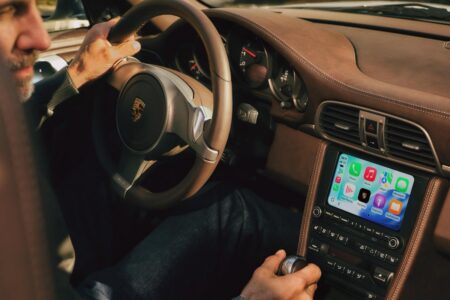
An acquaintance of mine recently stood in front of my classic car, looked at the tires, and commented something like: “Michelin—that’s how you see who loves their car.” It wasn’t meant as a technical statement, but rather a diagnosis of character. Anyone who puts this brand on their car doesn’t just want to get from A to B, but also wants to enjoy the curve in between.
I had to think of exactly that feeling when the Zeekr 7GT made its German premiere in the foyer of Geely Holding in Raunheim, near Frankfurt. Here, too, the message is demonstrative: the all-electric Grand Tourer doesn’t rely on just any tire; it treats itself to Michelin Pilot Sport EV on alloy wheels. The car says quite clearly: I want to be fun, not just rack up miles. Above all, this detail represents an ambition that doesn’t stop at the sound system presented under its own label. Regardless of the surprisingly affordable price for the vehicle and its premium speakers, this underscores the ambitious approach of the Chinese newcomer with its development center in Gothenburg, Sweden.
I wasn’t able to drive the 7GT that day. The first audio check of the sound system took place while stationary. However, the result made me sit up and take notice, especially since the concept of the Zeekr Premium Sound System immediately stands out from the general market offering.

European signature, 800 volts, and a cockpit without the annoyance factor
The design looks as if it wasn’t drawn for a showroom, but for people who get in every day. Clear surfaces, a light strip that doesn’t scream “look at me, I’m the future,” and a cockpit that is modern without trying to educate you with layers of menus. The 800-volt technology is communicated under the keyword “Golden Battery,” and even if you should generally take such terms with a grain of salt: the setup fits the Grand Tourer claim, because long-distance travel isn’t just about seats, but also about charging reality.

The sound system: 23 speakers and an exposed tweeter as a statement
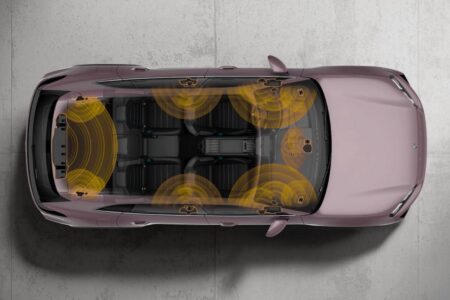
Zeekr calls it the Premium Sound System, and the key specs are a real statement: 23 speakers including a subwoofer, the center tweeter sits on the dashboard, and there are extra speakers in the driver’s headrest, which are also intended for navigation and phone calls. Added to this are high-quality metal grilles, the kind you know from European premium models.
The most exciting part, however, isn’t the material, but the openness of the operation. The user interface allows for fine-tuning that feels more like a developer menu than typical car preset clicking. You can adjust channels individually, editing factors like level, time delay, frequency response, as well as reverb and surround effects separately to save them as your own sound preset. This is a purebred professional interface, like something from a speaker manufacturer’s development department. Respect.
The downside: the corresponding areas of the sound setting menus overwhelm the average user and could keep even sound experts busy for a whole day, provided they don’t work in development and haven’t brought measuring equipment. Those who just want to start listening might briefly wonder if they are operating a car system or a studio tool. At least there are factory sound presets like “HiFi” or “Nahseld Surround,” and if you don’t want to experiment with the sound at a research level right away, you can find a standard 6-band equalizer without any detours.
Nevertheless: this openness shows a will to innovate, and it acts as a conscious statement from a brand that wants to be taken seriously in Europe. This gives Zeekr a unique position in the market for high-quality factory car audio systems.
The confident newcomer challenges established manufacturers
A comparison comes to mind because it is often seen as the benchmark in the premium segment: Bowers & Wilkins in Volvo and Polestar. After the first brief sound impressions at the premiere, the Zeekr wants to play in this league, albeit with its own priorities. The focus can be shifted more towards the driver’s seat via presets or optimized for the rear, for example. There is also an independent adjustment under the “Adaptive” preset. In terms of sound, the system feels tonally balanced, precise, and above all, not artificially exaggerated. The soundstage presentation also seems exceptionally good based on first impressions.


Stationary listening test: quick truths with familiar tracks
The audio check was a quick test, not a long-distance marathon. And as mentioned at the beginning, it took place while stationary. This limits the significance, as driving noise and the psychological effect of movement are missing. Nevertheless, vocals, bass control, soundstage, and treble quality can be quickly categorized when working with fixed references like our public listening test playlists on Qobuz.
In the quick test, while I was alone in the vehicle, I used a handful of tracks that quickly show me in such situations whether a system is trimmed for effect or for substance. With Anette Askvik’s “Liberty,” the focus was on the vocals. The Zeekr presented them with nuance, without exaggeration, but also without omitting subtle details. Foreigner’s “Urgent” (Live In Chicago) delivered a wide, deep stage with an immersive concert feeling.
The bass is fun too
Then bass and control: Depeche Mode Remixes 81>04 and Hedegaard’s “Ratchets” really put a sound system’s woofers to the test and also reveal resonances in the cockpit trim. The Zeekr delivered precise, powerful bass that doesn’t get bloated and still has punch. It was that pleasant feeling where the subwoofer doesn’t stand out as its own actor but supports the foundation.
Yamaha HiFi on board: Short drive with the Zeekr X


When it came to staging, the impression remained surprisingly mature. The stage was wide and stable. The already good focus gains even more contour by using the appropriate preset, in my case for the driver’s seat. All in all, based on first impressions, this resulted in high potential, as if Zeekr wanted to say that we will be hearing a lot more from this brand in the future—literally.
Zeekr 7GT: Conclusion and target group
The Zeekr 7GT showed one thing above all at its German premiere: this brand doesn’t just want to be “premium too,” but it wants to be so with its own signature. The sound system is tonally very balanced, with precise bass, clean vocals, and flawless treble. The operation is unusually deep and therefore not automatically for everyone, but from a HiFi perspective, it’s a rare and open offering.
If you’re looking for an EV that doesn’t look like gadget hype in the interior, and if you like having more control over audio than just presets A to D, you should put the 7GT on your list. On the other hand, if you expect immediately intuitive sound operation and have no desire for fine-tuning, you don’t need to be intimidated: even the normal settings of the Premium Zeekr Sound System are more extensive than usual, but not unnecessarily complicated. Thus, the extremely positive impression of the sound system matches the first exclamation mark that the young brand with the sporty Michelin tires made on me.
Zeekr 7GT – Prices and equipment lines
- Zeekr 7GT Core RWD from €45,990
- Zeekr 7GT Long Range RWD Launch Edition from €50,990
- Zeekr 7GT Privilege AWD Launch Edition from €57,490
More on the topic of electric cars on STEREO GUIDE
- BYD Sealion 7 review with Dynaudio Confidence Sound System
- Polestar 3 with Bowers & Wilkins 3D Surround Sound and Dolby Atmos
- Car HiFi Ranking