STEREO GUIDE verdict
Cambridge's L/R S impress as ultra-compact desktop monitors and as a small system, offering audiophile all-round qualities and decent bass, though with limited volume.
Pros
- Balanced and Natural Sound
- Quite Full-Bodied Bass for the Size
- Very Compact, Excellently Built
Cons
- Bass Level and Depth Have Limits
- Extension Cable and Angled Base Cost Extra
- No HDMI (ARC)
-
Sound: naturalness / transparency9
-
Sound: Bass / Dynamics8
-
Sound: spatial imaging8.9
-
Usability / Connectivity9
-
Price / Performance9.4
Rich bass from desk-friendly mini speakers – this promise is often made by speaker manufacturers, and often broken. Cambridge Audio, known for excellent streaming electronics, amplifiers, and headphones, aims to change that with the L/R S active stereo speaker set. The smallest in the L/R series is not only particularly easy to set up and control, but also remarkably affordable at 500 Euros for the lacquered versions.
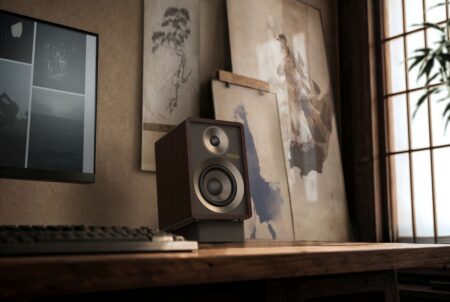
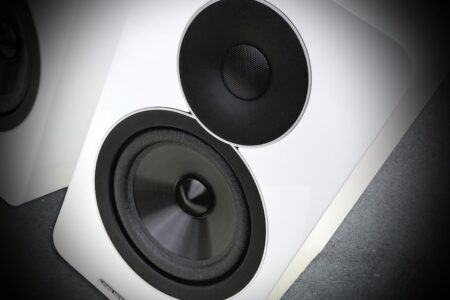
To emphasize the design aspect, the manufacturer offers five different lacquer colors, all in satin matte: black, white, racing green, midnight blue, and orange. Additionally, a real wood veneer option in walnut is available for a small surcharge.
Four Wins
Wireless music playback to the master speaker is via Bluetooth with aptX HD or AAC codec. Wired sources can connect via analog RCA input, USB-C, and optical Toslink. The latter is also the preferred choice for most TVs, as there is unfortunately no HDMI. Whether the master speaker is on the left or right can be adjusted via a switch.
A supplied wireless remote control allows for a variety of options including volume, playback control for Bluetooth, input selection, sound presets, and mute. Clever detail: the multi-colored status LED on the master speaker can be dimmed or turned off completely via the remote control.
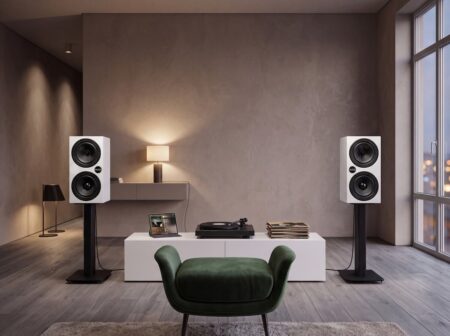
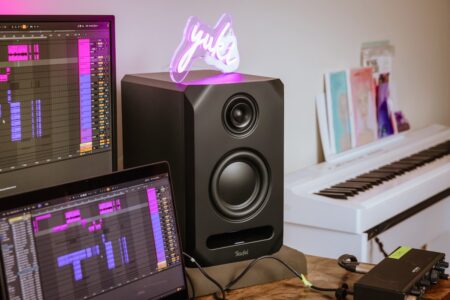
Despite their compact dimensions, the Cambridge Audio L/R S are designed to perform as computer speakers, on a lowboard, or on a shelf. With the help of two switches, they can be acoustically adapted to the respective placement. Additionally, three sound presets are available on the remote control.


Complete with Four Amplifiers
At just 22.5 cm high and 13.5 cm wide, the L/R S just about qualify as desktop monitors. The woofer, with a diameter of about 8 cm, is smaller than what we would expect from a bass-capable speaker of this type. It handles bass and mid-range, while a 21-millimeter aluminum dome handles the highs. The latter is integrated into a sound guide, a so-called waveguide, to make the dispersion wider and more even.
On the back of the speaker is a wide bass reflex port, which audibly contributes significantly to the low frequencies. With a few centimeters of wall clearance, this works quite well, but shelf placement should be avoided if the speakers are completely enclosed by books.
Technically, it is a stereo pair of 2-way speakers with woofer-midrange and tweeter. Both are driven fully actively, so each speaker chassis has its own power amplifier. Each of the four drivers in a stereo set is allocated 25 watts RMS power.
All electronics are housed in the master speaker. A switch determines whether it is on the left or right, which is very practical. The other speaker is powered by a four-core cable with a special connector and screw lock.
Cambridge L/R S in Practice
Out of the box, the small Cambridge speakers surprise with their compact dimensions. That they are primarily intended as computer and desktop monitors is evident from the supplied connection cable between the master and slave speakers. At approx. 1.8 m, it is very short. For lowboard or shelf placement, we therefore recommend ordering the longer cable variant as an accessory, which, at almost 5 m, is then quite long.
An optional angled foot is also available, which tilts the speaker vertically and blends quite harmoniously with the cabinet shape. It is highly recommended, especially if you are sitting very close to the speaker and your ears are significantly above the tweeter level.
Placement is crucial
Aside from placement issues, setting up the Cambridge L/R S was extremely stress-free. The Bluetooth connection worked immediately, provided Bluetooth was selected as the input, and the speaker also registered instantly as a sound card via USB-C.
The fact that a small colored LED at the bottom of the master speaker is the only feedback is not so impractical. You quickly get used to the color code. Only precise volume adjustment is difficult with it. This is especially true in Bluetooth mode, where the system volume of the speaker and that of the Bluetooth transmission are decoupled. So you should first turn up the volume fully on your smartphone or tablet, and then adjust it with the remote control. This, in turn, makes status tones and connection signals seem quite obtrusively loud.
This reveals a limitation in operation: the speaker has a source selection button on the back, but no volume control and no mute. If the small remote control is misplaced, you are initially lost. Apart from that, it worked excellently in the test and, thanks to wireless technology, does not require line of sight to the speaker.


How the Smallest Cambridge Audio Active Speakers Sound
We were curious whether Cambridge Audio had tuned the L/R S more for near-field operation, or if the small speakers would feel more comfortable at some distance on a lowboard. We are pleased to report from the first listening test: the British engineers found the golden mean, with a slight tendency towards larger stereo triangles. In typical computer or editing suite operation, the imaging seemed a touch too direct. This particularly appeals to fans of dynamic pop, rock, or electronic music. Here, the L/R S delivered fully, with a soundstage that was as balanced as it was lively, precisely layered in width, and provided an almost audiophile abundance of musicality and resolution.
Then the move to the lowboard: in a stereo triangle with sides of about 2.2 m, the small Cambridge speakers no longer sounded quite so stormy and massively authoritative, but the three-dimensional soundstage benefited. The sound presets on the remote control offered a somewhat more spectacular, but ultimately not balanced sound, so we stuck with the neutral setting. Especially acoustic recordings, jazz, and rock layered beautifully in depth, while still retaining their impulsive and transparent fundamental character. Aside from the slightly leaner deep bass, the L/R S filled the room quite effortlessly and still maintained a good overview of the soundstage.
Small speakers, big bass
Concerns that the tiny mid-woofers would quickly reach their limits were disproven by the small speakers right from the start with Donald Fagen’s “Morph the Cat”: the mini-monitors mobilized an astonishingly rich, contoured, and dynamic groove even at higher volumes. Certainly, kick drums didn’t have quite the rich depth as with a speaker twice or three times their size, but contour and impulsiveness were maintained, especially with electric basses and plucked double basses. Unreasonable volumes, especially with bass-heavy material like hip-hop or action sequences, were naturally not the L/R S’s forte. However, they also didn’t react too stressed to attempts to listen to Eva’s “Etincelle” louder; only a clear fading out of the bass and at most a slight loss of mid-range clarity was noted.
Just as the Cambridge L/R S proved flexible in placement, they were equally versatile in music selection: from hearty garage rock to film dialogues, to baroque classical, the tonal tuning as well as the balance between musicality and resolution always seemed just right. Aside from the physical limits in bass depth and level, Cambridge Audio has achieved a truly great success here.
Review Conclusion and Alternatives to the Cambridge L/R S
The compact Cambridge is both an ultra-compact desktop speaker and a shelf/lowboard speaker, whose connectivity and build quality also hold up in upscale living environments. The fact that it can deliver rich bass up to medium volumes despite its extremely compact dimensions sets it apart from practically all competitors in this size class. Even the KEF LSX II are no match here; at most, the larger Edifier MR5 can keep up quantitatively, but not qualitatively. The only drawback: it lacks the HDMI (ARC) input, which, for example, the less confidently performing Nubert A-125 has in this class.
You can find more alternatives in our Bluetooth speaker top list
Technical Specifications: Cambridge L/R S
- Manufacturer’s Recommended Price: 500 Euros (lacquer), 550 Euros (walnut)
- Dimensions (W x H x D): 13.5 x 22.5 x 18 cm
- Weight: 3 kg (master)
- Special Features: RCA, USB-C, optical S/PDIF input, Bluetooth, Sub Out, Placement & Sound Adjustment
- More at: www.cambridgeaudio.com