STEREO GUIDE test verdict
With the L/R X, Cambridge delivers an exceptionally well-rounded streaming active speaker: HDMI-eARC, MM phono input, a powerful app, and a mature, lively sound. Above all, its dynamic range, signal-to-noise ratio, and bass set new standards in the compact class.
Pros
- Balanced, dynamic sound
- Precise, deep bass
- Turn it up really loud
- Connectivity and the app are top-notch
Cons
- In small rooms, close to the wall, in bold
- Setup/adjustment requires a little attention
-
Tonal balance / transparency9.4
-
Bass / Dynamics9.5
-
Spatial imaging9.3
-
Usability / Connectivity9.9
-
Price/Performance9.7
Where does all the hype surrounding the Cambridge Audio L/R X come from? Why did so many reports from HIGH END 2026 claim that this was the true hi-fi revolution of our time? Active compact speakers that function as “all-in-one stereo sets” and incorporate all the features of a hi-fi system have been on the market for several years now. Think of the KEF LS50 Wireless 2 and the Technics SC-CX700. Why has the latter, with its HDMI ARC and MM phono input, remained such a niche product on the market?
Here’s the latest offering from Cambridge Audio. Even in our admittedly critical view, it could be poised to shake up the active speaker segment. After all, the British company—whose StreamMagic streaming platform has been proving its reliability in network components for 12 years now— had already demonstrated with the Evo One —which we tested —that it’s possible to integrate a high-end streamer, complete with a versatile preamp and app control, into a powered speaker.
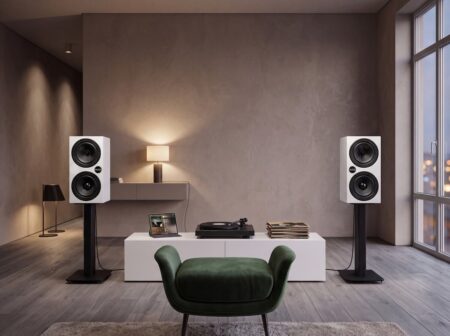
With the L/R X—the abbreviation stands for “Left-Right Extra Large”—this trend is now spreading to the segment of active stereo speakers, which audiophiles take much more seriously, and is poised to give Technics a run for its money. The set consists of two compact speakers in a classic, rectangular design, with exposed drivers. The controls and input jacks are located on only one of the speakers, the “master.” The fact that the British manufacturer is aiming for a broad customer base even outside the hi-fi scene is also evident in the available color options: There are five different matte finishes—in addition to the standard black and white, there’s a bright orange, as well as midnight blue and dark green—and a real wood option with a walnut veneer, which, however, costs an extra 100 euros and was made available to us for photo purposes.

Connectivity and Compatibility
In terms of playback options, the L/R X models are on par with the best streaming speakers currently available on the market: The proprietary network platform ensures seamless integration with services such as Spotify Lossless Connect, TIDAL Connect, Deezer, and Qobuz Connect, and also supports the popular protocols Roon Ready, AirPlay 2, Google Cast, and UPnP. All of this works at Hi-Res resolution of up to 96 kHz via Wi-Fi or Ethernet. A Bluetooth receiver is also built in.
The Masterbox (you can specify whether it’s on the left or right) also features a full-featured preamp with various digital and analog inputs. In addition to standard connections like RCA (line) and optical Toslink, it features a built-in phono preampfor MM systems, as well as an HDMI (eARC) port. Simply connect the TV to the HDMI (eARC) port, and you can then control the volume of the Cambridge Duo using the TV’s own remote control. This is ideal for when family members without smartphones want to listen to the system.
The two speakers can be connected either wirelessly or via a USB-C cable. Technically, there isn’t much difference; the PCM resolution is 96 kHz in both cases. The wireless connection is also said to be on par in terms of sound quality; the cable simply ensures that the slave speaker wakes up faster and provides a more stable connection, for example, in the event of radio interference in the room.
Here’s what’s included in terms of speakers and amplifiers
From a distance, the L/R X looks like almost any other compact 2-way monitor: a low-midrange driver and a tweeter in a waveguide on the front. But in reality, the Cambridge engineers managed to fit no fewer than five drivers into each speaker. In addition to the 5-inch driver on the front, the L/R X features a second bass driver hidden at the bottom of the enclosure, which operates through narrow slots between the enclosure and the base plate. With this 2.5-way design, not only is there double the cone area available for the bass, but the two cone drivers can also be powered by their own dedicated amplifiers. Each driver is allocated 135 watts RMS; that alone adds up to 540 watts for a stereo pair, plus the tweeter amplifiers.
The L/R X also breaks with convention when it comes to bass: Instead of a bass reflex port—which would take up additional space in such compact speakers—each speaker features two passive radiators. At six inches, these are not only larger than the active woofers, but they’re also mounted in the side panels of the speaker. This provides impulse compensation, because the rather heavy panels—painted or veneered to match the speaker’s color—would otherwise cause the cabinet to vibrate significantly if their movement impulses did not cancel each other out, as they do here.
The manufacturer claims that this will produce exceptionally clean and powerful deep bass while eliminating the unwanted noise that a significantly cheaper reflex tube can generate at extremely high air velocities.


Traditional String Section
For the high frequencies, Cambridge uses a 28-mm aluminum dome tweeter that kicks in at an unusually low 1.7 kHz. The driver and waveguide were developed specifically for the L/R Series active speakers. The waveguide is designed to give the tweeter more headroom in its lower operating range while also controlling the sound dispersion—an advantage especially in larger rooms, where too much high-frequency energy can quickly result in a hissy sound due to reflections.
The dome is designed to radiate sound toward the rear into a special chamber that contains only a small amount of damping material but, thanks to its ring-shaped design, is intended to operate without resonance. In cross-section, the shape of this chamber resembles a donut, and Cambridge has named it the “Torus.”
An app for every occasion
When it comes to connectivity, the L/R X leaves nothing to be desired. For some, the menu that displays the available inputs may seem overwhelmingly complex. But in practice, it’s easier than you might think, since the Cambridge-developed StreamMagic app typically controls the stereo pair. Here, you can enable and disable input options so that when switching between sources, you only see the ones you actually use.
Basic control options such as play, pause, volume, and source selection can also be accessed on the master box. The options are limited, but if you’ve misplaced the remote control and your smartphone isn’t connected, you can still reliably switch sources and activate Bluetooth pairing mode by pressing and holding a button. The only real drawback compared to the Onebox Evo One system—aside from the lack of a display—is that you can’t skip tracks or switch between Internet radio stations directly on the device.
That’s why the app—available for iOS or Android—is all the more important: it can not only replace the included remote control but also configure the device. In addition, it serves as a music browser for UPnP and music stored on a local USB drive, and maintains a connection to your own streaming services and a wide variety of Internet radio stations. When you stream music via AirPlay, Roon, Google Cast, or one of the Connect services, the app automatically takes over the stream and displays album art, track information, and resolution.
Full of possibilities
It takes a little while to really work your way through all the features of this superbly designed app. It includes position and room correction, which—once you enter the room length and distance from the wall—even applies a correction for the lowest rumble frequency. In addition, there’s a 7-band equalizer that, once you get used to it, lets you fine-tune the sound to suit your room and personal taste.
We didn’t really find anything missing. Except, perhaps, a true multi-room setup, since the StreamMagic app can only control one selected Cambridge system on the network at a time. If you have multiple systems and want to play the same music in several rooms at the same time, you’ll have to rely on setting it up in Google Home, via AirPlay, or in Roon.

Setting Up the L/R X in Practice
Unpacking and setting up the two fairly heavy bookshelf speakers heightened our anticipation for the listening test, thanks to the high-quality packaging, which included dedicated lifting straps for each speaker. The build quality also proved to be at a level one would normally expect only from speakers costing several times the pair price of 2,100 euros for the real wood version. Flawless edges, uniform surfaces, and a beautiful, continuous veneer pattern that flows harmoniously even over the passive radiator covers. This finish certainly deserves praise in this price range. Unless you look at the back of the speakers or have activated the wide LED backlighting, you wouldn’t even notice that this is a pair of active stereo speakers.
You can turn off the lights or adjust their color temperature using the app. In general, we strongly recommend setting them up via the app, even though you could theoretically use Bluetooth and the wired inputs without a smartphone.
For the network connection, you can choose between an Ethernet cable or Wi-Fi. We recommend using the Ethernet cable for setup, as the Cambridge app will then detect the newly connected speakers immediately and allow you to select your Wi-Fi network and enter the password using your smartphone. Afterward, you can remove the Ethernet cable. A completely wireless setup is also possible, but it takes a little longer, since the speaker must first establish a temporary Wi-Fi network without an internet connection to the app.


This is what Cambridge Audio’s largest powered speakers sound like
In its press release, Cambridge Audio made what Americans call a “bold claim” about the L/R X: these compact speakers were said to match the dynamics of full-sized floorstanding speakers. What can we say? Rarely in hi-fi has such a bold advertising claim been so true. Right from the first bars of Marcus Miller’s “People Make the World Go Round,” the L/R X kicked off with a force that we rarely experience even from high-end speakers several times its size.
Added to this was a sense of joy and dynamism that is unmatched by any other compact speaker. Time and again, new tracks heavy on drums or drum machines found their way into the playlist, because the Cambridge L/R X lets you experience beats in a whole new way. It delivers a rich and assertive sound in rooms, yet remains controlled in its transients.
We chose Azaleh’s “Mycelia,” with its calm opening and deep bass that’s almost earthquake-like yet very precisely controlled in terms of timing. Unlike other compact active speakers, which quickly cut off the low bass at higher volumes or audibly engage a limiter, the L/R X just kept getting louder and louder, as if it knew no reasonable volume limits at all.Compared to larger floor-standing speakers, or what we consider to be the world’s best compact active speakers like the Backes&Müller Io, you have to compromise a bit on authority in the lowest regions of synthetic low bass.
Would you like a little more?
The only minor criticism for fans of rhythm-heavy sounds—especially acoustic rock and jazz drums—is that when placed too close to the wall, the bass drums tended to sound a bit too boomy. Using the app’s superbly designed room acoustic correction—with a little help from the equalizer—did provide some relief, but ultimately we had to move the Cambridge speakers slightly away from the wall to get the low bass to sound absolutely clean.If, on the other hand, you place the speaker completely free-standing on stands, the deepest bass frequencies tend to stay on the neutral side. If you want richer beats here, you’ll need to use the equalizer.
However, the focus on fun, rhythm-driven tracks shouldn’t lead you to assume that the Cambridge L/R X can’t handle quiet sounds or audiophile-grade music. In fact, it does an absolutely outstanding job of it! The STEREO GUIDE playlist “Voices à Capella” is usually a litmus test for vocal reproduction and often reveals weaknesses. There’s no sign of that with the Cambridge. The vocals on Peter Gabriel’s new single “What Lies Ahead” were indeed more full-bodied in their fundamental tone and slightly softer in their brilliant timbre, but they were clearly defined and delivered with the exceptional clarity we expect from true high-end speakers.
Consonants came across as a bit pronounced and overly clear; despite its slightly warmer tonal character in the default setting, the L/R X is a speaker that tends to be on the more dynamic and forward-sounding side. We’re deliberately not calling them “fun speakers,” even though they excel at that as well. Surprisingly, however, this did NOT come with the particular ruthlessness that is often characteristic of detail-oriented and more impulsive speakers. It reproduced even older (Beatles) and generally noisier recordings (U2’s new EP “Days of Ash”) with a distinct gentleness, without lacking any sense of joy in the performance.
A Passionate Rocker and Roller
The only genres where we weren’t entirely satisfied were jazz and classical music with a lot of spatial depth in the recording: While the Cambridge excelled in detail resolution and clean timbres, voices in the midrange sounded a bit muffled, and the choirs lacked that final touch of clarity and airiness. But these are complaints at a very high level of sound quality; with precise angling—ideally about 10 degrees past the listener’s ears—the vocals can be improved further, though the impression of a midrange that was too full-bodied persisted even after adjusting the equalizer.
Because, aside from these drawbacks with acoustic recordings, the Cambridge showed absolutely no preference for any particular genre of music. On the contrary, from breathy jazz vocals to older rock albums recorded in a non-audiophile manner, all the way to heavy techno and hip-hop mixes that would have driven any other subwoofer to despair, the L/R X always performed at its best. What we particularly liked: a lively, energetic sound, powerful beats, and sheer fun never got in the way of audiophile listening pleasure with beautiful voices and gentle tones.
Test Conclusion and Alternatives to the Cambridge L/R X
In terms of its design concept and connectivity options, the Cambridge—as an all-in-one stereo system—has only one real competitor: the Technics SC-CX700, which we haven’t tested yet, however. The KEF LS50 Wireless II is likely the most widely used model in this segment; the only thing it lacks is a phono input. In terms of sound quality, the L/R X only marginally outperforms these two models.
When it comes to sound quality, however, the verdict is clear: Aside from the deeper, more stable soundstage—which classical and jazz fans in particular are likely to appreciate—and its better suitability for very small rooms, the KEF doesn’t stand a chance against the Cambridge. Its liveliness, dynamics, maximum volume, and—above all—the crisp, rich bass simply put the L/R X in a league of its own. For us, it’s the best compact active speaker with streaming, no ifs, ands, or buts.
Technical Specifications: Cambridge L/R X
- Manufacturer’s suggested retail price: 2,000 euros (all finishes), 2,100 euros (real walnut wood)
- Dimensions (W x H x D): 20 x 33 x 26 cm
- Weight: 10.5 kg (master/slave)
- Features: RCA, MM phono, USB-C, HDMI-eARC, optical S/PDIF input, Bluetooth, network, room and sound calibration via app
- More at: www.cambridgeaudio.com