STEREO GUIDE test verdict
Creative XF1 Review: For 159.99 euros, these desktop speakers impress with their neutral sound, USB-C, Bluetooth 6.0, LDAC, and versatile Nexus app. Only the subdued bass makes you wish for a subwoofer when using them in spaces larger than small rooms.
Pros
- Balanced tuning
- Coasters for desktop use
- Parametric 10-band equalizer
- Apps for iOS, Android, and Windows
- Subwoofer Output
Cons
- A somewhat thin bass foundation
- No variable channel assignment for primary and secondary speakers
-
Tonal balance / transparency8
-
Bass / Dynamics6.3
-
Room mapping7.9
-
Usability / Connectivity9
-
Price/Performance9.7
Creative isn’t traditionally associated with the hi-fi world. However, with Sound Blaster sound cards, PC accessories, gaming headsets, and compact multimedia solutions, the company has long made a name for itself in the audio industry. With the Creative XF1, the manufacturer now aims to bring full-fledged hi-fi sound to the desktop. The active two-way system offers 72 watts RMS, Bluetooth 6.0 with LDAC, USB audio, and an unusually wide range of sound customization options.
A few months ago, I reviewed the Creative Stage Pro soundbar for AUDIO/stereoplay. Given its suggested retail price of just 150 euros, I was completely surprised by its performance. So I took particular notice when the press release for the new Creative XF1 arrived. The compact pair of active speakers promised a fully active two-way design, Hi-Res Audio, and bi-amping—all for 160 euros. That was reason enough to order a review unit right away for STEREO GUIDE.


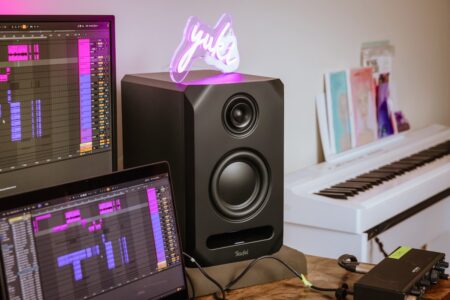
Visually, the Creative XF1 has a pleasantly understated look. No RGB lighting or flashy gaming design distracts from its actual purpose. The enclosures, available in either black or white, each measure just under 10 centimeters wide, 19.1 centimeters tall, and 15.5 centimeters deep. This means they fit easily next to a monitor or laptop. The left speaker weighs 1.29 kilograms, while the right speaker—which houses all the electronics—weighs 1.36 kilograms.
Creative XF1 with four power amplifiers
Each of the two 2-way bass-reflex speakers features a 3-inch (7.6 cm) low-midrange driver with a 1.9-xm tweeter positioned above it. Creative developed the woofer using finite element analysis (FEA) to extract as much sound output as possible from the small diaphragm while minimizing distortion. The fully active two-way design is controlled by a digital signal processor (DSP). Each driver has its own amplifier channel.

Each of the two low-midrange drivers has 26 watts RMS available, and each tweeter has 10 watts. This results in the total power output of 72 watts RMS specified by Creative. According to the datasheet, the frequency response ranges from 55 hertz to 40 kilohertz. As a result, the XF1 features both Hi-Res Audio certification for its wired inputs and the corresponding Hi-Res Audio Wireless certification for Bluetooth playback via LDAC.
All amplifiers and connections are located in the right primary speaker. The left speaker receives the separately amplified signals via a four-pin connection cable included in the package. At two meters long, it’s easily long enough for most desks. However, if the speakers are placed farther apart on a sideboard or shelf, the cable might be a bit short.
Cork coasters for the desk
In addition to the external power supply and the speaker connection cable, the package includes a 1.5-meter USB-A-to-USB-C cable and two wedge-shaped cork coasters. The coasters are much more than just a visual gimmick. They can be securely attached to the speakers using the included screws, ensuring a stable base and tilting the drivers slightly backward.
This ensures that the tweeters and midrange drivers are better aimed at your ears when the speakers are placed on a desk. At the same time, the cork slightly decouples the speakers from the desk surface. If you’re using the XF1 freestanding in a room, on a sideboard, or on a shelf, you should omit the coasters.

USB-C, Bluetooth, and subwoofer output
The Creative XF1 accepts digital audio signals via its USB-C input at a maximum of 24 bits and 96 kilohertz. This works not only with a Windows PC or Mac, but also with compatible mobile devices. A 3.5-millimeter jack input is available for analog sources.
In addition to the standard SBC codec, Bluetooth 6.0 also supports AAC and Sony’s LDAC. While Apple devices use AAC, compatible Android smartphones can stream at a higher data rate using LDAC. Creative specifies a range of up to ten meters in line-of-sight conditions.


If you want deeper bass when watching movies, gaming, or listening to music, you can connect an active subwoofer to the 3.5-millimeter output on the main speaker. This expansion option makes a lot of sense, especially when using the system with a TV or as a small desktop home theater.
However, Creative specifies the channel assignment: The primary speaker—which houses the electronics, connections, and volume control—always plays the right channel. I searched the app in vain for a way to swap the assignment. Depending on the setup, this fixed position can still be an advantage if it makes it easier to access the USB-C, AUX, and subwoofer ports on the right side.
The volume control on the front also serves as a multifunction button. Pressing and holding it turns the system on or off; a quick press switches between Bluetooth, USB, and AUX. The back also features the Bluetooth pairing button and a switch for power-saving mode.
Creative Nexus App: Endless Presets
For the Creative Nexus app, the manufacturer specifies Windows 10 or later (64-bit version), iOS version 17 or later, and Android version 10 or later. However, during the initial setup, you should follow the correct sequence. Since I don’t like reading user manuals, I first paired the iPhone with the XF1 the old-fashioned way via the Bluetooth settings. After that, the Nexus app couldn’t find the speaker system, even after several attempts.
However, after I disconnected the Bluetooth connection and started the search directly from the app, the speakers and smartphone were found quickly. I was then able to install a firmware update.
And “extensive” is almost an understatement. Creative offers more than 120 sound presets covering over 20 music genres and nearly 100 games. The list is so long that even users who love to experiment will eventually lose track of it all. If you want to do more than just listen to music on a rainy afternoon—if you want to play around with your speakers—you can spend hours here comparing sound profiles.
In addition, the app offers a parametric 10-band equalizer that allows you to fine-tune the sound exactly to your liking. For near-field use, there’s a mode aptly named “Desktop.” If you’re using the speakers at a greater listening distance—such as on a shelf or sideboard—simply disable this setting.
However, the Nexus does not function as a full-featured music remote control. To control playback on a smartphone connected via Bluetooth, you have to switch to the respective streaming app. There, you can start or pause the music, while the volume is adjusted using the buttons on the smartphone or directly on the right speaker.


Sound Test: Creative XF1
The Creative XF1s offer good focus and remarkably neutral vocal reproduction. On the live version of R.E.M.’s “Country Feedback,” Michael Stipe’s voice was clearly defined and positioned authentically between the speakers. The resolution and balance were also impressive for this price range. The sound signature is therefore generally well-suited for all genres of music, not just games, movies, or electronic beats.
As expected, the XF1s sound best at close range on a desk. Here, they produce a clean stereo image with a precise center. Small details stand out clearly without the sound becoming analytical or uncomfortably sharp. The switch for desktop use effectively adjusts the sound to accommodate the short listening distance.
When set up freely in the living room, however, the downside of the small enclosures and 3-inch drivers became apparent. The bass sounded noticeably thinner than one would expect—not only with hip-hop or electronic music, but also with rock. Daft Punk’s “Get Lucky” had rhythm and definition, but the physical impact in the low frequencies was missing. For use as a minimalist stereo system on a sideboard or shelf, one would simply wish for more substance.

Naturalness Takes Precedence Over Volume
Physics also sets clear limits on the maximum usable volume. This is hardly noticeable at close range. However, at a greater listening distance, you can already hear the bass starting to struggle once you’ve reached a little over two-thirds of the volume range. The DSP then steps in to protect the system, compressing powerful pulses and gradually reducing the richness of the sound. This prevents severe distortion and protects the small drivers, but it is no substitute for larger diaphragm areas.
The parametric equalizer allows you to fine-tune the tonal balance very precisely to your personal preferences and the specific setup. However, you shouldn’t force the small drivers to produce deep bass by applying a massive boost. At low and medium volume levels, the “Music” sound preset provides more substance in the bass. However, it also sets even tighter limits on the maximum volume level that can be achieved without distortion. If you want to enjoy high volume levels with rich bass—especially when using the speakers in the living room—you should connect an active subwoofer, which isn’t even possible with many competing products. However, you’d have to turn to another manufacturer for the bass module, since Creative doesn’t offer one.
Conclusion and Alternatives: Creative XF1
With the XF1, Creative delivers a versatile desktop audio system that—for 160 euros—is surprisingly well-balanced. In this regard, it even outperforms the Edifier M60, which has a slightly higher list price but, at a comparable size, offered a bit more punch and volume stability. However, anyone who values natural vocal reproduction above all else—or who plans to expand the system with a subwoofer anyway—will be well-served by the XF1 at an affordable price. The competitor also falls short on this last point: the M60s don’t have a subwoofer connection. Thus, Creative has put together a package with great potential at an affordable price.
Further alternatives can be found in our Bluetooth speaker best list.
Creative XF1: Technical Specifications
- Manufacturer’s suggested retail price: approx. 160 euros
- Dimensions (W x H x D): 10 x 19.1 x 15.5 cm
- Weight: Left speaker: 1.29 kg, right speaker: 1.36 kg
- Special Features: AUX input, USB-C port, subwoofer output, Bluetooth 6.0, app with 10-band parametric equalizer, AC adapter, cork coasters, connection cable set
- For more information, visit: www.creative.com