STEREO GUIDE verdict
The JBL Xtreme 4 delivers more power, especially in the bass, a more natural sound, and supports Auracast for playback chains consisting of multiple speakers. It can last significantly longer on a single battery charge—up to 24 hours—and with Eco Mode, even up to 30 hours is possible. However, this comes at the cost of bass. And some might miss an analog input like the one found on its predecessor.
Pros
- Enormously powerful and precise bass from a relatively compact box
- Stereo pairing and Auracast for party mode
- 24-hour runtime, up to 30 hours in Eco Mode
- Shoulder strap, power bank function, power adapter included
Cons
- No more analog input
- Power-saving mode makes the speaker sound harsh
-
Tonal balance / transparency7.9
-
Bass / Dynamics8.9
-
Usability / Connectivity8.4
-
Price/Performance9.2
With the Xtreme 4, JBL launched the fourth generation of its powerful outdoor Bluetooth speaker just over a year ago. Its predecessor, the Xtreme 3, had established itself in our review (you can find it here) as a high-volume all-rounder with a mature sound character and robust construction. The successor, offered in blue, black, and camouflage, is intended to step things up in several disciplines: with AI-supported signal processing, a replaceable battery, Bluetooth 5.3 including LE Audio preparation, and an even more consistent focus on sustainability.
Visually, JBL stays true to itself: the cylindrical housing with side passive radiators, robust rubber armor, and textile covering continues to signal outdoor suitability. However, I was surprised when I photographed the brand-new wireless speaker in the garden right after unpacking it. “Damn, it’s already totally covered in mud on the rubber bumpers the very first time I placed it on sand and stone,” I thought to myself.

It took a moment before I realized that the beige speckles embedded in the black rubber on the bottom were a design detail. Who on earth comes up with something like that? And for what? Is it supposed to represent a macho outdoor look, like someone who doesn’t wash their SUV after driving through a puddle in a sandy parking lot to radiate a hint of adventure?
With IP67 certification, the speaker, weighing around 2.1 kg, is protected against water and dust, making it ready not just for the next pool party, but also for the beach or a festival. The detachable shoulder strap remains part of the concept. Mobility isn’t just a marketing promise for the Xtreme 4; it’s an integral part of it.
More sustainability
What is new, however, is the more heavily communicated claim to sustainability: 70% of the plastic used and the entire fabric of the speaker cover are made from recycled materials. The system is packaged in paper certified according to the FSC standard for sustainable forestry and printed with soy inks. So, JBL is combining performance with a more ecological production approach here.

Technology: AI Sound Boost, more power reserves, and replaceable battery
Inside, a true 2-way setup with four active drivers and two side passive radiators continues to work. Specifically, two 7 cm woofers and two 2 cm tweeters are used. The output power is 2 × 30 watts RMS for the woofers plus 2 × 20 watts RMS for the tweeters when plugged in, reduced to 2 x 20 and 2 x 15 watts respectively in battery mode. The frequency range is specified as 44 Hz to 20 kHz. That is a remarkable range for a mobile system of this size.
The central innovation compared to the Xtreme 3 is the so-called AI Sound Boost. According to the manufacturer, an algorithm analyzes the input signal in real time and predicts how far the drivers can move without generating distortion. The goal is to better utilize dynamic reserves, reduce distortion at high levels, and maximize bass output at the same time. Technically speaking, it is an adaptive, signal-dependent limitation and optimization—a kind of intelligent DSP that doesn’t just limit, but actively pushes the available performance to its limits.
Extending runtime through battery replacement
Also new: the replaceable battery. It is hidden under a cover between the elongated rubber feet on the bottom of the mesh-wrapped housing. However, you need an Allen key to loosen the two screws to open the battery compartment. JBL solved this more elegantly without any tools on the PartyBox Club 120, Stage 320, or 520 models we reviewed. The battery is available separately and can at least be changed by the user. This is a plus for longevity and repairability.

The 68 Wh lithium-ion polymer pack (7.2 V / 9444 mAh) is said to provide up to 24 hours of playback. According to JBL, up to six additional hours can be gained via “Playtime Boost” by adjusting the power output. Charging is done via USB-C with up to 20 volts/3 amps; ten minutes of fast charging is said to provide around two hours of playtime.
On the wireless side, JBL now relies on Bluetooth 5.3 with A2DP 1.3 and AVRCP 1.6. In addition, the Xtreme 4 supports Auracast for multi-speaker pairing: two devices can be operated as a true stereo pair, and several compatible JBL speakers can be linked together to form larger sound groups.
No turning back from the future
But beware: the JBL Xtreme 4 cannot be paired with its direct predecessor, the Xtreme 3. The reason is the platform change: while the Xtreme 3 still relied on JBL PartyBoost, the Xtreme 4 exclusively supports Auracast. The two systems are technically incompatible. So, if you have an existing PartyBoost setup, you cannot seamlessly integrate the Xtreme 4. Pairing only works with other current JBL models like the Charge 6 or the Flip 7, which also support Auracast.


Something else that is no longer possible with the Xtreme 4: the mobile Bluetooth speaker no longer has an analog AUX input. This might not matter to most users by now. But for specific applications, the fourth generation is no longer an option.
The integrated power bank function allows mobile devices to be charged directly at the speaker via USB-C. On the predecessor, a USB-A port was responsible for this, but now charging and power output both run through the same USB-C socket. Fortunately, the necessary USB power adapter is included.
With dimensions of 29.7 × 14.9 × 14.1 cm, the Xtreme 4 remains portable but clearly sits in the segment of more powerful party and outdoor speakers.

App and Operation
The JBL speaker is controlled either via large buttons on the top of the housing, though only some are color-contrasted. The top row of buttons is for functions like powering on, establishing a Bluetooth connection (multipoint connections to several devices at once are also possible), and pairing with other Auracast speakers. These buttons are clearly highlighted by high-contrast printing and are even illuminated. The three buttons for volume control and playback control (via multi-press functions that some might only discover in the manual) are large but kept in the housing color. Overall, though, there’s nothing to complain about regarding operation. And the included carrying strap is easy to attach and remove with its carabiner hooks on the solid-looking eyelets in the housing.
However, if you want to install software updates or influence the sound via a seven-band equalizer, you can’t avoid the JBL Portable app available in the Apple App Store and on Google Play. There you will also find four sound presets (“JBL Signature”, “Chill”, “Energetic”, and “Voice”) as well as the energy-saving function called PlayTime Boost. As the subsequent sound test shows, this does not come without quite drastic consequences for the sound. More on that in the next section. The following sound test clarifies how the combination of AI optimization, powerful power amp, and revised energy management performs in practice.


Sound Test: Can the Xtreme 4 improve further with AI Boost?
Even though it’s been a while since I reviewed the JBL Xtreme 3, the explosive and precise power play makes it unmistakably clear from the first few bars that JBL has stepped up the sound quite a bit here. The fact that AI Sound Boost is not just a marketing promise was already made unmistakably clear to us in recent tests of the smaller JBL Charge 6 and, a while before that, the compact JBL Flip 7. The Xtreme 4 is among the smallest Bluetooth speakers in the mid-sized range. Yet it played with a force and precision that, with eyes closed, you would have attributed to a much larger wireless speaker.
When you’ve reviewed a triple-digit number of Bluetooth speakers for the F.A.Z. Kaufkompass alone, not to mention magazines like LowBeats or AUDIO, you’re really not easy to impress. But the Xtreme 4 actually succeeded right away. I started the sound test with “Enjoy the Silence” by Depeche Mode because I had recently heard the song in the car. The deep and powerful electronic basses of the album “Remixes 81>04” came through really punchy and crisp. The precision left nothing to be desired, even beyond its size class. Instead of the upper bass emphasis previously preferred by JBL, there is now even more depth and differentiation. The remarkable low-end foundation was maintained even up to surprisingly high volume levels.
Fresh hights
What shone in this recording, but also in audiophile tracks like “I’ll Be Your Baby Tonight” by Norah Jones, were the clear and fresh highs. The JBL Xtreme 4 was also able to reproduce voices very cleanly and with nuance. The transparency of the playback revealed a high level of detail; the lively performance was the opposite of the washed-out sound mush you sometimes get from compact speakers tuned for volume.

Not entirely free of showmanship
Even though the almost party-ready Bluetooth speaker tried to impress listeners with a pinch of showmanship through slightly exaggerated brilliance, you can really enjoy quieter singer/songwriter sounds with it despite all the bass power. Personally, I liked the “JBL Signature Sound” preset best as a successful compromise between punchy beats and clearly articulated voices. But the “Energetic” preset is also fine if you want to tune the sound a bit more for a party.
What I didn’t like at all was the effect of the PlayTime Boost function. It neutered the bass range so much that the clear, fresh voices and impulses in the midrange became too prominent, while drums or electronic beats clearly lacked substance. So, personally, I would only use the energy-saving function when the Xtreme 4 is close to shutting down in battery mode or if I want to listen to an audiobook. But the latter only happens every few years as a little ego trip with my own works—so it wouldn’t be a use case for me, as they say nowadays.
Conclusion and Alternatives: JBL Xtreme 4
What JBL really succeeded at with the Xtreme 4 is the perfectly balanced combination of wideband sound reproduction with lively, finely resolved highs and a differentiated, comparatively deep-reaching bass foundation, plus very decent volume stability for its size. Once you’ve experienced this very portable outdoor Bluetooth speaker in battery mode, you’ll hardly believe that it can even step it up a notch when connected to the included USB power adapter. However, the effect was very subtle in the test. This is especially true compared to the energy-saving mode, which robs the sound of its rich bass foundation.
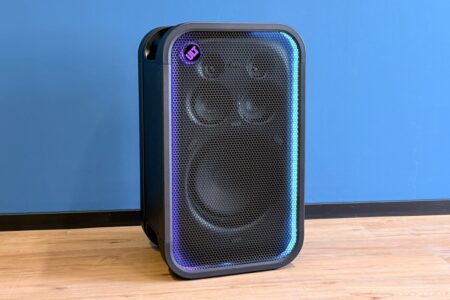
To my ears, the Xtreme 4 and the more compact Charge 6 are two distinct highlights in the American manufacturer’s Bluetooth speaker lineup. However, even if you ignore the list price of the Xtreme 4 and base it on the street price, you can sometimes get larger calibers for the same money, such as the Panasonic SC-BMAX5, whose MSRP is significantly lower at 280 euros. That can make sense if bass and volume carry more weight for you than mobility.
Find more alternatives in our Bluetooth speaker best list.
Technical Specifications: JBL Xtreme 4
- Manufacturer’s suggested retail price: 350 Euro
- Dimensions (W x H x D): 29.7 × 14.9 × 14.1 cm
- Weight: 2.1 kg
- Battery life up to 24 hours, up to 30 hours with PlayTime Boost
- Special features: Bluetooth 5.3 incl. LE Audio, water/dustproof according to protection class IP67, JBL Auracast Multi Speaker Connection, power bank function, equalizer
- More at: www..jbl.com