STEREO GUIDE verdict
JBL Xtreme 5 Review: Deep bass, natural vocals, and superb sound even at high volumes. It also features USB audio playback, Auracast Party Mode, stereo pairing, and up to 28 hours of battery life with Playtime Boost. However, this power-saving feature is only recommended for podcasts. Still, 24 hours in normal mode is nothing to sneeze at.
Pros
- Very deep, powerful, and—given its size—surprisingly nuanced bass
- Natural, clear, and balanced voice reproduction
- Sounds balanced, confident, and relaxed even at high volumes
- IP68 protection and rugged construction
Cons
- No analog input
- USB power adapter not included
-
Tonal balance / transparency8.1
-
Bass / Dynamics9
-
Usability / Connectivity8.5
-
Price/Performance9.2
When it comes to a portable Bluetooth speaker, larger dimensions and greater weight aren’t necessarily seen as an improvement at first glance. With the new JBL Xtreme 5, however, the growth spurt is impossible to overlook—and certainly impossible to ignore. Compared to its already very powerful predecessor, JBL has not only fundamentally redesigned the acoustic construction but has also stepped up its game in terms of power, bass response, and features.
At 34.6 centimeters wide, the fifth generation is nearly five centimeters wider than the Xtreme 4. At the same time, its weight increased from 2.1 to 2.9 kilograms. That represents an increase of about 800 grams, or just under 40 percent. While the Xtreme 5 still ranks among the mid-sized Bluetooth speakers, its weight and sound volume already place it well on the path toward the larger models.
Fortunately, a length-adjustable shoulder strap is included. Its sturdy carabiners can be easily clipped into the two eyelets on the case. This means that even transporting this substantial wireless speaker isn’t a serious problem. The Xtreme 5 isn’t really meant for a small bag anyway. It’s designed to be worn visibly over the shoulder.


Sturdy construction with a new light show
In terms of design, JBL stays true to its signature style. The enclosure is covered with a durable fabric, while rubber pads on the sides and bottom provide protection and ensure stability. JBL’s signature passive radiators are located on both ends, and their movement visually emphasizes the powerful bass.
Compared to the Xtreme 4, which is IP67-rated, its successor takes it a step further with an IP68 rating. This means it is dustproof and protected against temporary submersion. JBL also describes the design as shock-resistant. As a result, the Xtreme 5 is not only suitable for the living room and patio, but also for the garden, beach, pool, or festival.
When it comes to sustainability, JBL continues along the path it set with its predecessor. The speaker uses recycled plastic and fabric, as well as a recycled driver magnet. The PVC-free packaging is made of FSC-certified paper and is printed with soy-based ink.
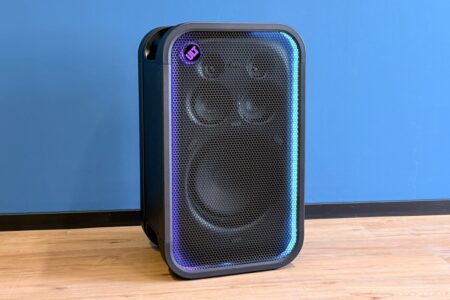
The most striking design difference, however, becomes apparent as soon as you turn it on. Two LED strips run along the top and bottom edges of the front panel. The ambient lighting not only indicates operating status, Bluetooth pairing, battery level, and Auracast connection; it also pulses in time with the music and can be customized to your personal taste within certain limits.
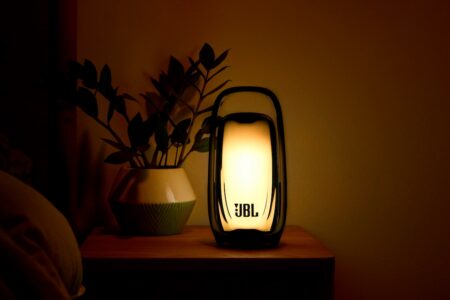
I especially liked the neon effect with its rich bluish lighting, which ranges from medium blue to turquoise. With this, JBL adds a distinct visual touch without going all out with the full light show of a party speaker. Of course, if you prefer to listen to music in the dark, you can always turn the lighting off.

New technology with 130 watts of power
Inside, almost nothing remained the same. While the Xtreme 4 used two 70-millimeter woofers and two 20-millimeter tweeters, JBL’s Xtreme 5 features a single oval woofer measuring 98 × 145 millimeters and two 20-millimeter tweeters.
When plugged in, the rated power increases from a total of 100 to 130 watts RMS. Of this, 90 watts are allocated to the woofer and 20 watts each to the two tweeters. In battery mode, 60 watts are available for the bass and 15 watts each for the tweeters. This results in a total power output of 90 watts, compared to 70 watts in the previous model.
To match this, the specified frequency response at the lower end has been extended from 44 to 40 hertz. Four hertz may not sound like a quantum leap on paper. In the deep bass range, however, they can already make a significant difference in a compact speaker, as the listening test would go on to demonstrate.
JBL has adopted the AI Sound Boost—already familiar from the Xtreme 4—in an enhanced form. The algorithm analyzes the music signal in real time and is designed to make the most of the drivers’ excursion and the available amplifier power without producing any distracting distortion. Simply put, it is an adaptive DSP control system that keeps the speaker operating within its optimal range for as long as possible.
Bluetooth 6.0, Auracast, and USB Audio
The JBL Xtreme 5 uses the latest Bluetooth 6.0 for wireless transmission. The manufacturer lists SBC, AAC, and LC3 as the supported audio codecs. Using Auracast, two Xtreme 5 speakers can be connected to form a stereo pair. Alternatively, multiple compatible JBL speakers can play together in Party Mode.
However, older PartyBoost models are still not supported. JBL had already switched to Auracast when it transitioned from the Xtreme 3 to the Xtreme 4. Therefore, anyone who still owns an existing PartyBoost system will not be able to integrate the new generation into it.
The analog AUX input is also not returning. However, in addition to charging and the power bank function, the USB-C port now supports lossless digital audio playback from compatible devices. However, neither a compatible USB cable nor a power adapter is included in the package.
This is a slight step backward compared to the Xtreme 4. If you want to get the maximum power when plugged in and charge the battery quickly, you’ll need a USB-PD adapter with sufficient power. Conversely, you can use the USB-C port to charge smartphones or other mobile devices from the speaker’s battery.

Replaceable battery, but less playtime boost
The capacity of the removable lithium-ion battery remains unchanged at 68 watt-hours or 9,444 milliampere-hours. JBL promises up to 24 hours of music playback. With Playtime Boost enabled, an additional four hours should be possible. Based on my testing experience, this is a fairly realistic figure at moderate listening volumes. During the hours-long listening test, the battery level didn’t even drop by 10 percent, even though I kept the lighting on the entire time and, for good reason, didn’t use Playtime Boost (more on this in the sound description).
This means the Xtreme 5 lasts nominally just as long as its predecessor during normal use. In power-saving mode, however, the difference drops from six to four hours. Given the significantly higher output power and the additional lighting, this still seems respectable. As always, the actual runtime depends heavily on volume, the type of music, and the selected lighting mode.
A full charge should take about three and a half hours using a compatible 20-volt power adapter. According to JBL, ten minutes on the appropriate fast charger provides up to two additional hours of playback.

Operation: Large buttons, short travel
The controls follow JBL’s tried-and-true design. The top panel features a spacious control panel for power on/off, Bluetooth, Auracast, volume, and playback controls. The buttons are backlit and have clearly discernible contours.
On our black test unit, the volume and play/pause buttons—which are used particularly frequently—barely stand out from the casing in terms of color. However, thanks to their size and the noticeable raised surface, they’re still easy to spot even in low light and, most importantly, easy to feel by touch.
The central play button starts and pauses the music. You can also skip tracks by pressing it multiple times. After a short learning curve, you can therefore operate the Xtreme 5 for the most part without having to look at the keypad.
However, the app pairing causes a bit of confusion. In the spec sheet, JBL still refers to the JBL Portable app. Since I didn’t look at it until after I’d set up our test unit, I accidentally configured it without any issues using the JBL One app installed on my iPhone. Just like in the JBL Portable app, you can install software updates, adjust the lighting, and select various sound profiles there. The differences from the Portable app I used afterward, however, are essentially limited to the design.
In addition to a fully adjustable 7-band equalizer, the app includes the “JBL Signature,” “Chill,” “Energetic,” and “Voice” presets, which were already available on the previous model. You can also enable Playtime Boost in the app.


Smart EQ without a switch
The spec sheet also mentions a new Smart EQ mode. According to JBL, an AI analyzes the current content and distinguishes between music and speech. The DSP then automatically adjusts the sound settings in real time—for example, to improve speech intelligibility in podcasts and deliver a more powerful sound for music.
However, the app does not include a dedicated Smart EQ menu item or a toggle to enable or disable the feature. The term “mode” is therefore somewhat misleading. According to everything JBL has published on the subject, the feature operates automatically in the background.
A direct comparison with and without Smart EQ was therefore not possible. It is therefore impossible to determine with certainty to what extent this feature contributes to the remarkable vocal reproduction. The result, however, is impressive.
Sound Test: JBL Xtreme 5: Surprisingly Mature
During the listening test, I was simply thrilled from the very first track. There were essentially two reasons for this. The first is the exceptionally neutral and natural vocal reproduction. Regardless of the music genre or recording, voices sounded very clear and distinct, without artificially pushing themselves to the forefront.
In doing so, the Xtreme 5 avoided both an unpleasant sharpness and that colored warmth that some Bluetooth speakers use to create a supposedly pleasing sound. Singers came across as present, harmonious, and surprisingly natural. In terms of balance, this already exhibits true hi-fi qualities.
The second reason for the immediate enthusiasm was the extremely deep and rich bass—uncommon for this weight class. Many compact speakers focus on the lower bass because even small drivers can produce an impressive punch in that range. In the lower octaves, however, they can barely distinguish between different pitches and textures.
The JBL Xtreme 5 went a step further. Not only did it deliver plenty of bass, but it also revealed nuances and details you wouldn’t expect from a portable Bluetooth speaker of this size.

Peter Gabriel: A Goosebumps-Inducing Experience
So I found myself listening to even challenging tracks like Peter Gabriel’s “The Rhythm of the Heat”—the live version from the WOMAD Festival—on the Xtreme 5. I usually save recordings like that for my stereo system or my car, with its Harman Kardon sound system.
But it wasn’t just really fun to hear the powerful bass drums coming from the compact JBL speaker. At some points, I even got goosebumps. That’s quite a compliment for a speaker that you can simply sling over your shoulder at the end of the listening test.
Yet the sound wasn’t driven solely by sheer bass volume. The Xtreme 5 rendered the various drums with astonishing detail and combined their power with a clear, natural-sounding reproduction of the other instruments. The result wasn’t the impression of a small speaker with artificially boosted bass, but rather that of a significantly larger speaker.
When it comes to bass, placement is key
Despite all the enthusiasm, however, it must be objectively noted that the bass response in indoor environments can be sensitive to speaker placement. Depending on the distance from the wall, the placement surface, and the room acoustics, the bass lost some definition at certain frequencies on some recordings and, at medium to high volumes, came dangerously close to sounding boomy.
This is something that discerning listeners in particular are likely to notice, and changing the speaker placement usually reduced the effect significantly. Most importantly, the sound never became truly muddy. JBL still managed to pull it off elegantly with its tuning.
In any case, the Xtreme 5 has no competition to fear anytime soon in this size class, both in terms of the quantity and quality of its bass response. This was also evident when playing electronic music.
While listening to Kruder & Dorfmeister’s “DJ-Kicks” mix, I couldn’t help but marvel time and again at how mature and rich the sound from this medium-sized Bluetooth speaker was. The beats had punch and depth without drowning out vocals or electronic soundscapes. The punch was spot-on, too.
This is reminiscent of much larger speakers, albeit with one crucial difference: Many party speakers seem to play only a single note in the bass range and tend to sound unpleasantly harsh when reproducing vocals or high frequencies. The Xtreme 5, on the other hand, combined its enormous low-frequency power with detail and a remarkably balanced midrange and high-frequency response.
What was particularly impressive was how long it maintained this balance, even at high volume levels. Many compact Bluetooth speakers begin to significantly roll off the bass via DSP well before reaching their maximum volume. This shifts the sound balance toward the mids and highs, while the sound becomes increasingly strained and harsh.
The Xtreme 5, on the other hand, could play really loud without its DSP immediately cutting off the bass foundation. Even at high volumes, it remained surprisingly balanced, composed, and relaxed. It didn’t sound strained or frantic, but retained its rich, mature character. That’s exactly what made it so much fun and tempted you to turn the volume up just a little bit more.
The music was so much fun that the JBL was still playing as I wrote this—and not exactly quietly.
The best heights are the ones you don’t think about
Do you notice anything? So far, I’ve hardly said a word about the high frequencies. In this case, that can be taken as a compliment. It simply reproduced everything that the recording contained in terms of harmonics and detail.
The Xtreme 5 delivered a clean sound and felt fresh, without overly emphasizing its brilliance. There was neither a jarring sharpness nor a muffled haze. The highs blended so naturally into the overall sound that you didn’t even start thinking about individual frequency ranges.
The only exception, if any, was the remarkable subwoofer. It certainly does rely on a certain amount of showmanship. But given its size and intended use, a little showmanship is part of the concept. The key is that JBL doesn’t lose sight of the balance.
Sound Presets and Playtime Boost
As usual, my favorite sound preset was “JBL Signature.” This setting combined deep bass with clear vocals and balanced highs. It worked well with a wide variety of music genres and made additional adjustments to the equalizer largely unnecessary.
The “Energetic” preset emphasized the kick drum more. As a result, the Xtreme 5 initially sounded a bit more punchy, but it lost some depth and volume. That might work for a party, but over time, the “JBL Signature” preset seemed much more balanced to me.
As with the Xtreme 4, I would really only use the Playtime Boost for audiobooks or podcasts. The power-saving feature significantly reduced the bass response and made the overall sound balance seem a bit tinny. For four extra hours of battery life, that price would be too high for me when listening to music.
Conclusion: JBL Xtreme 5
With the Xtreme 5, JBL has created one of the best mid-sized Bluetooth speakers we’ve heard so far. It combines a bass response that’s exceptionally deep and nuanced for its size with very natural vocal reproduction and perfectly integrated highs.
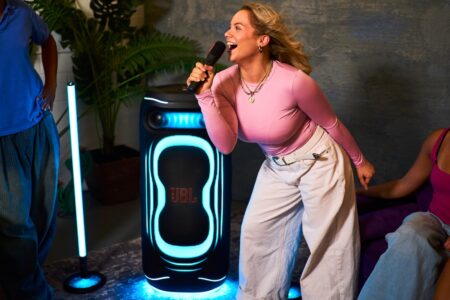
It is precisely this balance that sets it apart from many party speakers designed for effects and maximum volume. The Xtreme 5 can really pack a punch and play very loudly without its DSP immediately cutting off the bass. Even at high volumes, it remains balanced, composed, and surprisingly relaxed. But it also handles more demanding music with ease—the kind where timbre, naturalness, and detail are key.
Compared to the already excellent Xtreme 4, its successor offers improvements primarily in bass response, power, and the natural sound of the vocals. It also features Bluetooth 6.0, lossless USB audio, IP68 rating, the new ambient lighting, and the automatic Smart EQ.
The downside is its larger size and a weight of 2.9 kilograms. In addition, the powerful bass can sometimes be sensitive to its placement in indoor settings. The fact that JBL no longer includes the power supply—despite the recommended retail price remaining unchanged—also seems a bit petty.
The included shoulder strap still keeps the Xtreme 5 sufficiently portable. If you’re looking not for the smallest JBL speaker, but perhaps the most “grown-up” one that’s still comfortable to carry, you’ll get an amazing combination of outdoor durability, party power, and true hi-fi quality.
By the way: If price is more important to you than compact dimensions, the Hama Canton UltiMate Pro —with an MSRP of 250 euros—is another option that offers a particularly well-balanced sound; however, it’s almost twice as large and twice as heavy.
You can find more alternatives in our best Bluetooth speaker list
Technical Data: JBL Xtreme 4
- Manufacturer’s suggested retail price: 350 Euro
- Dimensions (W × H × D): 34.6 × 16.5 × 15.5 cm
- Weight: 2.9 kg
- Battery life up to 24 hours, up to 28 hours with PlayTime Boost
- Charging time: about 3.5 hours with a compatible power adapter
- Colors: Black, Blue, and Camouflage
- What’s Included: JBL Xtreme 5, Quick Start Guide, and Safety Information
- Special Features: Bluetooth 6.0 with SBC, AAC, LC3; water- and dust-resistant per IP69 rating; JBL Auracast Multi Speaker Connection; power bank function; equalizer; shoulder strap;
- More at: https://de.jbl.com