STEREO GUIDE verdict
The JBL PartyBox 520 impresses with its powerful, yet balanced sound and impressive level stability. Its rich bass remains controlled and precise even at high volumes. With Auracast, app control, exchangeable battery and splash protection, it offers features that leave little to be desired in its class. Only the high weight limits its mobility somewhat.
Advantages
- Clear, balanced sound even at high levels
- Precise, rich bass without exaggeration
- Removable battery & quick charge option
- Extensive connectivity with Auracast & app control
Cons
- High weight, limited transportability
-
Tonal balance / transparency9
-
Bass / Dynamics10
-
Usability / Connectivity9.6
-
Price/Performance9.2
With the PartyBox 520, JBL is expanding its portfolio of mobile speakers with a new top model for party use. The battery-powered speaker is designed for high volumes and has an output power of 400 watts RMS. Two 7.5-inch woofers (20.8 cm) and two 1-inch dome tweeters (2.5 cm) ensure broad frequency coverage between 40 Hz and 20 kHz. The signal-to-noise ratio of the Bluetooth speaker is specified at over 80 dB.
The signal processing relies on JBL’s new “AI Sound Boost” technology, which analyses music content in real time using artificial intelligence and optimizes it for the lowest possible distortion playback with high sound pressure. In addition to the audio performance, the PartyBox 520 comes with an integrated light show that provides visual support for the music via LED effects and strobe functions.


Practical connectivity
The connection options are extensive. In addition to Bluetooth 5.4 (including A2DP and AVRCP profiles), the speaker has an analog AUX input (3.5 mm jack), two combined XLR/6.35 mm jack inputs for microphone and guitar or DJ console as well as a USB-C port. The latter is used both for audio playback and as a charging port if there is no socket for the integrated power supply nearby and supports MP3, WAV, WMA and FLAC formats – with the exception of FLAC playback in the EMEA region. The USB-C socket supports charging profiles up to 20 V/1.5 A (PDO) and PPS protocols for dynamic charging.

JBL relies on a rechargeable lithium-ion battery with a capacity of 99 Wh. As with the smaller PartyBoxes of the current generation – the PartyBox Club 120 and the PartyBox Stage 320– the individually available power supply is located under a flap on the back of the bass reflex housing, which can be opened without tools. This is not only good in terms of sustainability.

Exchangeable battery for extended parties
If you buy an additional JBL Battery 600, you can continue partying after a quick change if the music playback has drained the battery after 15 hours at the latest. However, that’s three hours less than the smaller Stage 320 can ideally last. How long the speaker plays music away from the socket depends on the volume and program material. The charging process takes around three hours when the device is switched off. For mobile use, the PartyBox 520 is equipped with an extendable telescopic handle and large, sturdy castors. In keeping with its robust appearance, the speaker has a net weight of 25.5 kg.

Auracast on board
A special feature is the multi-speaker connectivity via JBL’s proprietary Auracast technology. This allows several PartyBox models to be wirelessly linked, either in a stereo setup (with two identical speakers) or as a distributed speaker network. The music, light show and sound control can be conveniently controlled via the JBL PartyBox app for iOS and Android. The functions correspond to those of the two smaller models in the series, the PartyBox Club 120 and the PartyBox Stage 320, which we were able to review last year.
For DJs and performers, the app features a clearly laid out effects pad in landscape format, which can be used to fire off short sound samples and create them live. Another useful tool for adapting to different locations in the JBL PartyBox app is the integrated 7-band equalizer. This allows the sound to be adapted more specifically to room conditions and personal preferences. In addition to familiar presets such as “JBL Signature Sound” and “Movie”, significantly expanded options are now available to adjust the sound more individually.


Immediately familiar: The operation of the PartyBox 520 is not a mystery
The control panel on the top of the PartyBox 520 also corresponds to the layout of the PartyBox Stage 320. The most important control commands such as volume, playback, skip and light control are directly accessible. Three freely assignable buttons allow the integration of typical DJ effects such as countdown signals or voice announcements à la “Let’s Go!”. There is also a third row: four rotary controls allow separate bass and treble adjustment for microphones and instruments as well as individual control of volume and echo.
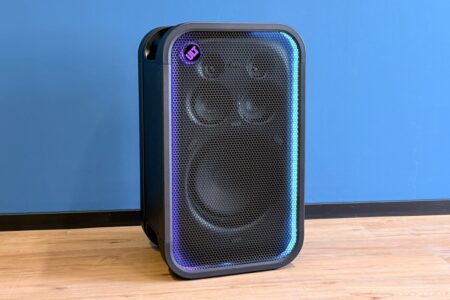
The housing is splash-proof to IPX4 and is therefore also suitable for outdoor use. I see this as an advantage over many competitors in this speaker segment, such as the Panasonic SC-BMAX10, which usually have to make do without splash protection. JBL uses partially recycled plastic for the PartyBox 520. The packaging is made of FSC-certified paper and is printed with soy ink.


Sound test: Sounds really grown up
After the smaller PartyBox 320, with its packaging, could not be transported to the parcel station for return transport in the trunk of a coupé or convertible, but instead made its way back by special collection after the review, I had the PartyBox 520 delivered to the editorial office of the F.A.Z. Kaufkompass in Munich to test it there – especially as there is an elevator there. After all, with the next update it will also be included in the party box review overview that I supervise. I was therefore very excited, as I had only been able to hear the larger Sony ULT Tower 9AC in the new editorial offices on Karlsplatz, which made quite a noise.
It seemed all the more remarkable to me and my colleague Faris Delalic, who also listened to it, how balanced and precise the JBL PartyBox 520 was. Shortly beforehand, I had listened to the Bluetooth speaker on a roof terrace in the open air at an event at the Gamescom trade fair in Cologne and took away the impression that JBL had achieved a particularly well-rounded tuning here.
During the second encounter in a room measuring around 20 square meters, it quickly became clear that the PartyBox 520 really is even more homogeneously tuned than its two smaller sister models. Voices sounded more balanced and authentic. Not only the mids, but also the highs avoided the sharpness that was inherent in the 120 and 320, depending on the placement, listening angle and mixing of the recording. The sound presets did not change the basic judgment, they merely varied the sound character within the limits of a fundamentally very successful sound tuning. And even with the bass boost activated, there’s no contourless rumble indoors.
Party box for special use

With its surprisingly neutral tuning for a party speaker, the Bluetooth speaker is also suitable for acoustic music, for example if, like a reader of STEREO GUIDE, you are looking for a speaker to play accompanying instruments for online guitar lessons.
What counts for most people in the party speaker segment, however, is the bass. And the JBL doesn’t miss a beat here either. It produces a powerful, precise low-frequency foundation that doesn’t fall to its knees even at high volumes. It’s not easy to say whether this is only due to the AI-supported real-time analysis of the audio stream, as I wasn’t able to review the predecessor. But in the end, it doesn’t matter: the punch, precision and level it delivers on balance is an impressive performance for its price, size and mobility.
JBL PartyBox 520: Conclusion and alternatives
With the PartyBox 520, JBL delivers a consistent further development of its portable speaker line – and sets an exclamation mark in terms of sound quality, features and suitability for everyday use. The surprisingly balanced sound in particular clearly sets it apart from many of its competitors in the party segment. Despite a considerable maximum level, the sound remains controlled and the bass is powerful but never intrusive. Especially in comparison to the in-house Stage 320 or the smaller Club 120, the 520 has an even more rounded sound, which benefits vocals and acoustic material in particular.
It also comes with a practical equipment package: exchangeable battery, app control with equalizer, DJ effects, Auracast coupling and a redesigned control panel with extended sound controls. JBL also scores points in the details – for example with the splash-proof housing, which you often look in vain for in competitor models such as the Panasonic SC-BMAX10.
Less impressive is the weight: at over 25 kilograms, mobility remains relatively limited despite the wheels and telescopic handle. However, if you are looking for a really powerful, sonically convincing and versatile party speaker, it will be difficult to find a better alternative in this class with the JBL PartyBox 520.
Technical data: JBL PartyBox 520
- Manufacturer’s suggested retail price: 700 euros
- Dimensions (W x H x D): 42 x 77 x 37 cm
- Weight: 25.5 kg
- Battery life up to 15 hours
- Special features: splash-proof according to protection class IPX4, bass boost, 2 XLR/jack inputs (microphone/instrument) with gain and level controls
- More at: jbl.com