STEREO GUIDE test verdict
The Bose Noise-Canceling Wired Earbuds combine exceptional comfort and excellent ANC with precise low-end bass, fine detail, and outstanding spatial sound. Classical music fans, in particular, get a lot for just under 100 euros. With rock and pop, they lack a bit of punch and dynamic range; vocals can sound slightly harsh. In our test, the remote control also malfunctioned on a locked iPhone when no music was playing.
Pros
- High transparency and fine resolution, good spatial imaging
- Deep, well-defined bass
- Particularly well-suited for classical music and jazz
- Effective ANC, high comfort
Cons
- Wired, no app
- Could use a little more punch for rock and pop
- Channel labels are barely visible
- Controls are more cumbersome than on Bluetooth earbuds
-
Tonal balance / transparency8.6
-
Bass / Dynamics8.5
-
Usability / Connectivity8.3
-
Price/Performance9.5
After years of using true wireless earbuds, a cable connecting your ear to your smartphone almost feels nostalgic. With the Bose Noise-Canceling Wired Earbuds, it brings back mostly fond memories for me: The QuietComfort 20, introduced in 2013, were among my favorite companions on flights and train trips. At the time, they offered what I considered the best noise-canceling. Combined with their exceptionally comfortable fit, this made long journeys much more relaxing.
With its new Noise-Canceling Wired Earbuds, Bose is reviving this concept. However, a lot has changed since the days of the original classic. The headphone jack has disappeared from most smartphones, replaced by USB-C. That’s exactly where the new wired earbuds plug in. And with a suggested retail price of around 100 euros, this comeback is pleasantly affordable.

USB-C Delivers Music and Power
The digital connection serves two purposes: it transmits the music and supplies power to the electronics, including the active noise cancellation. The Bose Noise Cancelling Wired Earbuds do not have their own battery. So you don’t need to recharge either the earbuds or a charging case. The power comes from the connected smartphone, tablet, or computer.
A USB-C port with support for USB audio is required. There is no need for Bluetooth pairing or setup via an app. Bose states that the headphones support lossless audio playback, with playback at a fixed 24-bit resolution and 48 kHz sampling rate. The cable is 1.28 meters long. The headphones are IPX4-rated for splash resistance.

In-ear headphones can be this comfortable
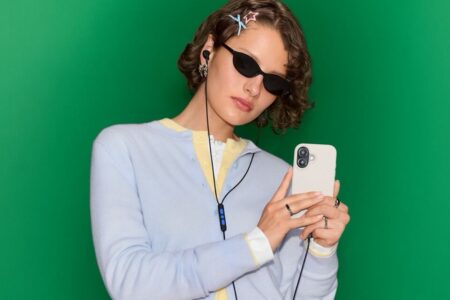
As soon as you put them in, you get that familiar, comfortable feeling. The soft ear tips don’t press into the ear canal the way many other in-ear headphones do. Nevertheless, the Bose earbuds stay securely in place, thanks to small silicone fins that anchor the earbuds in the outer ear. I already appreciated this combination of high comfort and reliable fit in my previous Bose earbuds.
The package includes ear tips in three sizes, with the medium ones already attached. The separately replaceable stability fins are included in sizes M and L; the large ones are factory-installed. This allows you to adjust the seal and fit independently of one another. The left-right markings on the earbuds seem less well thought out: they’re barely visible in everyday use.
The included soft case is also reminiscent of the earlier wired earbuds. It has a zipper and a small compartment where the additional silicone parts can be stored.

Three buttons for music, calls, and ANC
The controls also follow a familiar layout via a wired remote control. The multifunction button is located between the two volume buttons. Pressing it once starts or pauses playback; pressing it twice skips to the next track; pressing it three times skips back. Incoming calls can be answered and ended using the same button. The corresponding microphone is located on the back of the remote control.
If you hold down the middle button, the controls cycle through the three modes: Quiet, Aware, and Off. A voice announces the current mode. As soon as the desired setting is announced, release the button. “Quiet” activates noise cancellation, “Aware” lets ambient sound through, and “Off” turns off active noise cancellation.
However, when I tested them with my iPhone, I encountered an annoying limitation: If the smartphone was locked and no music was playing, the controls often didn’t respond. In those cases, I couldn’t start playback by pressing a button or switch to ANC mode as desired. This somewhat reduces the convenience, especially if you just want to use the earbuds for noise cancellation from time to time.
Press again for silence
A total of four microphones—two per earbud—work together to provide the noise cancellation feature known as Bose QuietControl. The results are impressive: the ANC on these new wired earbuds is very good. However, it doesn’t quite match the performance of the second-generation QuietComfort Ultra Earbuds.
In addition, a snug fit is even more important with noise-canceling wired earbuds. During testing, I had to press the earbuds down slightly after inserting them to ensure the silicone tips sealed tightly and the noise cancellation worked to its full potential. With the QC Ultra, this is less of an issue: their ANC works very well even when they sit relatively loosely in the ear.
Audio Review of the Wired Earbuds: Depth with Subtlety
In terms of sound, the Bose Noise-Canceling Wired Earbuds have a unique character. The bass extends very deep and has a distinctly dry quality. It’s easy to follow, well-defined, and, thanks to its precise character, suits a wide variety of music genres. Compared to the second-generation Bose QuietComfort Ultra Earbuds, however, it sounds less rich and lacks their powerful punch.
Even at higher frequencies, they deviate from the warm sound signature typically associated with many Bose headphones. The highs come across as exceptionally crisp, finely detailed, and open. Combined with good transparency, this results in a sound that clearly brings out even the smallest details.
In the midrange, however, I would have liked a bit more body. Vocals sound a bit thin in places and can take on a hint of harshness. This was noticeable not only with Eminem, but also with Luke Combs on “Fast Car.” Yet neither his voice nor this mix would normally give rise to any particular harshness. Bose seems to have prioritized transparency and richness of detail here, accepting a slight roughness in exchange.

A Grand Stage for Young Listeners
Just how captivating this tuning can be was particularly evident with classical music. In Schubert’s “Winterreise” with Benjamin Bruns, the vocals sounded rich in detail and clearly articulated. The Bose speakers also revealed a great deal of the recording space. The notes of the accompanying piano came through with precision, and the decay of the notes could be followed for a long time.
Above all, the soundstage was remarkably wide by earbud standards. The music seemed to emerge clearly from the head, and the audible reverberation contributed to the sense of open space. It was precisely this combination of transparency, fine detail, and spatial breadth that made listening such a pleasure.
The new Bose speakers also handled strings well. In Max Bruch’s “Canzone, Op. 55,” featuring David Pia, they rendered the solo cello with great finesse and nuance. Their ability to capture subtle differences really shone through here. With a large orchestra, however, the sound could get a bit sharper during the tutti passages.
Overall, these noise-canceling wired earbuds excel more in fine dynamics than in broad dynamics. On my iPhone, the maximum volume they could reach was rather modest. When listening to rock, I also would have liked more punch and impact. While this in no way detracts from their ability to reproduce subtle details, it does limit their appeal for those who enjoy high-energy rock and pop music. Above all, it’s important not to overlook the affordable price for earbuds with effective ANC.
Conclusion on the Review of the Bose Noise-Canceling Wired Earbuds
Personally, I would prefer the second-generation Bose QuietComfort Ultra Earbuds, which I also use at home. I particularly appreciate their extra punch, drive, and dynamics when listening to rock and pop. On top of that, there’s the freedom of going wireless and the even more effective noise cancellation, which is less demanding in terms of fit.
For classical music lovers, the decision might be different. The Noise-Canceling Wired Earbuds combine exceptional comfort and excellent ANC with precise deep bass, refined high-frequency detail, and outstanding spatial sound for this design. If you want to capture as many musical nuances as possible, appreciate lossless transmission via USB, and don’t want to spend three times as much on top-of-the-line Bluetooth models, this is a great option. In terms of suggested retail prices, the wired earbuds cost 100 euros, compared to 300 euros for the Ultra Earbuds.
It’s important to keep in mind the occasionally somewhat thin and slightly harsh vocals, the limited volume headroom on the test iPhone, and the operational issues described above. However, this comeback holds a special appeal, especially for fans of transparent, spacious classical music reproduction. After all, a new trend seems to be emerging here, loosely based on the motto “back” to the future. Just yesterday, Sony announced the return of its 1979 Walkman headphones —also with a USB connection instead of a jack cable.
You can find more options in our list of the best headphones
Technical Specifications for Bose Noise-Canceling Wired Earbuds
- Manufacturer’s Suggested Retail Price: 100 Euro
- Type: In-Ear
- Transducer principle: Dynamic
- Weight: 22.2 g
- Colors: Black, Smoky White, Dewdrop Mint (limited edition)
- Special Features: Active noise cancellation, IPX4 water-resistant, 3 pairs of silicone ear tips (S, M, L), 2 pairs of stabilizers
- More at: bose.com