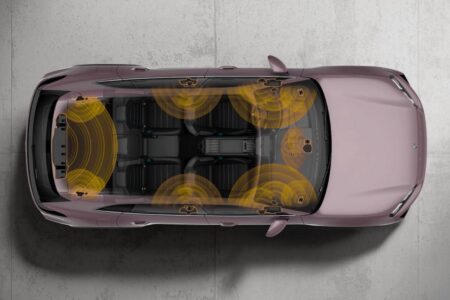
At a premiere event in Erfurt’s Zentralheize at the end of February 2026, Mercedes-Benz officially celebrated the production launch of 3D audio technology from Fraunhofer IDMT. What was previously known as “SpatialSound Wave” will now be called Audiofields. Developed based on decades of experience at Fraunhofer in nearby Ilmenau, the technology is designed to make spatial sound accessible not just in high-end systems, but across the entire model range.
Representatives from politics, research, and industry attended, including Thuringia’s Science Minister Christian Tischner, Fraunhofer President Prof. Holger Hanselka, and development managers from Mercedes-Benz and Burmester. The consensus: a successful technology transfer from research to mass production.


From the research institute to the production vehicle
Fraunhofer IDMT in Ilmenau has been working on spatial audio reproduction for more than two decades. Initially, solutions were found in theaters, opera houses, planetariums, and professional sound systems. As early as 2007, Fraunhofer began working with partners like Audi to adapt the technology for the automotive sector. Over 10 years ago, I was able to experience an audio system based on wave field synthesis with 64 speakers arranged all around in an Audi Q7 test vehicle in Ilmenau.
Since 2021, the algorithm has been specifically optimized for vehicle use in collaboration with Mercedes-Benz and Burmester. According to developers, the key challenges were limited computing power, integration into existing processor architectures, and the cost structure of series production. In 2025, the first integration into the fully electric Mercedes-Benz CLA was finally achieved.
With the renaming to “Audiofields,” Fraunhofer is now positioning the technology more broadly—not just as a 3D music enhancement, but as a platform for object-based sound control in the vehicle.

3D sound for everyone – regardless of the sound system
I find the approach of not tying the algorithm exclusively to high-end systems remarkable. Audiofields is available in vehicles with premium or high-end Burmester systems as well as in Mercedes models with the fourth generation of the MBUX infotainment system.
The spatial expansion can be continuously adjusted via a slider in the menu: from a subtle sense of space to a clearly perceptible widening of the stage. Conventional stereo material is analyzed and processed so that sound sources subjectively detach from the speakers. In a personal conversation, Christoph Sladeczek, Head of Smart Acoustic Solutions at Fraunhofer IDMT and always ready with a joke, told me that behind the scenes it took quite a bit of effort to make this concentrated technology configurable for consumers with a single virtual slider on the central display.
Personal impressions: CLA Standard vs. GLC with Burmester
STEREO GUIDE was able to try out the new process in two vehicles during the premiere: a Mercedes CLA with a standard audio system and a GLC with a Burmester 4D high-end system featuring 19 speakers, two exciters in the front seats, and 750 watts.


In the CLA with the base system, you can immediately see how much the algorithm upgrades the existing hardware in terms of soundstage imaging and 3D surround sound. The spatial expansion in all three dimensions is clearly audible: voices move more freely into the foreground, and instruments detach more strongly from the speaker positions. However, the physical foundation—limits in bass punch, volume levels, and vocal delicacy—naturally remains. But Audiofields achieves a noticeably airier presentation. All in all, it’s pretty much the best standard audio solution you could wish for in this vehicle class right now.
In the GLC with Burmester HiFi, the effect feels even more effortless. Here, the technology benefits from higher power reserves, more channels, and better drivers. Even at a moderate setting, there is a credible gain in depth and width without voices becoming unnaturally bloated or reverb sounding artificial. Even when I turned the spatial sound slider on the display all the way to the right, it didn’t produce that echoey “washroom sound” known from many less sophisticated spatial sound algorithms.
It’s interesting that the system doesn’t primarily aim for spectacular overhead effects, but for a smooth spatial expansion of the classic stereo image in the difficult vehicle environment. Especially in a car, where speakers are distributed asymmetrically and reflections dominate, such algorithmic correction can bring audible benefits.
More than music: Perspectives for assistance and warning systems
Audiofields explicitly sees itself as more than just a music enhancer. The object-based structure allows for the precise positioning of signal and operating sounds in the future. Navigation instructions could eventually come from the actual direction of travel, and warnings could be clearly assigned spatially.
This shifts the focus from pure entertainment to functional sound design—a field that is gaining importance in the era of increasingly automated vehicles.
The start has been made
With Audiofields, Fraunhofer and Mercedes-Benz have taken a remarkable step: the democratization of 3D sound across different equipment levels. While many immersive audio approaches remain hardware-intensive, Audiofields relies on algorithmic intelligence and efficient integration. Where early prototypes required a whole trunk full of computers, the Audiofields software fits into the existing DSP amplifiers of Mercedes-Benz car audio systems.

The CLA, GLC, GLB, and S-Class models are leading the way. But it’s already certain that other model series from the Swabian manufacturer will follow. A central question arose, as I received the invitation to the premiere shortly after a Mercedes-Benz and Dolby event (click here for our report), where the two partners proudly presented their Atmos solutions for all model series. However, the Dolby Atmos process known from good cinemas and home theaters and Audiofields are not in competition. In fact, the Fraunhofer algorithm is even intended to build upon object-based multi-channel recordings with Dolby Atmos.
Unfortunately, the Dolby Atmos-capable GLC with the Burmester high-end sound system lacked an app, such as Amazon Music Unlimited, Tidal, or Apple Music, to stream the appropriately encoded music into the vehicle.
In any case, the step from the research lab to the production vehicle has been completed. And it shows that acoustically, the car has long been more than just a means of transport. Especially in the premium segment, it is increasingly becoming an individually designable listening room.
How does Audiofields work?
Audiofields is based on an object-based signal processing approach. Unlike classic surround upmixers, which primarily widen the stereo signal through level and time-delay manipulation, the Fraunhofer algorithm analyzes the input signal in real-time for spectral, dynamic, and spatial characteristics.
To put it simply, the system recognizes tonal structures—such as dominant voices, percussive impulses, or spatial reverb components—and models additional spatial layers from them. These are distributed across the existing speakers in such a way that an expanded perception of depth and width is created without individual channels appearing artificially isolated.


Sound as an object
Important: Audiofields does not create discrete surround channels in the classic sense. Instead, the existing stereo signal is psychoacoustically transformed so that sound sources subjectively detach from the speaker positions. Phase stability and mono compatibility are maintained. This is a crucial point in a vehicle, where seating positions and reflection conditions vary greatly.
For production use, the algorithm had to be massively optimized. While stationary 3D systems in theaters or studios use dedicated computing units, Audiofields runs in the vehicle on existing automotive processors that simultaneously serve numerous other audio and vehicle systems. Efficiency and latency minimization were therefore central development goals.
As mentioned, the long-term perspective goes beyond music: since the system works on an object basis, individual sound events can be specifically positioned in space. This opens up potential for directionally accurate warnings, differentiated sound design for autonomous driving functions, or personalized acoustic zones in the interior. We’ll stay tuned to the topic of 3D sound in Mercedes and will test Fraunhofer Audiofields on the road when the opportunity arises.