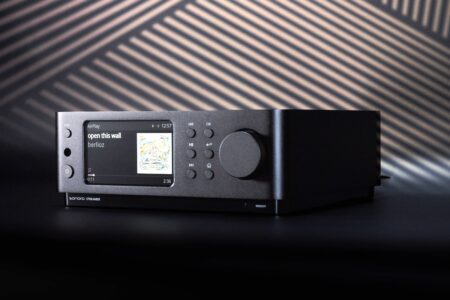
One more letter, plus four digital inputs: With the TAD-A1000D, Technical Audio Devices is expanding its Evolution series with an integrated amplifier featuring a built-in D/A converter. The purely analog A1000 serves as the basis, and the new model incorporates its amplifier circuitry. For the German market, TAD has announced a delivery date of December 2026 and a suggested retail price of 33,000 euros.
Four digital and five analog inputs
The additional Digital Main Board features a balanced XLR digital input, a coaxial RCA connector, an optical TosLink input, and a USB-B port. This allows devices such as CD drives, network transporters, and computers to be connected without requiring a separate D/A converter.
Via the balanced and coaxial inputs, the A1000D processes PCM signals with sampling rates up to 192 kHz; via TosLink, up to 96 kHz. USB supports PCM up to 384 kHz as well as DSD64, DSD128, and DSD256 at up to 11.2 MHz. The analog connectivity remains extensive: three balanced stereo inputs via XLR and two stereo inputs via RCA are available.
Clock modules from the Reference Series
When it comes to digital technology, TAD draws on developments from its Reference Series. The third-generation Ultra-High-Precision Crystal Generator (UPCG) is used here. Its technology was originally developed for the TAD-D700 CD/SACD player. An SC-cut quartz crystal is designed to minimize phase noise and temperature-induced frequency deviations. The USB interface operates asynchronously and utilizes a proprietary circuit with an FPGA.
TAD also puts considerable effort into the analog processing stage following the D/A converter. A dedicated amplifier with current negative feedback handles the current-to-voltage conversion. It feeds the converter’s output current directly back into the negative feedback loop. TAD’s goal is to achieve a simple, low-impedance, and low-noise signal path. The selected components include non-magnetic carbon-film resistors and field-effect transistors matched in pairs.


Two amplifiers per channel
The power section is identical to that of the A1000. Two amplifiers per channel operate in a BTL (Bridge-Tied Load) configuration. TAD places great emphasis on a symmetrical design between the positive and negative signal paths as well as between the two channels—right down to the circuit traces and cable lengths. The manufacturer specifies the output power as 250 watts per channel into 4 ohms, measured at 1 kHz.
A large toroidal transformer powers the circuit. Each channel has separate windings as well as its own circuits for rectification, smoothing, and stabilization. In addition, there are four filter capacitors developed for TAD, each with a capacity of 33,000 microfarads. The preamp uses a single-stage amplifier with current negative feedback; the electronic volume control utilizes a switched resistor network.
Five compartments, three feet, 29 kilograms
Inside the enclosure, the preamp, power amp, transformer, control circuitry, and digital input are distributed across five compartments. TAD provides separate ground planes for the digital, preamp, and power amp sections. The power supply is additionally shielded both mechanically and electrically.
Three feet with internal, inverted spikes are designed to reduce the transmission of external vibrations. TAD mounts the centrally located volume knob on ball bearings; the generously sized speaker terminals are modeled after those on the Reference Series power amplifiers. Measuring 44 centimeters wide, 20 centimeters high, and 55.3 centimeters deep, the integrated amplifier weighs 29 kilograms.
Price and Availability
The TAD-A1000D is expected to be available from December 2026 at select specialty retailers. The manufacturer’s suggested retail price is 33,000 euros, including VAT. The purely analog TAD-A1000 remains in the lineup for 26,000 euros. The integrated digital features thus come at an additional cost of 7,000 euros.
For more information: TAD.