BMW E46: The last classic 3 Series


I can describe the handling of the E46, built from 1998 – 2007, pretty well, at least as far as the top version, the M3, is concerned. But here it comes. I haven’t even heard two bars of music in it! Because if there’s one thing that has given me more pleasure since I can remember than turning up a stereo system: giving it some gas on two, four wheels or runners. I was able to test the BMW M3 E46, which was introduced in mid-2000, at the limit on the Sachsenring and the Grand Prix circuit of the Nürburgring. Once it was about sound recordings with engine sound as part of test drives by the magazine sport auto – without question also an opportunity to drive a few fast laps on the race track with the 343 hp sports coupé.


E46 M3: Rarely was speed on the race track so easy
Even back then, I was amazed at how foolproof the M3 of the 2000s could be moved at high speed on the race track. This impression was reinforced once again during a purely private event when I took part in a race track training course of M GmbH in the M3 E46 on the Nürburgring Grand Prix circuit in 2005 with my then girlfriend. The vehicles corresponded at least in some areas such as brakes or tires to the specifications of the legendary M3 CSL, which had recently been re-tested for sport auto by tester legend Horst von Saurma-Jeltsch.
Although she didn’t have her own car at the time, but only driving experience with her father’s high-horsepower sports coupés, even my ex was so fast that I couldn’t believe my eyes when I stopped her lap times and then compared them with brand cups from the same year. She didn’t think anything of it, not even when she stuck so boldly to the instructor’s bumper that he was already driving with two wheels on the green strip. Of course, she was also helped by the automated 6-speed SMG transmission, which made handling the gear lever and clutch superfluous.
She took the Bilstein bend with 180 km/h at the entrance and came out with 200 – quite easy. Of course, I had to add one to it with 200 at the entrance and 220 at the exit. Interestingly, I got understeer when accelerating out and had to correct slightly. The understeer also occurred with full throttle at 180 km/h at the exit of the last bend onto the start-and-finish straight.
The slightly different sign of perfection
But the grip on the rear axle was simply overwhelming thanks to the electronically controlled differential lock (“M Variable Differential Lock”) with up to 100 percent locking effect. In other words: the race track in the M3 E46 felt almost as unexciting to me, especially with the SMG, as riding a bus. Not a car for me, I already found the M3 GT so boring on the race track despite the manual transmission that I switched to a Z3 M Roadster after three and a half years. You could drive the car by ear in the rain on race tracks like Hockenheim or Hungaroring: If the engine sound in the bend became sharp at 5,500 revs, you could blindly rely on the rear coming across in the next moment in third gear. That’s what I call in-car entertainment!
Late encounter with Harman Kardon
To my shame, I must admit that I didn’t even find a quiet minute for a proper listening test with the Harman Kardon HiFi system of the E46 Touring at the birthday party where the group pictures for this endless story, which was actually planned for mid-year, were taken. Ashes on my head. But I was able to collect interesting details for this little journey through time within the long history of the 3 Series BMW.

Sound and HiFi solutions in the BMW E46: The breakthrough to genuine system audio
With the BMW E46, the 3 Series took a decisive step forward in terms of audio. For the first time, BMW understood the sound system not just as a mere accessory, but as an integral part of the vehicle – with vehicle-specific acoustics, active signal processing and clearly graduated equipment variants.
Standard audio system: Functional, but sober
The basic system remained clearly designed for practicality. Woofers sat in the front footwell, supplemented by simple loudspeakers in the rear area. There was no external power amplifier, the power came directly from the radio. In terms of sound, the system was clean, but flat: limited dynamics, little treble resolution, hardly any spatial imaging. It was enough for news and background music – nothing more.
HiFi system: The actual turning point
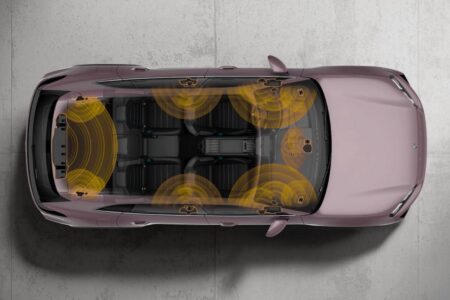
The optional BMW HiFi system was much more interesting. It worked with an external multi-channel power amplifier, active frequency distribution and a total of ten loudspeakers. In addition to the footwell woofers, tweeters were added in the door mirror triangles, as well as additional loudspeakers in the rear. The total power output was around 200 watts, depending on the version.
For the first time, this created a reasonably convincing front stage in the 3 Series, which brought voices forward and staggered instruments more clearly. The bass remained controlled and rather dry than spectacular, i.e. very BMW, but the system seemed balanced and suitable for long distances.
Harman Kardon: Sound design instead of just technology
The Harman Kardon Surround Sound System finally marked the upper class. It offered 12 loudspeakers, a more powerful power amplifier with around 320 watts, specially tuned chassis and a significantly more powerful bass section. In addition, there was digital sound processing, which gave the system more spaciousness and pressure.
In contrast to the HiFi system, Harman Kardon played more emotionally and spectacularly. More bass, more volume, more stage – without being rough or unpleasant. For many, this was the first time a factory sound system that they didn’t want to replace immediately.
Headunits and integration
The E46 also benefited from more modern BMW business and professional radios with RDS, CD changer connection and later also navigation. Important: The systems were strongly integrated into the vehicle, which made retrofitting more difficult, but brought clear advantages in terms of sound. DSP, power amplifier and loudspeakers worked together as a unit for the first time.
BMW E90: Even with V8 power as M3


The generation internally designated as E90 (sedan), E91 (station wagon), E92 (coupé), and E93 (convertible) was produced from 2005 to 2013. The 3 Series, once described by former CEO Eberhard von Kuenheim as the “bread and butter car,” was characterized by 4- and 6-cylinder engines in its first three generations. However, in the 5th generation, there is a dazzling exception besides the extremely rare homologation model M3 GTR E46 for the US IMSA series. The V8 of the M3 E90 was not created from the modular system, but from the idea of translating a Formula 1 concept into a road-suitable M car.
Individual Sound System instead of effect sound
I owed my first drive in it to the fact that my Munich-based supplier actually adopted something from me into the series for once in four decades. And it happened like this: The fact that there was an M5 E60 with a 507 hp V10 gnawed at me simply because of the spectacular performance data. It was convenient that BMW was then focusing more on the duo B&O and Audi. (Fans of the Ingolstadt-based company who have persevered this far can find our review of the Audi S8 with B&O Advanced Sound by Dr. Ian Kuah here). The BMW Individual Sound System, developed by BMW M in collaboration with the Bavarian manufacturers LPG (Eaton) and Lear (amplifier), was my free ticket to test the V10 powerhouse for the magazine sport auto.
The sister magazine Auto, Motor und Sport had previously celebrated the BMW Individual Sound System as the best car audio system available ex works on this planet, but obviously only heard it while stationary or at city speeds. But while the M-Power of the V10 made the corners of my mouth turn upwards as the speed increased, the bass went down the drain. Quite incidentally, during a lively discussion with the developer who accompanied me in the passenger seat, I noticed that the test car was not locked at 250 km/h.
The following high-speed orgy only ended a good distance beyond the magical 300 (as I said, please don’t imitate). While the car enthusiast in me didn’t really care about the lack of bass at that moment, the HiFi tester in me naturally had to discuss the matter with the brave developer on the way from Garching near Munich to Deggendorf and back.


Individual Sound System instead of effect sound
In the subsequent discussions at M GmbH, it was concluded that it was obviously not enough for an M model to rely on data from the parent company BMW – then called “die AG” in Garching – when adapting the speed-dependent equalizer (GAE). This is because they are based on measurements of the noise level of the quieter and slower base models. In the original words of Wolfgang Hübner, the responsible engineer, it sounded like this in my short test of the M3 E93 in “sport auto” 1/2009: “We took another look at it and realized that we should better develop a sharper, M-specific adaptation.”
This improvement, which was devised as a result of my test, was then immediately incorporated into the BMW Individual Sound System for the 3 Series E90, which was also developed under the direction of Wolfgang Hübner and was based on the HiFi system of the M5. It already had the patented central bass speakers under the front seats, which used cavities in the body structure as subwoofer housings. This offered acoustic advantages and saved space and weight at the same time.
V8 sound versus high-end audio
That’s why a little later I was able to convince myself of the new tempo-suitable sound tuning in an M3 with a 420 hp V8 engine. In my heart of hearts, however, the perfectly balanced, detailed sound of the 13 loudspeakers had a hard time against the beguiling working noise of the 4-liter high-revving unit. The M GmbH had done everything possible with mechanical means, such as the vibrating floor of the airbox, to make its new sports car roar really nicely. And that came across very unfiltered in the open steel roof convertible.
Nevertheless, the Individual Sound System was able to hold its own well against the roaring V8 engine. There was a bass foundation that had never been seen before in a BMW, which offered punch and precision even with the steel roof open. The in-house solution was also able to convincingly tick off points such as homogeneity, resolution and treble brilliance.
The rise of the central screen
In the 3 Series BMW of the E90 series, the screen, which was still mounted low in the E46, wandered to the very top of the dashboard, where it remained perfectly in view even while driving. At the same time, the initially controversial iDrive operating concept with rotary push button on the center console also made its debut. After its debut in the BMW 7 Series (E65) developed by chief designer Chris Bangle, the criticism of the rather revolutionary iDrive flowed into essential improvements for the BMW E90. Additional buttons for direct access to important infotainment functions and to return to previous menus made the E90 a vehicle that actually only lacked the Internet connection with smart functions and streaming services compared to today’s cars.
When I later borrowed the BMW M3 E90 as a sedan from sport auto, it was for a reality check for driving simulators and racing games for PlayStation and Xbox. After the previous lines, it is probably unnecessary to say that when drifting uninhibited on a test site with a skidpad, the question “do I just do a 180-degree drift or a donut?” pushed the HiFi sound completely into the background. In any case, what remained of this second encounter with the E90 was above all the electronically controlled rear axle differential with up to 100 percent locking effect and killer grip.
BMW F30: Networking arrives

The chapter on the E90 has now become a little long again. That’s why I’ll keep it very short with the F30 (2012 – 2019). I only drove the car very briefly – as a rental car because my own car had to go in for inspection. It was a steel roof convertible with a 6-cylinder engine. I can’t remember the displacement anymore. But I do remember – believe it or not – the Harman Kardon sound system with 16 loudspeakers and 600 watts. You could choose between normal stereo playback and Logic 7 surround sound. At that time, as is now generally the case, there were also two simpler solutions under the Harman Kardon option, which was subject to a surcharge.
In addition to the standard audio system, there were two sound options
In the BMW F30, the standard audio system remained clearly limited to the essentials. With six loudspeakers that were controlled directly by the radio, it lacked power reserves and depth. The sound was clean but flat – sufficient for news and background music, but not for dynamic or spatial listening.
Would you like a little more?
The optional HiFi system for under 700 euros was much more coherent. It worked with nine loudspeakers and an external amplifier with around 200 watts of total power. This audibly improved the clarity and structure of the playback. Voices moved forward, instruments could be located better, and the bass also played in a more controlled manner without being obtrusive. For many drivers, this system was the sensible middle ground between ambition and restraint.
With Harman Kardon into the modern age

Harman Kardon for the masses
At the top was the Harman Kardon surround system, which I subjected to a listening test during a drive and which significantly enhanced the acoustics of the F30. It cost around twice as much as the mid-range HiFi system. In return, it offered 16 loudspeakers plus a digital DSP amplifier. And it delivered noticeably more pressure with around 600 watts of power and the low-frequency loudspeakers under the front seats that are typical of BMW. In addition, there was a high level of stability and a wide, impressive stage. The tuning focused less on fine restraint than on dynamics and presence – a sound that remained confident even at higher volumes and clearly anchored the F30 in the modern age in terms of sound. At that time, I switched several times between stereo playback and Logic 7 surround sound. The all-enveloping sound had a certain charm, but I preferred stereo for its focus and precision.
The 3 Series goes online
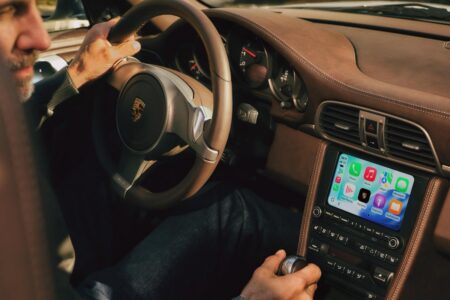
The functionality of the sound settings was already on par with today’s premium vehicles. When it was launched in 2012, the BMW F30 was already online-capable via ConnectedDrive and offered numerous functions that were previously reserved for the upper class with online navigation, real-time traffic information (RTTI) and the BMW online portal. With the facelift from around 2015, the range was noticeably expanded and the online services were more strongly integrated into navigation and vehicle functions. From 2016/2017, Apple CarPlay finally became optionally available, bringing smartphone connectivity up to the level of current standards. Overall, the digital networking of the F30 seemed much more modern and suitable for everyday use than that of the E90, which in this respect clearly remained a child of the pre-smartphone era.
BMW G20: The 3 Series in the format of earlier 5 Series


I have had virtually no contact with the BMW 3 Series of the G20 series (Touring: G21), which was launched on the market in 2019. Although I had put together an Alpina D3 S on the configurator three years ago, I didn’t go for it after all. On the one hand, I don’t really trust the political situation when it comes to diesel, but above all I like compact, lightweight cars like my E21. And the G20 is a giant – longer and wider than my M5 E34 from the early 90s. Coincidence was still good to me: the current 3 Series was of course a must at the 50th birthday of an acquaintance. Undoubtedly one of the most beautiful modern BMWs, even if the group picture cannot conceal the significant growth spurt – after all, the double kidney remained pleasingly moderate.
Familiar size: Harman Kardon sound system with Logic 7 surround
As much as I like the look of the G20, it would be too big and too heavy for me personally. For those who think similarly, however, BMW offers an alternative: the 2 Series Coupé of the G42 series, which is technically based on the G20 but is more compact. Both models are based on the CLAR platform, so they not only share the basic body structure, but also large parts of the electronics architecture. This applies in particular to infotainment, networking and audio: iDrive, ConnectedDrive services and the complete signal processing come from the same development family.
Accordingly, the four-seater, which is by no means petite at just under 1,800 kilograms in the xDrive version, also took over the Harman Kardon sound system with Logic 7 surround largely unchanged from its big brother, at least in the first row. I have the sound of the 2 Series sound system in my ear, which is why I could basically have saved myself the test drive, at least for the classification in this chronicle. I had to, because otherwise it still wouldn’t be finished. STEREO GUIDE and magazines like AUDIO or WALTER have kept me pretty busy in the past year. In case of doubt, such projects have to take a back seat on our own platform.
The sound of the optional Harman Kardon sound system with 16 loudspeakers and 464 watts impresses with its exemplary tonal balance, a rich and, above all, precise bass foundation for the price range, plus good stage imaging. The G20 system not only has more power, but also four more loudspeakers. This is due to a stronger focus on the sound in the rear. After all, higher demands are placed on a five-seater, four-door sedan or station wagon than on a four-seater coupé with a narrow rear. The 3 Series has a graphic equalizer with finely graduated bands that can be used to meticulously adjust the sound to personal preferences. The balance and fader menu can also be used to adjust the focus as required.
Surround or stereo – to each their own
The decision between the switchable Logic 7 surround sound and pure stereo is a matter of taste. I used to prefer stereo playback without artificially added spaciousness in listening tests. In normal everyday life, when I switch off my head as far as music is concerned, I now use surround playback in my company car because it really envelops you in the music and you distribute the desired playback level across more loudspeaker chassis, which means that the individual drivers are not so heavily stressed.
The Harman Kardon sound systems in modern BMWs may lack that last bit of attack, punch in the bass, treble resolution, focus and level stability, but their exemplary naturalness and very decent front staging make for a great price-performance ratio. And they don’t even make the blunders that sometimes impair the homogeneity or timing even in expensive high-end audio systems offered ex works.
From analog to digital: The 3 Series cockpit reflects 50 years of progress


What remains of 50 years of BMW 3 Series
If that’s not a bullseye: On the last day of the anniversary year, I was finally able to publish my mammoth work on the topic of 50 years of the 3 Series from BMW, which I had experienced over decades. Despite all the enthusiasm for the topic of engines, the topic would never have appeared if it did not also exemplify the evolution of car sound systems ex works and in the infotainment area using an eternal bestseller from the premium sector.
This is especially true because BMW has always been at the forefront when it comes to operating concepts when it comes to implementing new technologies in the automotive sector. From the driver-oriented analog cockpit to the check control with Condition Based Service introduced in the E30 or the central screen arranged on the dashboard in the E90 to the networked Connected Drive in the F30. Not to forget the concierge service that I liked to use, which was recently shut down quietly and secretly.