50 years of the BMW 3 Series – hardly any other model series has shaped the concept of the sporty mid-range class so sustainably. Since the debut of the first generation in 1975, the 3 Series BMW has stood for driving dynamics, technical evolution and a change that goes far beyond design issues. From the purist E21 with carburetor and injection engines to the driving dynamics milestones of the M models to the highly networked G20 of the present, the 3 Series not only reflects the history of BMW, but also the zeitgeist of five decades of automotive development. This also applies to the constant evolution in hi-fi and infotainment.
50 years of the BMW 3 Series – a very personal approach
This report deliberately approaches the anniversary not only from a technical or historical perspective, but from personal experience. Over several generations – from the E21 to the E30, E36, E46, E90 to the current G20 – it’s about driving feel, character, mistakes, learning curves and, last but not least, a topic that has long been underestimated in the car: music, sound and hi-fi in the BMW 3 Series.
BMW E21: The ancestor of the sports sedan
When the BMW 3 Series debuted in 1975 under the development code E21, I didn’t have a driver’s license yet. And besides, with my penchant for Italian design, I found the styling of BMW and Mercedes very old-fashioned at the time. This was especially true for the 3 Series, because – as I now know – it was designed by the poached Daimler designer Paul Bracq. When one of the last 3 Series of the first series, which rolled off the production line in 1982, was purchased in 1983, I already saw some things with different eyes.
From design doubt to inner values
After two years and countless workshop visits with a chic but technically unconvincing Fiat Bertone X1/9, I was ready to concentrate on the inner values of a car. The 3 Series had plenty of them: starting with the rock-solid 1.8-liter injection engine with overhead camshaft, cross-flow cylinder head, contactless transistor ignition and Bosch K-Jetronic injection system, the extremely crisp four-speed gearbox from ZF with short shift lever to the red-lit cockpit, which faces the driver.


Baur Cabrio – open-top driving with compromise
As far as the body shape was concerned, I wasn’t so enthusiastic. The main thing was open, I thought to myself. Because a school friend – he had already painted “BMW” on the mudguard of his children’s bicycle with oil paint – had found a Baur Cabrio as a one-year-old car at the BMW dealer in the newspaper. I found the split roof of the construction, reminiscent of a landaulet carriage, about as exciting as orthopedic support stockings. But the car radiated solidity and impressed with technical perfection down to the last detail and with its cockpit, which was far ahead of its time.
Learning to appreciate rear-wheel drive – drifting instead of diva
Above all, I consoled myself with the fact that you can drift with a BMW like in a thriller. My buddy with his Fiat 1502 and his father’s BMW 528i had drastically demonstrated this to me for two years. In contrast, the mid-engine Fiat proved to be an extreme diva at the limit. In addition, with its weak 73-hp engine and the weight of the engine and transmission on the rear axle, it simply lacked the power to spin the rear wheels on dry roads.
Looking back after four decades
When I open the gate to the garage of my Baur, inherited unrestored from my mother with the first soft top and decorated with starting numbers from various classic rallies, I think: “What a pretty, dainty car without frills.” And at the sight of the striking front end in the iconic sharknose design, I take my hat off to Paul Bracq.

When I then sit in my 318i Baur in the original “Polaris Silver” paint on a hot summer’s day and beam myself directly back to the 80s with the first burst of gas, I would by no means want to exchange my family heirloom for the barless full convertible of the successor series (1982 – 1994) as in the late 80s. Apart from the fact that after more than four decades I find the body shape almost iconic with the common streamlined uniformity on the roads: When I see the open full convertibles at the classic car rallies in midsummer temperatures, I admire the occupants less than the cars: A real case of masochism.
Sun, heat and the advantage of the Baur concept
When it gets really hot and the sun is burning, the long-misunderstood Baur Cabrio can show its strength. The front targa roof then protects against aggressive sunlight, while the small folding roof behind the roll bar provides draft-free ventilation. When the Bauer, which could be ordered directly from BMW, was built in Stuttgart in the early 80s, tinted windows in German cars were still a rarity, as were its electrically adjustable, tinted exterior mirrors.
The underload drive design, i.e. a deliberately short gear ratio, allows the engine to increase speed quickly and respond spontaneously. This made the 3 Series lively in everyday use and on winding roads, even if it revved higher on the highway than comfort-oriented competitors. In addition, there is an agility-promoting low weight plus a smooth but precise ZF rack-and-pinion power steering, which was still an extra subject to a surcharge at the time.

In contrast, the soft suspension was a step backwards in sporting terms compared to the crisp 02 series. With this, the Munich-based company apparently wanted to position itself as a compact Mercedes alternative. Fortunately, my car-enthusiastic mother, who continued to drive the car after I moved away, had a Bilstein sports suspension with the yellow gas pressure dampers and a subtle lowering installed in the mid-80s. This means that the Baur Cabrio, which has now been inherited by me, still sits on the road like the proverbial board. And it certainly has, like the Recaro seats also installed in the 80s, a share in the numerous podium places at classic car rallies that I have achieved with the small driving machine since taking it over in 2019.
50 years change the view of many things
So after more than four decades, you can have a completely different picture of a vehicle, especially since you and your demands have changed over the long period of time. In the past, I didn’t find the low engine output of 105 hp very exciting, in addition to the design. Today, with its relatively low weight of just over 1,000 kilograms and the almost go-kart-like handling compared to modern cars, I would prefer it in sporting terms to many heavy, large horsepower protagonists with their electronic controls and electromechanical power steering.


Music in the E21 – hardly worth mentioning back then
However, there is one thing that I will probably never get used to with 80s cars: From today’s perspective, I find the sound systems of that time even creepier than I did back then.
Although the original Blaupunkt cassette radio has long since given way to a 90s Bavaria from my BMW M5 E34, which was subsequently equipped with a more modern RDS tuner, on the one hand the broadband loudspeakers from Blaupunkt with their oval cardboard diaphragms were the biggest weak point in the BMW E21. And secondly, the car radios of that time without DAB tuner and especially without Bluetooth or USB interface are completely out of date.
Although I showed a few years ago for LowBeats using the example of my BMW E21 in a detailed guide how to bring classic cars up to a more modern standard in terms of sound system without sawing. The means of choice include above all new loudspeakers, which ideally fit into the original installation openings and thus do not impair the originality of the oldie.


After many decades, the surrounds are causing problems
Replacing the loudspeakers is necessary in older vehicles simply because their surrounds like to dissolve into thin air over time. This is especially true for the simple surrounds of the cheap loudspeakers that were common in the 70s, 80s and early 90s. After all, the diaphragms with their centering devices and surrounds in the car are exposed to extreme temperatures and humidity. Accordingly, the material crumbled apart. This caused the distortions of the broadband chassis, which were not particularly clear-sounding anyway, to rise far above a tolerable level.
My Baur Cabrio had to make do with two oval Blaupunkt loudspeakers in the footwell as standard, while the sedan at least optionally offered four sound transducers – a luxury that was denied to the open E21 because of the rear folding top. I found a replacement in the form of two Alpine SXE-4625S. With their oval diaphragms in the format 10×15 cm (4×6 inches), these 2-way coaxial loudspeakers correspond to the original broadband loudspeakers from Blaupunkt. Unfortunately, the drivers were inextricably linked to the perforated plastic covers and I was lucky that a friend had two matching covers at hand, which actually came from the rear shelf of an old Porsche Carrera.
The Bluetooth interface is particularly missed in the E21
As far as playing music from the smartphone was concerned, I tried two solutions: An FM transmitter, which in this case came from Technaxx. This small device fits into the cigarette lighter, which supplies it with energy. It can receive Bluetooth audio from the cell phone and pass it on to the car radio’s external antenna via an FM transmitter with a variable frequency. The second option would be an adapter in the form of a compact cassette for the cassette radio’s drive, which is connected to the smart device via a 3.5 mm jack cable. However, additional USB-C adapters are now required for this, as analog headphone connections are history.
But it turned out that all these solutions are ultimately very compromised. Anyone who really expects hi-fi sounds in their 80s BMW with contemporary connectivity will not be able to avoid changing the head unit in the E21 or E30. The only promising option would be to retrofit a Bluetooth board. There are numerous providers on the Internet and Simon Wonka from the BMW Classic workshop in Stuttgart has a handful of customers every year who ask for such solutions for their classic car or youngtimer.
What else you could do with such an old car is to install a booster power amplifier, which can be installed covertly using a plug-&-play cable. And then I would recommend a subwoofer, especially for the E21, which can be integrated without changes to sheet metal and trim and can also be easily removed if necessary. Suppliers such as Audiotec Fischer from the Sauerland region have various solutions for the trunk. The most elegant one fits into the spare wheel well, if it is to be completely invisible and you have a tire repair kit with a compressor on board as a replacement for the spare wheel.
Retrofit solutions for the E21 and other oldies
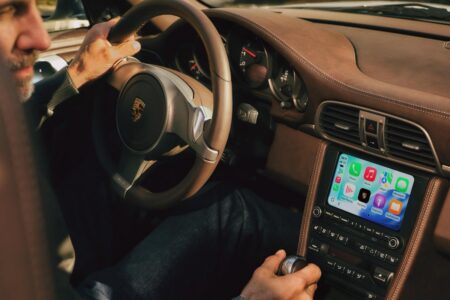
Anyone who wants to elegantly put a check mark on most of the problems described above must either make friends with the modern look of a current DIN head unit from the retrofit market or use Porsche Classic: The Zuffenhausen-based company launched a timelessly simple classic radio five years ago, which I then also subjected to a LowBeats driving test in the open Boxter. The Porsche Classic Communication Management (PCCM) for vehicles with 1-DIN slot and combines powerful power amplifiers with useful functions such as navigation, Bluetooth, USB playback and DAB+ and Apple CarPlay.
In conclusion, one can say about the first model of the BMW 3 Series: From today’s perspective, there is a lot of need for action in terms of acoustics. But even after 50 years, one must bear in mind in the historical context that the BMW E21 at least came with stereo loudspeakers ex works, even in the rear on request. When the first 3 Series BMW came onto the market, stereo was not yet a matter of course for Opel, VW and Ford, and this was still the case in the early 80s, when my 318i with the injection engine rolled off the production line. Often only a single mono loudspeaker played in the dashboard. Against this background, even two loudspeakers in the BMW already seemed progressive and also underlined the premium claim of the aspiring Munich-based brand.
BMW 3 Series E30: Electronics move into the cockpit

The author convinced himself at the wheel of his 1982 BMW E21 Baur Cabrio in the high-speed oval of Boxberg how far the Munich brand was already ahead in autonomous driving when the term “Tesla” still meant magnetism… (Please do not imitate). (Photo: Falk Visarius)
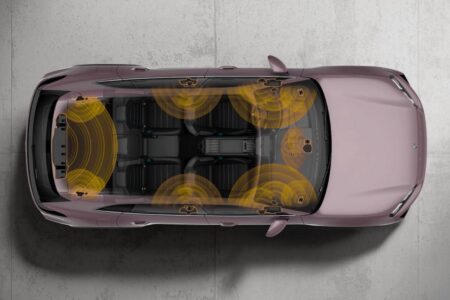
With the E30, BMW noticeably caught up in the early 1980s. Although the basic solution remained manageable here as well, there were significantly more variants and retrofit options. Four loudspeakers with 13 cm broadband chassis made the, later came optionally eight loudspeakers, distributed on footwell (low-midrange), doors (tweeters in the mirror triangles) and rear shelf (two 2-way systems). The installation locations were also better thought out, which benefited the spatiality. The stage wandered with the BMW Sound System, which was subject to a surcharge, from the footwell upwards. In addition, the chassis used improved: more stable diaphragms, better load capacity and somewhat more treble presence.
Another difference was the head units. While the E21 remained firmly stuck in the era of simple FM radios and cassette drives, RDS technology made its debut in the E30 towards the end of its production period. More powerful BMW Bavaria and Becker radios with better power amplifiers also became available. Nevertheless, even in the E30, the sound system remained clearly functional and far removed from what is understood today as factory hi-fi.
Retrofitting instead of factory solution
What I already tried out in my then BMW 320i E30 in the early 90s was replacing the four standard 13 cm broadband loudspeakers with a relatively inexpensive retrofit kit from MB Quart, a high-end audio and car hi-fi specialist that has since disappeared from the market. The Swabians had tailor-made round 2-way coaxial loudspeakers with a tweeter dome and plastic cone for the low-midrange range in their range. All you had to do was loosen the screws of the cover grilles at the front in the footwell and at the rear on the rear shelf to carry out the replacement. This meant that the sound was no longer recognizable despite the standard original BMW cassette radio with its four amplifier channels. Suddenly there was something like bass and above all clear mids and a decent treble resolution.
For the standards at the time, that was already very decent music reproduction – at least if the focus was on the joy of driving and not pure listening pleasure. And I must admit that at the wheel, I only saw music reproduction as an accompaniment to the sound of the mostly six-cylinder engines.
Back then, the engine sound was still more important than HiFi
Although I was already active as a HiFi reviewer in the mid-80s and had also launched HIFI MOBIL as a sister magazine of HIFI VISION, my passion for horsepower still came before audiophile ambitions. Of course, during regular tests of unique items, some of which were prepared in months of manual work for sound competitions, I was able to get an impression of what is acoustically possible in a car if you have no inhibitions about effort or costs and are also prepared to reach for the tin snips for the sake of bass and make compromises in the everyday usability of the vehicle.
Not infrequently, the sheer sound pressure was the main focus at the sound-off competitions anyway. I took impressions from a visit to Arizona of tin roofs bending in rhythm with the beats. Of sound levels of a starting jet and vehicle cabins in which no person could stay during the measurement because they would not have survived. 130 dB SPL is still considered entry-level among the self-installation freaks. The world records are over 170 decibels! This is just a side note, as a classification that STEREO GUIDE usually only deals with things that can be ordered ex works and not with high power hardware from the illustrious retrofit scene.
BMW 3 Series E36: No 3D sound, but 3D rear axle geometry

As far as the sound system was concerned, my first car from the E36 series, manufactured from 1990 to 2000, was no match for the pimped music system with the four MB Quart boxes in my previous E30. Once again, there was a BMW Bavaria car radio with four speakers mounted in the front footwell and in the rear on the parcel shelf. But as far as the chassis was concerned, the streamlined E36 made a quantum leap. This was mainly due to its multi-link rear axle. Its three-dimensional geometry maintained the camber of the wheels even when the suspension was compressed. This had a very stabilizing effect on the previously very loose rear end of the BMW 3 Series.
This overcame a key problem of the two rear-wheel drive E21 and E30, whose semi-trailing arm rear axle was already used in the legendary predecessor of the 02 series in the 60s. You could drift excellently with them. In my father’s 325i, I liked to drive at full throttle in third gear, sideways, straight ahead on an empty road at night in the rain (please don’t imitate!). But many, including an acquaintance, ended up with their then generally notorious rear-wheel drive cars on the tree.
The multi-link rear axle as a turning point
The fundamentally new chassis was not the only reason for the big leap in driving stability. In addition, my 318is Coupé in particular had an even weight distribution. The short four-cylinder four-valve engine was also located behind the front axle under the long bonnet and the battery was moved to the trunk in the six-cylinder and M models for better balance. This put more weight on the rear wheels, which were able to build up so much grip that my 318is tended to understeer even with summer tires on snow. (There was no winter tire requirement at the time and I lived in the flat countryside).


ABS, balance and new driving stability
The E36 was my first car with ABS, as it was now part of the standard equipment. And I wasn’t thrilled, to put it cautiously. The control frequency was very sluggish and if a front wheel lost ground contact slightly due to bumps or lost grip due to a dirty road surface when braking sharply in a tight bend, the ABS electronics also reduced the deceleration on the other side. The only thing that helped was to step on the accelerator fully and I also had to get used to the roughly controlled stutter braking on snow.
BMW M3 GT – Motorsport for the road
However, the ABS problem dissolved into thin air with a spontaneous order. When I saw an M3 in British Racing Green (BRG) – my favorite color at the time – as a stock car with a tempting red price in the window in the showroom of the BMW branch in Frankfurt, I couldn’t resist despite the homologation rear wing. After sleeping on it for a night, I came across a rare evolution model for the ADAC GT Cup, where one of my heroes, the former motorcycle world champion Johnny Cecotto, and his team-mate Steve Soper literally humiliated the competitors with it. After the first season, the M3 GT was banned from starting.
ADAC GT Cup and a car from another planet
It quickly became clear to me why: the chassis with its strut brace between the front shock absorber mounts and the mechanical differential lock on the rear axle was like something from another planet in the mid-90s in conjunction with the sophisticated aerodynamics and numerous aluminum components on the body. I actually got bored on the race track because the 3-liter engine with its 295 hp, which was only available at the edge of the red zone, couldn’t really exploit the chassis. The brakes and seats, on the other hand, could.
After a Sunday on the old Grand Prix circuit of Hockenheim with the long forest straight, the left flanks of the front tires were largely shaved off and the front brake discs were warped. What hurt much more: I had never been overtaken on the road before. Then the H&H Provos – an E36 with a V8 compressor engine that had recently been tested in sport auto – shot past at the end of the then eternally long forest straight in the last few meters before the hairpin bend and left me behind in a fireball from the exhaust pipes when downshifting. What can I say: a traumatic event, even if you could put him under pressure in the Motodrom thanks to the high grip level of the M3 GT.

Plenty of lateral acceleration instead of nervousness
Speaking of lateral acceleration: on the Salzburgring, in the Nockstein bend, even in pouring rain, I could only hold myself in the seat to some extent against the enormous lateral acceleration by supporting myself with my knee and elbow on the driver’s door. This was only possible because the M3 GT could be easily controlled with one hand even under such circumstances. As comfortable as the seats were on long business trips, they lacked considerable lateral support for the race track in this special model.

Incidentally, the ABS not only regulated much more finely and later than in the normal E36. It even regulated backwards. I know this because it torpedoed my self-taught 180-degree backwards skid turn in the crime style, because the front axle of the M3 GT did not lock on snow when the brake was applied, as in my previous 318is, and therefore did not break out sideways.
Otherwise, breaking out was not an issue either. Rather, it was the case that the M3 GT developed noticeably more downforce at higher speeds and you could compensate for its basic understeering tendency in fast highway bends by fully depressing the accelerator pedal with the yaw moment on the rear axle.
Finally a proper HiFi system on offer
Where were we? Oh yes, the HiFi system was the best I had ever had ex works in the car. According to my actually recovered invoice, it was the BMW Business RDS cassette radio for DM 1,086.96 with the HiFi active loudspeaker system offered for a modest surcharge of DM 817.39. That was the first time that I would really speak of HiFi ex works in one of my own cars. Although you had to make certain compromises in terms of level stability, especially if you had helped the bass a little in the sound settings. But finally the bass and treble reproduction largely met high-fidelity basic requirements.
My research for this story on the 50th anniversary of the BMW 3 Series revealed that for late E36s, instead of the HiFi active loudspeaker system, there was also a Harman Kardon option with 10 loudspeakers and significantly higher overall power available ex works for an extra charge.
My best musical experience, by the way, came from the interplay of the BMW HiFi sound system and the rear wing, which really has an aerodynamic function for the race track. (See warning in the special operating instructions, which I kept just for the Cecotto autograph). The rest was done by the road surface, which was wetted with water from a previous rain shower: At high speed, a huge rainbow formed in the spray of water that the rear wing kicked up like a racing car, which followed me in the rear-view mirror. At the same time, the song “Angels” by Robbie Williams came on the radio. This unforgettable experience is hard to beat even with 500 watts and even more hp.