Close Menu
stereoguide.com
  • Home
  • Bluetooth Speakers
    • Home/Indoor
    • Mobile/Outdoor
    • Stereo Speaker Sets
    • Bluetooth Speaker Ranking
  • Headphones
    • In-Ears
    • On-Ear/Over-Ear
    • Noise-Cancelling
    • True Wireless
    • Gaming Headsets
    • Mobile headphone DACs
    • Home headphone amplifiers
    • Mobile digital audio players
    • Headphones Ranking
  • Hi-Fi
    • WIFI Onebox
    • WIFI Stereo
    • Soundbars
    • Subwoofers
    • Turntables
    • Hi-Fi Ranking
  • Car-Hi-Fi
    • Car Hi-Fi reviews
    • Car-Hi-Fi reports
    • Car Hi-Fi Ranking
  • Guides
    • News
    • Buying Guides
    • Technology
    • Acoustics
    • Streaming
  • About us
    • Our approach
    • About us
  • English
    • German
Facebook Instagram RSS YouTube TikTok
YouTube Facebook Instagram TikTok LinkedIn
stereoguide.com
  • Home
  • Bluetooth Speakers
    • Home/Indoor
    • Mobile/Outdoor
    • Stereo Speaker Sets
    • Bluetooth Speaker Ranking
  • Headphones
    • In-Ears
    • On-Ear/Over-Ear
    • Noise-Cancelling
    • True Wireless
    • Gaming Headsets
    • Mobile headphone DACs
    • Home headphone amplifiers
    • Mobile digital audio players
    • Headphones Ranking
  • Hi-Fi
    • WIFI Onebox
    • WIFI Stereo
    • Soundbars
    • Subwoofers
    • Turntables
    • Hi-Fi Ranking
  • Car-Hi-Fi
    • Car Hi-Fi reviews
    • Car-Hi-Fi reports
    • Car Hi-Fi Ranking
  • Guides
    • News
    • Buying Guides
    • Technology
    • Acoustics
    • Streaming
  • About us
    • Our approach
    • About us
  • English
    • German
stereoguide.com
Home » Bluetooth Speakers » Stereo Speaker Sets » Edifier MR5 review: The surprisingly grown-up 3-way desktop monitor
Active speakers Stereo Speaker Sets

Edifier MR5 review: The surprisingly grown-up 3-way desktop monitor

Tri-amping power, strong bass & app tuning
Stefan SchickedanzStefan Schickedanz28. November 2025
Facebook Twitter Pinterest WhatsApp Email
Edifier MR5 review
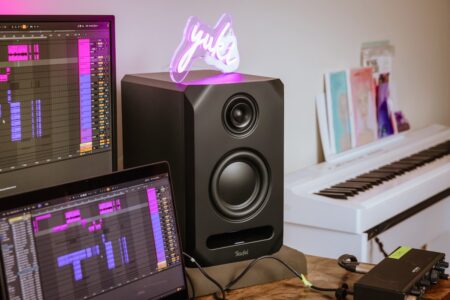
The Edifier MR5 proved to be a positive surprise in the test. (Photo: Stefan Schickedanz)

STEREO GUIDE verdict

87%
87%
Buy Tip

Edifier MR5 review: Triple active desktop monitors with strong bass, precise mids and ConneX app tuning. A real recommendation for 250 euros,

Pros
  1. Rich bass and great playfulness
  2. Sound customizable via app and controls
  3. clean and transparent even at high levels
Cons
  1. Volume control of the app not synchronized
  2. No streaming/digital inputs
  3. Tone colors not quite as natural
  4. Danger of droning in small rooms/near walls
  • Tonal balance / transparency
    8.5
  • Bass / Dynamics
    8.4
  • Spatial imaging
    7.8
  • Usability / Connectivity
    9.3
  • Price/Performance
    9.6

Even if you have been writing test reports for a long time and have reviewed many small desktop monitors in recent years, you can always be surprised by something new. The Edifier MR5 actually just looks like a larger, better equipped version of the cheaper MR3. The visible cone driver remains surprisingly small.

The fact that there are more inputs on the rear connection panel, including professional XLR sockets, is noticeable at first glance. And you also quickly notice that elongated openings have been integrated into the side panels of the active speakers, which weigh 10.8 kilos as a pair and are 26.4 centimeters high. However, they neither look like conventional bass reflex openings, nor do they make sense as recessed grips in the MDF housing with foil veneer. And then there were the typical oval bass reflex ports on the backs of both stereo speakers, which are available in black or white.

Advertising
Edifier MR5 2.0 Studio Monitor Bookshelf Speakers, 110W(RMS), Hi-Res Audio, Bluetooth 6.0, 3-Way Active Design, Room Compensation, XLR/TRS/RCA Inputs, Compact Size for Home Studio & Music - White
349,99 €
Auf Lager
as of 12. December 2025 08:32
Amazon.com
Edifier MR5 2.0 Studio Monitor Bookshelf Speakers, 110W(RMS), Hi-Res Audio, Bluetooth 6.0, 3-Way Active Design, Room Compensation, XLR/TRS/RCA Inputs, Compact Size for Home Studio & Music - Black
349,99 €
Auf Lager
as of 12. December 2025 08:32
Amazon.com
For links on this page, STEREO GUIDE may receive a commission from the merchant. This applies, for example, to those marked with *.

Unconventionally implemented monitor concept

Of course, I hadn’t read the complete technical documentation immediately after unpacking and was quite surprised when I read about tri-amping in the technical data. What on earth are three power amplifiers supposed to do in what is read as a typical 2-way speaker? While I was still searching for an explanation, wavering between a marketing gag or a mistranslation, only one possible solution came to mind: the 3.7-inch cone on the front with its striking copper-colored, concave dust cover is not a bass-midrange driver as in the MR3, but really only responsible for the mid frequencies.

Finally, I also found references in the technical data to a 5-inch woofer designed for long excursion. Now all it took was an exploded view to confirm the only possible conclusion. The intrepid designers of the Edifier MR5 have concealed their heaviest artillery beneath the three drivers per speaker. Finally, I found an X-ray image on the website that confirmed my suspicions.

The tweeter of the Edifier MR5
The Edifier MR5 relies on a 2.5 cm silk dome tweeter with waveguide to optimize the dispersion characteristics. (Photo: Stefan Schickedanz)
Midrange driver of the Edifier MR5 monitors
All show: The plastic midrange driver of the Edifier MR5 is made of carbon and copper. (Photo: Stefan Schickedanz)

This really is an extremely unusual design, which makes this desktop monitor speaker, available for 250 euros, something very special. It retains the slender baffle of a standard 2-way monitor, but can use a 12.7 cm woofer optimized for long excursion. If the midrange driver can concentrate on the fundamental range, but does not have to transmit the bass with its accompanying large excursions, it can devote itself much more carefully to the timbres of voices and instruments.

3-way structure with clear distribution of tasks

The 3-way combination is accompanied by a classic bass reflex tuning, not a bandpass like other “hidden” subwoofers. The latter alone receives a decent 30 watts from a dedicated amplifier. Above this, a comparatively large 3.75-inch midrange driver takes over, which receives a further 15 watts and is intended to cleanly work out the important presence range. Finally, tweeter reproduction is handled by a 1-inch silk dome tweeter, which also has its own 10-watt amplifier.

This clear division of labor – 30 watts for the bass, 15 watts for the mid-range and 10 watts for the treble per speaker – not only allows the MR5 to separate individual frequencies more precisely, but also to act in a much more relaxed manner when one of the paths reaches its limit (which is usually the bass). Voices and acoustic instruments in particular benefit from this separate mid-range unit in our sound tests, while the woofer handles the low-frequency work confidently without overlaying the rest of the spectrum with intermodulation.

Edifier MR5 review
The elongated openings on each side of the MDF housing are sound outlets for the woofer hidden inside. (Photo: Stefan Schickednaz)

110 watts total power for a powerful boom

As in the smaller MR3 monitors, Edifier has combined the electronics with the connections, the DSP and the total of six power amplifiers in the primary speaker, which is intended for the right channel in the factory setting. (However, the sides can be swapped in the app). The second speaker (preset for the left channel) is controlled via a special cable supplied, which transmits three separate, amplified signals for the three drivers. This sets the fully active stereo speaker set apart from simpler solutions such as the Mackie CR8BT or CR3.5BT, which have their own amplifiers in the primary speaker, but in which only one power amplifier per channel drives the two 2-way systems of the primary and secondary speakers via a conventional crossover.

This gives Edifier a further advantage with the MR5, as the three power amplifiers for each channel can be controlled via an active DSP crossover. This also enables targeted equalization of the individual speaker chassis as well as influencing the lower cut-off frequency in order to relieve the woofer at high levels. Finally, Edifier states a maximum level of 101 decibels in the technical data.

Edifier MR5 review: connection panel in the primary speaker
The connection panel is combined in the primary speaker. Tone controls are also located here. (Photo: Stefan Schickedanz)

Ports & connectivity: Unusually versatile for this class

When it comes to connections, the Edifier MR5 shows its professional side in the test. The rear of the primary speaker features an unusually wide range of connections for nearfield monitors in this price range: balanced XLR and balanced 6.35 mm TRS are available for balanced studio setups, while an unbalanced RCA input covers classic hi-fi sources. There is also a 3.5 mm AUX socket on the front for quick connections. There is also Bluetooth if the player is to work wirelessly.

However, according to the manufacturer’s data sheet, the multimedia studio speakers only support the LDAC and the simple SBC codec. Apple aficionados would still want AAC and some Android users might also miss aptX. Practical for everyday desk use: In addition to the AUX input with 3.5 mm jack, there is a 3.5 mm headphone connection on the front, which automatically mutes the speakers. All in all, the MR5s offer exactly the connection flexibility you want from modern desktop monitors. Whether in the home studio, at the workstation or as high-quality PC speakers is irrelevant.

Edifier MR5 - Primary and secondary speakers
Primary and secondary loudspeakers (right) are connected via a tri-amping cable. (Photo: Stefan Schickedanz)

Individual sound customization thanks to the Edifier ConneX app

We already know many elements from our review of the MR3, but with the CR5 Edifier once again demonstrates the extent to which a compact active system can be adapted to the room and listening taste. On the rear of the primary loudspeaker are two classic controls for basic acoustic compensation, which can be used to adjust the bass and treble to the respective listening environment. The bass can be adjusted at 125 hertz, the treble at 10 kilohertz – each with a range of -6 to +6 decibels. This is completely sufficient for many setups, for example if the speaker is too close to a wall or a heavily muffled environment requires a little more brilliance.

If you want even more precision, you can use the Edifier ConneX app for iOS and Android, which is available free of charge in the App Store and on Google Play. It adds a 9-band equalizer to the analogue controls, allowing you to fine-tune the sound considerably more precisely. Two presets, “Studio” and “Music”, serve as an uncomplicated starting point and can be called up at the touch of a finger.

Edifier ConneX app in test with Edifier MR5

Differentiated sound tuning

The app also offers surprisingly extensive sound tuning that goes far beyond the usual convenience functions. For example, the lower cut-off frequency can be set flexibly – including selectable slopes of the high-pass filter between -6 and -24 decibels per octave. This function noticeably reduces the load on the small woofers if you regularly demand high levels or combine the CR5 with an external subwoofer via a cable connection to a mixing console. Another practical feature is the “Acoustic Space” setting, which compensates for unwanted bass boosts caused by positioning the speaker close to a wall or corner. For desk setups, there is also a near-field mode that smoothes the presence range somewhat and improves the image at short listening distances.

However, the ConneX app was not entirely free of criticism in the review. On the iPhone 16 Pro, it reliably showed which track was currently playing and allowed pausing and skipping. However, it did not display the covers of the tracks collected in my Qobuz playlist. In addition, the app’s volume control, just like the rotary control on the speaker itself, does not work in sync with the Apple Music or Qobuz apps. For maximum sound quality and to exploit the full dynamic range, it is advisable to turn the volume all the way up in the streaming app and then adjust it in the ConneX app . This is a little inconvenient, but does not involve any compromises in terms of sound quality and is still more practical than having to walk to the speaker every time you listen from a great distance.

Edifier MR5 with the cable set
In addition to the 2.5 meter long speaker cable, the supplied cable set also includes all kinds of connection cables. (Photo: Stefan Schickedanz)
Edifier MR volume control
On the front of the primary speaker there is a headphone connection, an AUX input and the volume button, which is also used to switch the speaker on and off. (Photo: Stefan Schickedamz)

Sound test: This is what the desktop monitor speaker sounds like

While the MR3, which is literally two sizes smaller, simply lacked bass and fundamental volume, the Edifier MR5 leaves nothing to be desired. It makes full use of both its larger cabinet volume and its 12.7 cm long-throw woofer, which is invisibly concealed inside. The performance was simply more gripping and mature. And with songs such as “Solitary Man” by Johnny Cash, it was also able to convey emotions. Although the American singer’s voice was not 100 percent free of coloration, even in monitor mode, it was still at a very decent level in terms of price.

As far as stereo imaging is concerned, the compact monitors do a good job. However, the 2.5 meter long connection cable is a little short to position the speakers far enough apart, even when placed on a shelf in the living room. For near-field operation on the desk, however, it is easily sufficient. Vocals not only come out of the two speakers vividly. They also develop a vibrant liveliness and differentiation. This is especially true when you consider the comparatively low price range.

Strong Bass

As far as the bass was concerned, the Edifier combination also really went all out with electro-pop such as the current Depeche Mode album “Memento Mori”. The synth bass was so powerful that objects in the room began to vibrate. Only at very high levels can some contour be lost in the bass range, depending on the recording. However, the speakers themselves remained clean and showed no signs of being overloaded. This makes electronic music with deep beats a real pleasure. In small and medium-sized rooms, nobody is likely to miss a subwoofer that can’t be connected directly anyway. This combination of a rich, yet precise bass and fresh, clear and clean mids and highs makes the MR5 a speaker that you’ll want to turn up. For 250 euros, Edifier has a hot iron in the fire, especially for young people.

Conclusion and alternatives: Edifier MR5

What at first glance looks like a slightly larger, better equipped MR3 turns out to be a technically extremely ambitious design on closer inspection. The hidden long-throw woofer inside, the generously dimensioned midrange driver on the front and the actively separated three-way architecture give the Edifier MR5 a sovereignty that you wouldn’t expect in this price range. Voices and acoustic instruments in particular clearly benefit from the fact that the midrange driver doesn’t have to struggle with large bass strokes.

The connection section covers pretty much everything from the home studio to the desktop to the multimedia setup, and the ConneX app offers real added value if you want to get to grips with sound optimization. Convenience weaknesses such as the volume control, which is only synchronized with the ConneX app, should be known, but they hardly cloud the very positive overall impression. Electronic music and pop in particular benefit from the tight foundation, while singer-songwriter material and vocals come across pleasantly vivid.

For around 250 euros, the MR5 is therefore an extremely strong overall offering that appeals to both young music fans and price-conscious producers. If, on the other hand, you can do without the convenience of an app and prefer sheer membrane surface area and level capability for around 50 euros extra, the Mackie CR8-BT is an exciting alternative. It plays less delicately, but more uncompromisingly in the bass and with significantly greater breath.

Edifier MR5: Technical specifications

  • Manufacturer’s suggested retail price: 250 Euro
  • Dimensions (W x H x D): 15.9 × 26.4 × 28 cm (active speaker), 15.9 × 26.4 × 25.7 (passive speaker)
  • Weight: 10.4 kg (pair)
  • Special features: High-level RCA and 3.5 mm jack AUX input, balanced 6.3 mm jack and XLR stereo inputs, Bluetooth 5.4, app with 6-band equalizer, headphone output with 3.5 mm jack on the front, connection cable supplied
  • Edifier M60 review: desktop speaker with Bluetooth
  • Mackie CR3.5BT review: Studio sound for the desktop
  • KEF XIO review: High-end soundbar with Dolby Atmos & Uni-Q MX
Analog input App Control Black Bluetooth Bluetooth Speaker Edifier Weiß
Stefan Schickedanz, STEREO GUIDE
Stefan Schickedanz
  • Website
  • Facebook
  • X (Twitter)
  • LinkedIn

The founder and editor in chief of STEREO GUIDE has been testing for over three decades as a hi-fi expert for print and online magazines such as AUDIO, stereoplay, LowBeats or FAZ Kaufkompass. In addition to cultivated music playback, he likes fast cars - including classic cars - with rich sound. He also reports regularly on this topic, not least on this platform.

Related Posts

Mackie CR8BT Studio Monitor review

Mackie CR8BT review – Compact with great breath

Compact active loudspeakers with considerable bass depth

Mackie CR8BT review – Compact with great breath

Mackie CR3.5BT review

Mackie CR3.5BT review: Studio sound for the desktop

How much studio is in the small stereo Bluetooth speakers?

Mackie CR3.5BT review: Studio sound for the desktop

Edifiert MR3 Studio Monitor review

Edifier MR3 studio monitors review

What can you expect from a stereo set in the 150 euro class?

Edifier MR3 studio monitors review

Econik Six with Mundorf-AMT review

Econik Six with AMT from Mundorf review

AMT instead of dome: What are the benefits of the fast foil transducer?

Econik Six with AMT from Mundorf review

Most viewed Articles
Edifier M60 Review Title

Edifier M60 review: desktop speaker with Bluetooth

Small wonder: tiny sound sensation for the desk

Edifier M60 review: desktop speaker with Bluetooth

Despite their tiny size, the Edifier M60s offer a great sound. However, one small flaw prevents them from being used as a hi-fi system.

JBL Charge 6 test - the Bluetooth speaker hangs from a strap in a tree

JBL Charge 6 review – More power, more sound?

Is the Super Charge coming?

JBL Charge 6 review – More power, more sound?

JBL Charge 6: We test the sound, battery, functions and price/performance. Is the upgrade worth it? All the info on the popular outdoor speaker.

Bang & Olufsen Beo Grace review

First sound test: Bang & Olufsen Beo Grace

This is what the Danish designer in-ears sound like

First sound test: Bang & Olufsen Beo Grace

We were able to try out the Bang & Olufsen Beo Grace with Dolby Atmos sound, adaptive ANC and NearTap control. A short test.

JBL Go 4 in the test: Speaker lies in the terrain

JBL Go 4 mini Bluetooth speaker review

Should you Go 4 it?

JBL Go 4 mini Bluetooth speaker review

As the smallest Bluetooth speaker of its brand, the new JBL Go 4 is hard to beat in terms of mobility. However, this requires compromises in terms of sound.

Cambridge Audio Melomania A100 review

Cambridge Audio Melomania A100 review – great sound for little money

These new in-ear headphones are perfect for all types of music

Cambridge Audio Melomania A100 review – great sound for little money

The Cambridge Audio Melomania A100 sound balanced with great voice reproduction. The bass has punch and depth – but only with ANC.

Latest Articles
FiiO Innovations 2025

FiiO expands its portfolio: K13 R2R desktop DAC & FT13 over-ear headphones

FiiO sharpens its profile - two new products for discerning listeners

FiiO expands its portfolio: K13 R2R desktop DAC & FT13 over-ear headphones

Qobuz x ECM Advent Calendar

Qobuz and ECM launch musical Hi-Res Advent calendar

Exclusive Hi-Res Advent calendar 2025 with 24 remastered ECM albums

Qobuz and ECM launch musical Hi-Res Advent calendar

Bose QuietComfort Ultra Earbuds 2nd Gen

Bose QuietComfort Ultra Earbuds 2 review: What does the model update bring?

Cancel culture against environmental noise

Bose QuietComfort Ultra Earbuds 2 review: What does the model update bring?

Edifier MR5 review

Edifier MR5 review: The surprisingly grown-up 3-way desktop monitor

Tri-amping power, strong bass & app tuning

Edifier MR5 review: The surprisingly grown-up 3-way desktop monitor

Cayin RU9 Review

Cayin RU9 review: How good does a tube dongle really sound?

High-end audio has rarely been so mobile and affordable

Cayin RU9 review: How good does a tube dongle really sound?

STEREO GUIDE – The Hi-Fi Magazine

Here on STEREO GUIDE – the online hi-fi-magazine – you will find profound and independent coverage on bluetooth speakers, headphones, home-hifi gear and in-car entertainment reviewed by experienced journalists. Our authors have one thing in common: expertise and a lot of listening experience both in terms of live concerts and state-of-the-art audio systems.

  • Home
  • Data protection
  • Imprint
© 2025 Stereo Guide

Type above and press Enter to search. Press Esc to cancel.

Manage cookie consent
We use cookies to optimize our website and service.
Functional Always active
Technical storage or access is strictly necessary for the lawful purpose of enabling the use of a particular service expressly requested by the subscriber or user, or for the sole purpose of carrying out the transmission of a message over an electronic communications network.
Preferences
The technical storage or access is necessary for the legitimate purpose of storing preferences that are not requested by the subscriber or user.
Statistics
The technical storage or access that is used exclusively for statistical purposes. The technical storage or access used solely for anonymous statistical purposes. Without a subpoena, the voluntary consent of your Internet service provider, or additional records from third parties, the information stored or accessed for this purpose alone generally cannot be used to identify you.
Marketing
Technical storage or access is necessary to create user profiles, to send advertisements, or to track the user on a website or across multiple websites for similar marketing purposes.
  • Manage options
  • Manage services
  • Manage {vendor_count} vendors
  • Read more about these purposes
Settings
  • {title}
  • {title}
  • {title}