STEREO GUIDE test verdict
The AE Active impresses with its pure neutrality. It delivers a finely resolved, balanced sound that remains free of harshness even at high volumes. Its bass has punch and definition, but doesn’t extend particularly deep in large rooms. Its biggest limitation remains its purely analog connectivity.
Pros
- Extremely balanced sound with natural vocal reproduction
- Well-defined bass with good punch for its size
- RCA and XLR inputs
- Impeccable high-gloss finish
Cons
- No digital inputs
- No wireless interface
-
Tonal balance / transparency9.5
-
Bass / Dynamics8.9
-
Spatial imaging9.5
-
Usability / Connectivity8.8
-
Price/Performance8.8
“When Do I Get To Sing ‘My Way’?” asked the Sparks in 1994, with a subtle blend of self-deprecation, melancholy, and sarcasm, referring to one of the most frequently covered songs. For hi-fi reviewers, there are similar timeless classics that everyone should have had the chance to experience at least once. An Acoustic Energy AE1 is definitely one of them.
For STEREO GUIDE, where we’re dedicated to modern audio equipment, an active model is naturally our preferred choice. And just as we were daydreaming about timeless hi-fi components, the distributor offered us the chance to test the brand-new version of the AE Active. That said, the British company has since dropped the “1” from the name: The new model is officially called Acoustic Energy AE Active, setting it apart from the AE1 Active introduced in 2017—it’s said to have been modernized from the ground up, acoustically, technically, and visually.
But even in the active speaker segment, the British stick to “My Way.” They embrace a purist approach that has survived the turn of the millennium remarkably unscathed. Network, Bluetooth, USB input, or even HDMI ARC? None of that here. In keeping with the old-school tradition, signals are fed in analog via RCA or XLR; the signal processing, crossover, and power amplifiers also remain entirely analog.

Acoustic Energy AE Active: A Classic Loses Its Top Spot
The original AE1 Active was launched in 2017 and, even back then, took a different approach than many active speakers. It wasn’t intended to replace an entire system with a built-in DAC, wireless receiver, and source selector, but rather to eliminate the need for a power amplifier and passive crossover. Acoustic Energy remains committed to this concept. The new AE Active is therefore not a smart all-in-one speaker, but a consistently analog, fully active two-way speaker.
This means that each enclosure houses an active crossover and two separate power amplifiers. The mid-bass driver and tweeter each have their own amplifier, precisely tailored to their respective frequency ranges. At the same time, both speakers are technically on equal footing. There is no “master” speaker that relays the signal to the second speaker digitally or via a speaker cable. Both require their own power connection and their own line signal from a preamp, a DAC, or a streamer with an adjustable output.
Compared to the 2017 AE1 Active, the new version is much more than just a cosmetic facelift. According to Acoustic Energy, the amplifier circuits have been optimized for greater dynamic range. The analog filters have also been revised to reduce phase shifts in the crossover region. The crossover frequency has been lowered from 3.5 to 3.1 kilohertz. Instead of a steep-slope fourth-order filter with 24 dB/octave, a flatter second-order filter with 12 dB/octave is now used. Above all, however, the AE Active has been equipped with new or further-developed drivers.
Made in China, with a very British design
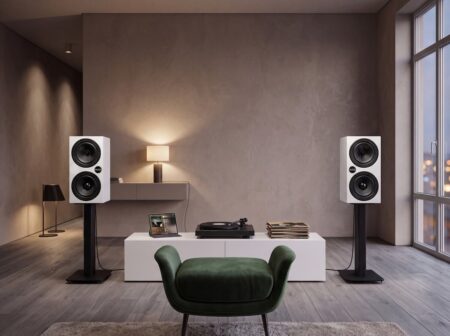
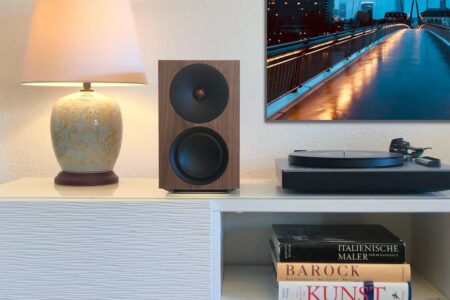
The new AE Active made an excellent impression right from the start with its cabinet. This British speaker, manufactured in China, clearly outperforms my own Acoustic Energy Radiance 2—which, at the time, was made in Malaysia—in this regard. The high-gloss white finish on the test pair has a deep, even appearance; the side edges are elegantly rounded, and the transitions are seamless. Acoustic Energy has neatly integrated the slit-shaped bass reflex port on the rear. Alternatively, the speaker is available in high-gloss black or with a natural walnut veneer. The price per pair is 1,500 euros. Given the four built-in power amplifiers and the quality of the craftsmanship, this is an exceptionally fair price.
At 31.2 centimeters tall, 18 centimeters wide, and 25 centimeters deep, the AE Active remains pleasantly compact. Each speaker, however, weighs a hefty 7.5 kilograms. The cabinet is made of 18-millimeter-thick MDF and is reinforced internally with bracing and damping elements. The slotted reflex port makes efficient use of the available width and is designed to reduce airflow noise. Because it radiates sound toward the rear, you should still leave some space between the speaker and the back wall or use the three-level bass adjustment.
The magnetically attached fabric grille requires no visible mounting pins and leaves the baffle looking pleasantly tidy once removed. The new, silicone-coated speaker frame surrounds also contribute to this. The small distance between the tweeter and the mid-woofer is striking. The closer their acoustic centers are to each other, the closer a two-way speaker approaches the ideal of a point source. This should result in stable, precise spatial imaging, especially at short to medium listening distances. Of course, only a listening test will reveal whether this expectation is met.


Sixth-Generation Metal Diaphragms
For the 12.5-centimeter low-midrange driver, Acoustic Energy draws on a design from the passive AE1 40th Anniversary Edition. Its ceramic-coated aluminum cone follows in the tradition of the metal cones that once made the brand famous. The manufacturer now refers to this as the sixth generation of this technology. The hard-anodized aluminum cone, formed using a metal stamping process, is designed to be particularly rigid yet lightweight. This is intended to allow it to move as piston-like as possible within its operating range, rather than deforming and generating its own partial vibrations. Whether this actually results in the promised speed and impulse response remains to be seen in a listening test.
A 2.7-centimeter aluminum dome tweeter is mounted above it. For the new AE Active, the tweeter features a redesigned rear chamber. It is designed to reduce distortion around the crossover frequency and, in particular, make voices sound more natural and less harsh. The dome is housed in a WDT waveguide. The acronym stands for Wide Dispersion Technology. The waveguide is designed to disperse high frequencies more widely while simultaneously focusing the tweeter’s lower frequency range more intensely. The goal is a more uniform dispersion pattern, in which less sound energy reaches the listener via early reflections from walls, the floor, and the ceiling.
Acoustic Energy specifies a frequency response range of 42 hertz to 28 kilohertz for the AE Active, but does not list a corresponding level tolerance in this data sheet. The drivers are powered by classic analog technology: Each driver is driven by a 50-watt Class A/B power amplifier, powered by a linear power supply. This means each speaker contains 100 watts, and the stereo pair features a total of four power amplifiers delivering a combined 200 watts. Acoustic Energy completely avoids digital signal processing. Even crossover and sound correction are handled purely analog.

Analog Connections Instead of a Complete Streaming Package
The connection panel is correspondingly uncluttered. Each speaker has an unbalanced RCA input and a balanced XLR jack. Acoustic Energy has upgraded the RCA connector compared to the previous model so that it works better with high-quality, sometimes quite bulky, audio cables. XLR is recommended especially for longer cable runs because the balanced signal transmission is less susceptible to interference. The user manual expressly prohibits using both inputs simultaneously.
In addition to two power cords, the package also includes two RCA cables, each three meters long. This allows a compatible preamp or streamer to be connected directly to both speakers. There is no pass-through option from one speaker to the other. This is consistent with the design, but when the speakers are placed far apart, it requires correspondingly long cable runs from the centrally located source to both sides.
Separate rear-panel controls allow you to adjust the level of each speaker from mute to 0 dB. If you’re using a source with a variable output, you’ll typically set both controls to the same value—ideally to maximum—and conveniently adjust the volume on the preamp or streamer. A source with a fixed line output can also be connected. In that case, however, you would have to adjust the volume on both speakers separately while ensuring they are perfectly synchronized. Finally, there is no remote control or app available.
Analog Purism

Two additional controls allow for moderate adjustment of bass and treble by plus or minus 2 dB each. The bass control is particularly helpful when the speakers are placed close to a wall, while the treble control can be used to compensate, within certain limits, for heavily dampened or rather reverberant rooms. This correction is part of the active analog circuitry and can therefore be used by purists without a guilty conscience. In practice, it’s significantly more useful than many dogmatic hi-fi enthusiasts would care to admit.
Ultimately, the AE Active proves to be more suitable for everyday use than its predecessor when it comes to power management. In “Auto” mode, the speakers switch to standby mode after 15 minutes without an input signal and wake up again when the input voltage reaches 24 millivolts. Alternatively, they can be left on continuously or completely disconnected from the power supply using the separate power switch. An LED integrated into the bezel below the low-midrange driver indicates the operating status with a white or red light.
This leaves only two questions to be answered for a modern, living-room-friendly system: Which compact source complements British analog purism with streaming, convenient volume control, and additional inputs? And does the AE Active deliver on the sonic promises made by its sophisticated technology and rich heritage? The first question was answered with surprising elegance. For the second, it had to prove itself in the listening room.
Acoustic Energy AE Active Review: The Art of Going Unnoticed
Rarely have I found it so difficult to describe the sound of a speaker. And I mean that as a huge compliment. When a speaker has rough edges, sharp corners, or distinct preferences, a reviewer can quickly find the words to describe its character. The AE Active makes it significantly harder: This small active speaker embodies neutrality in its purest form.
Of course, there is a certain range within which a speaker can still be described as neutral. Some speakers lean more toward the bright side, others toward the dark side of this narrow line between musical accuracy and coloration. Classic British speakers often tend toward a slightly warmer, softer sound, while traditional German designs sometimes come across as brighter and more analytical. The British model from Acoustic Energy, on the other hand, stays right in the middle with remarkable consistency.
That doesn’t mean, by any means, that it sounds dull, boring, or emotionless. On the contrary: With the AE Active, you can fully enjoy virtually any genre of music without having to constantly think about technical nuances, even during a listening test. Instead of drawing attention to individual frequency ranges or effects, it conveys the character of the recording itself.
“My Way” without being eccentric
Of course, we had to play the very track that kicked off this review: Sparks’ “When Do I Get to Sing ‘My Way’?” Russell Mael’s high-pitched voice, the synthetic pads, and the bouncy rhythm can quickly sound a bit strained through speakers tuned too brightly. The AE Active neither introduced any harshness nor softened the production’s characteristic edges. It didn’t come between me and the music—and precisely because of that, it captured its unique sound with great precision.
Ultimately, that’s the most accurate description of their greatest strength: you don’t hear them. At least not as speakers, and certainly not as a technical device standing between the listener and the recording. I ended up leaving the test pair playing while I wrote this review—no longer out of a sense of analytical duty, but simply because listening to music with them was so much fun.
With the AE Active, you can completely immerse yourself in the music and perceive the essence of a recording at both low and high volumes. When you add up its characteristics, you inevitably arrive at the primary virtues of a good studio monitor: high neutrality, fine resolution, level stability, and the ability to reveal differences between productions. At the same time, however, it avoids that cool detachment that sometimes gives the term “monitor” a somewhat unmusical connotation.
Finely resolved, but never harsh
The AE Active delivered particularly impressive high-frequency performance. The aluminum dome dome reproduced sound with fine resolution without emphasizing details with artificial brilliance. Even at higher volumes, the sound remained smooth. In Mahler’s Symphony No. 2, conducted by Iván Fischer and performed by the Budapest Festival Orchestra, the strings, woodwinds, and brass remained clearly distinguishable from one another even during the grand crescendos. The small speaker maintained a sense of cohesion without breaking the music down into separate parts.
Even the famous guitar solo in Dire Straits’ “Money for Nothing” had the necessary bite and stood out dynamically from the arrangement. However, the AE Active didn’t turn this into a showcase for its metal diaphragms. Cymbals shimmered delicately and lingered, guitars had energy, and vocals retained their natural presence—only a bothersome technical signature was absent.
When it comes to the bass, control and punch are key
If there was one characteristic that stood out—even before the inevitable comparison with my own high-end system—it was the bass. Even at low volumes, the AE Active delivered an astonishingly powerful punch thanks to its active technology. Low frequencies sounded tight, cleanly defined, and rhythmically precise.
With Yello’s “The Expert,” she let the electronic bass pulses bounce with a dry, precise quality. In my very large living room with sloped ceilings and bass-absorbing drywall, however, she didn’t reach particularly deep. The lowest frequency range lacked the substance one might initially expect given the otherwise confident performance. In a smaller, rectangular room or in the near field of a studio, this issue would likely be much less noticeable. There, the controlled tuning might even be just right and help avoid problematic rumble.
A somewhat unfair family comparison
The biggest difference compared to my own system was in the bass. The Acoustic Energy Radiance 2s—which are a good three times as large—are passive 2.5-way floorstanding speakers with dual woofers. Combined with the external bi-amping electronics from Naim and Phonosophie, they delivered a more explosive punch, greater depth, and noticeably more substance. Given their size, the effort that went into them, and their price, anything less would have been quite a surprise.
What was truly remarkable, however, was what happened when I switched back. As much as I appreciate my Radiance 2, immediately after listening to the exemplary balance of the AE Active, the large floorstanding speakers sounded almost a little harsher and cooler. On its own, I would hardly have noticed this tendency. The direct comparison, however, showed just how steadfastly the small active speaker maintains its tonal balance.
Even in terms of spatial imaging, the significantly more affordable active solution was by no means outclassed. Both Acoustic Energy models produce a wide, stable, and cohesive soundstage, but they tend to position individual sound sources more as a broad plane rather than isolating voices and instruments from the space with surgical precision. In this respect, a certain family resemblance is certainly evident.
In Tori Amos’s rendition of “Swimming Pools” on Trevor Horn’s album “Echoes: Ancient & Modern,” her voice sounded authentic and floated freely between the speakers. Reverberation and subtle background sounds remained clearly discernible, without the singer appearing as an overly three-dimensional sound hologram in front of the speakers. Those seeking a maximally physical, deeply layered soundstage will find speakers elsewhere that are more heavily engineered to produce this effect. The AE Active, on the other hand, prioritizes homogeneity and long-term reliability.
Minimalist streaming via Bluetooth
The real limitations of the AE Active aren’t in the sound, but in connectivity. It’s one of the few modern active speakers that doesn’t even have digital inputs. Bluetooth and USB—as found on the Cambridge Audio L/R S —are missing, as is the full network streaming capability of a Cambridge Audio L/R X. Acoustic Energy essentially delivers an analog active monitor—the owner must provide the source themselves.
In addition to traditional playback devices like CD players and turntables, I therefore opted for a solution that’s as minimalist as it is smart—and one that pairs perfectly with the AE Active: the Audioengine B1, tuned by Phonosophie. I had already tested this small Bluetooth receiver years ago for my friends at HiFi-IFAs, and I still enjoy using it on my own system to this day.
When connected directly to the AE Active speakers via RCA cables, the result is an amazingly compact hi-fi system. The smartphone and B1 handle source selection and volume control, while the two speakers require only power and the analog music signal. In my case, the music came from our streaming partner Qobuz, which offers recordings at up to 24-bit and 192 kilohertz. Naturally, this resolution isn’t achieved natively via the Bluetooth connection. Nevertheless, the combination sounded surprisingly mature, clean, and musical.
This solution is nearly perfect for casual background listening. But even when listening intently, it already conveys much of what sets the AE Active apart. If you want to unlock its full potential, you can always add a high-quality streamer or DAC with an adjustable output later on. An affordable streaming preamp like the WiiM Ultra (MSRP 439 euros), for example, would also be a great option for this.
Conclusion and Alternatives to the Acoustic Energy AE Active
The bottom line is that the Acoustic Energy AE Active is an exemplary neutral speaker that’s well-suited to virtually all genres of music. It delivers finely detailed sound, is comfortable to listen to for long periods, and remains free of harshness even at higher volumes. At the same time, it remains compact, is superbly built, and—considering its built-in amplifier technology—is surprisingly affordable.
The only real limitations stem from the purely analog connectivity and—at least in very large rooms that absorb bass—the lack of absolute depth. Its most important virtue, however, can be summed up in a single sentence: The AE Active doesn’t sound like a speaker. It simply lets the music play. Anyone who really just wants to stream using two speakers and a smartphone—or who values multi-room functionality—will find the Cambridge Audio L/R X A versatile alternative equipped with a sophisticated streaming engine. Although it costs 500 euros more according to the price list, it doesn’t require any additional electronics. And with its down-firing woofer and passive radiators on both sides, it can fill even larger rooms with a solid bass foundation.
More alternatives in our STEREO GUIDE Hi-Fi Top Picks
Technical Specifications: Acoustic Energy AE Active
- Manufacturer’s suggested retail price: 1,500 euros
- Dimensions (W x H x D): 18 x 31.2 x 25 cm
- Weight: 7,5 kg
- Colors: Walnut wood veneer, high-gloss black, and high-gloss white
- Special features: RCA, XLR, bass/treble control ±2, fabric covers with magnetic mounts
- For more information, visit: https://acoustic-energy.de