STEREO GUIDE test verdict
In our test, the WiiM Sound proved to be a smart streaming speaker with practical AI RoomFit calibration, a voice remote, high-resolution streaming, and a surprisingly mature—though not audiophile-grade—sound.
Pros
- Balanced sound for all genres of music
- Excellent room calibration
- Excellent app for multi-room and multi-channel
- Top-notch controls with voice remote and touchscreen
Cons
- Apple users are likely to miss AirPlay
- A bit thin; the bass isn't quite as rich
-
Tonal balance / transparency8.4
-
Bass / Dynamics7.8
-
Usability / Connectivity9.7
-
Price/Performance9
With streaming devices like the WiiM Pro, the WiiM Amp, and most recently the WiiM Ultra, WiiM has evolved in an astonishingly short time from an insider’s secret to a major player in the affordable streaming market. Now, with the WiiM Sound, the brand is introducing its first fully integrated smart speaker. And within just a few minutes, it’s clear that WiiM has done its homework.
Intuitive Controls and an Exceptionally Beautiful Display
Visually, the WiiM Sound stands out pleasantly from the usual monotony of many streaming speakers. The compact enclosure feels high-quality and combines soft curves with a pleasantly minimalist design. Particularly well-designed: the controls on the top.
That’s because the sensor buttons remain hidden at first and are only gently illuminated by a proximity sensor as soon as a hand approaches. This looks surprisingly elegant and avoids having control panels that stay lit all the time in the living room.


The real eye-catcher, however, is the round front display. In standby mode, it displays a clock whose design can be customized in the WiiM Home app. During music playback, a circular section of the respective album cover appears instead. That may sound like a small detail, but it gives the speaker a tremendous amount of character and charm.

Exemplary Setup with AI Calibration
The WiiM Sound really stood out during setup. Integrating it into the network is remarkably straightforward, and existing WiiM devices are recognized immediately. Anyone already using products like the WiiM Pro or Amp will feel right at home.
A real highlight, however, is the new AI RoomFit technology. Unlike many competitors, WiiM doesn’t require a built-in measurement microphone in the speaker itself. Instead, automatic calibration is conveniently performed via a smartphone at the listening position. The app analyzes the room and then automatically adjusts the sound to match the speaker’s placement and the room’s acoustics.
This can make an audible difference, especially with compact speakers, which are often placed on sideboards, shelves, or in smaller rooms. WiiM takes a refreshingly pragmatic approach, avoiding a high-end obsession with measurements and instead focusing on optimization for everyday use in typical living spaces.


Modern streaming equipment, including a voice remote
The WiiM Sound also boasts an impressively comprehensive set of features. However, AirPlay is missing. Anyone who wants to stream Apple Music directly from the iPhone app to the speaker will have to use Bluetooth instead. Supported features include Chromecast, Spotify Connect, TIDAL Connect, Qobuz Connect, DLNA, and Alexa Cast. Network connectivity is provided via Wi-Fi or Ethernet, and WiiM also features Bluetooth 5.3 with LE Audio.
What’s especially nice: Despite all the app features, control isn’t limited to your smartphone. That’s because the new WiiM Voice Remote 2 Lite is included in the package. The remote control not only offers standard control functions but also includes voice control for Alexa. Especially in everyday life, this is often much more convenient than having to constantly unlock your smartphone.
The range of connectivity options is also impressively comprehensive. In addition to Wi-Fi and Bluetooth, the WiiM Sound also features a 3.5-mm analog input. This makes it easy to connect devices such as turntables with a phono preamp, portable media players, or televisions.
Compact design with 100 watts of power
Inside, a 4-inch (10.2 cm) long-throw woofer works in tandem with two dome tweeters, each 2.5 centimeters in diameter. WiiM specifies a maximum output power of 100 watts total. It supports high-resolution audio streams up to 24-bit / 192 kHz.
Flexibly expandable up to a Dolby 5.1 system
It’s also exciting to see just how flexibly the WiiM Sound can be integrated into the existing WiiM ecosystem. If you already own WiiM components, you can not only use the speaker as a single unit in the traditional way, but also combine two units to create a true stereo pair. The spatial soundstage in particular should benefit significantly from this, as the compact speaker already delivered a surprisingly wide soundstage when used on its own.
In addition, WiiM even supports the setup of a wireless Dolby 5.1 system. When combined with other WiiM components—such as the WiiM Amp, Ultra, or additional speakers—you can gradually build a complete streaming and home theater setup. It is precisely this modular approach that increasingly sets WiiM apart from many traditional smart speaker manufacturers, whose systems often operate in a much more closed manner.


This Is What the WiiM Sounds Like
In the listening test, the compact speaker demonstrated a pleasantly balanced sound overall. Fortunately, the WiiM avoids the exaggerated “bathtub” sound found in many lifestyle speakers and instead offers a more mature sound profile.
Vocals came through clean and clear, though they weren’t entirely free of slight harshness. For example, Michael Stipe’s voice on R.E.M.’s “Country Feedback” took on a slightly rough, minimally sibilant quality. Tori Amos also sounded a bit muffled at times. The mids occasionally had a slightly tinny quality, though without ever becoming truly unpleasant.
The bass and treble, on the other hand, were pleasantly balanced. The bass extends surprisingly low for such a compact design and remains controlled enough not to drown out voices. At the same time, the WiiM avoids the artificially inflated lower bass that is common in many smart speakers of this size.
The spatial presentation was also interesting. While the WiiM Sound already performed quite well in the near field, it audibly improved as soon as you moved a little further away from the speaker. The sound then spread much more evenly throughout the room, the soundstage seemed larger, and the overall playback felt more relaxed and balanced. That’s why the speaker performed better on a sideboard or placed freely in the room than as a traditional desktop monitor.
Conclusion and Alternatives: WiiM Sound
With the WiiM Sound, WiiM has made a surprisingly polished entry into the smart speaker market. In particular, the exemplary setup, the clever AI calibration via smartphone, the exceptionally beautiful display, and the well-designed Voice Remote set this speaker apart from many of its competitors.
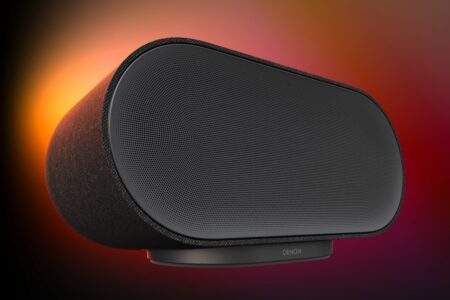
In terms of sound quality, the slightly rough midrange reproduction does prevent it from being a true audiophile standout. Overall, however, the WiiM Sound combines modern streaming technology, flexible features, and a pleasantly mature sound to make it one of the most interesting smart speakers in its class. Conceptually, it’s similar to the Denon Home 200 in terms of driver design and is also priced at a comparable level. In terms of balance, however, it is slightly superior, while the Denon delivers more authority in the lower frequencies. Furthermore, the Japanese model has the larger HEOS ecosystem behind it, which is supported by numerous audio components from brands such as Marantz and Classé.
WiiM Sound Technical Specifications
- Manufacturer’s suggested retail price: 350 euros (each)
- Dimensions (W x H x D): 14.6 × 19.3 × 14.6 cm
- Weight: 2,5 kg
- Special Features: Wi-Fi, Bluetooth 5.3 LE Audio (SBC, AAC), analog input, closed-back design, supports Chromecast, Spotify Connect, TIDAL Connect, Qobuz Connect, DLNA, and Alexa Cast, stereo pairing
- More at www.audiotra.de