STEREO GUIDE verdict
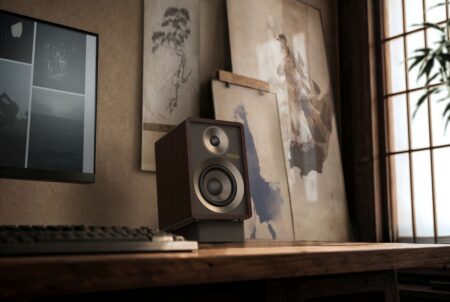
As slim and sleek as the Backes&Müller Jubilé IO may seem, this compact active speaker from the Saar region is a dynamic marvel with impressive bass.
Pros
- Dynamik und Bass-Qualität, wie sie manche riesige Standbox nicht hinbekommt
- Parametric digital equalizer for precise room correction
- It looks really stylish, especially with the Z tripods
- Still works well even in a reverberant environment
Cons
- The goal is to turn the volume up so loud that it's bad for domestic harmony
-
Tonal balance / Transparency9.8
-
Bass / Dynamics9.9
-
Spatial imaging9.7
-
Usability / Connectivity9.2
-
Price/Performance9.5
High-end is when it’s big, expensive and old-fashioned. We at STEREO GUIDE like to remind ourselves of this when we are offered high-end components for testing and politely decline. But how did it come about that we made an exception to this test philosophy for a pair of compact loudspeakers such as the new B&M Jubilé IO with a price tag of 20,000 euros? Well, sometimes a concept just sounds too convincing not to be tried out.
Because the pair of rather inconspicuously designed bookshelf loudspeakers contain a sophisticated acoustic concept. We were first blown away by the sound at the HIGH END 2024, so much so that we returned to the B&M room several times. The largest speaker we played there, the BMLine 60, was one of the absolute best we’ve ever heard at a trade fair in terms of impulse processing, punchy bass and fun factor with no regrets. But it was also a man-sized speaker with a price tag well into the six-figure range. So really nothing for STEREO GUIDE.

“No problem,” Andreas Kühn from the B&M base in Kornwestheim near Stuttgart told us after the trade fair. The smallest speaker in the portfolio is said to have similar qualities and to bring the same responsive directness and perfect timing into the living room as the XXL horn. At the same time, the two columns, which are less than 20 centimeters slim, should be able to compete dynamically with any floorstanding speaker. The Americans would call this a “bold claim”. But it made us so curious that we really wanted to test the system
Slim instead of cabinet boxes for the living room
From a distance, the B&M Jubilé IO doesn’t look much different from other compact loudspeakers. However, the acoustic concept, in particular the way in which the sculpture, which is only 19 centimeters narrow, emits sound, is said to be unique on the market.
The basic problem is well known to us from years of testing high-end loudspeakers: They often sound outstanding in a well-damped listening room, but often sound terrible in rooms with minimalist furnishings. The further away you sit as a listener, the more the reflected sound in the living room spoils the sound and makes it muddy, hissy, slow and noisy.
Until now, only massive XXL loudspeakers have been able to counteract this. Horns, line array speakers, panel speakers and the like ensure that much more sound is emitted towards the listening zone on the sofa and much less into the room.
A musical kind of line fee
The B&M Jubilé IO therefore features a central cylindrical wave radiator. It directs the mid-high frequency sound quite narrowly vertically to the desired listening zone, and significantly wider horizontally. B&M have patented this principle, which was previously only used in the company’s very expensive and extremely large models. Behind it is a pressure chamber driver, as known from conventional horns, but unlike typical horns, the sound is only directed vertically, without the typical horn sound.
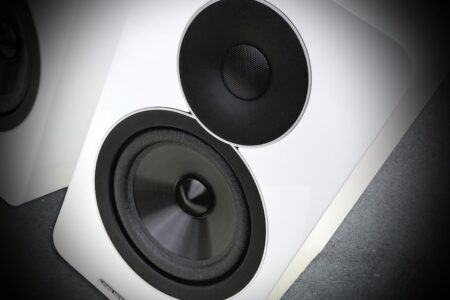
Above and below this magic slit, B&M also install two basic drivers. Due to their distance from each other, these should provide a similar directional effect to the line array. According to chief developer Johannes Siegler, nothing is worse than a sudden, audible break in the radiation pattern. These two classic drivers are a little hidden and could probably also produce real bass, but B&M only use them in the upper bass and lower mid-range in favor of higher reserves.

Control is “wetter”
For proper bass, the Saarland-based company relies on the most powerful speaker we have ever tested at STEREO GUIDE: a 30-centimeter woofer. One of these sits on each side of the much narrower speaker and remains concealed behind a white fabric cover.
However, the manufacturer is expressly not interested in sheer bass pressure, but in the best bass impulses and control. The powerful chassis is installed in a closed housing and does not require bass reflex support. This trick and active control via a motion sensor should result in perfect impulse processing and dry bass.
Acoustically, this makes sense in two ways: on the one hand, the mid-high range of the smallest B&M – this much can be anticipated from the listening test – already sounds quite direct and subjectively “fast”, a wobbly, boomy bass would not fit in any way. On the other hand, both technologies aim to perform as well as possible on a shelf or lowboard in typical living rooms. And in such problematic locations, only a closed, bone-dry bass can sound clean and musical.

Fully digital with a connection to the old world
The connection panel on the back of the slim beauty seemed rather minimalist to us. According to the manufacturer, the full range of streaming functions and protocols were deliberately omitted to make the speaker future-proof. A preamplifier or streamer is therefore mandatory as a player, whereby the owner can choose between analog, digital and B&M-exclusive input signals.
The latter is called “B&M Easy Link” and is a transmission technology that delivers unaltered digital music signals plus volume information plus DSP control from a digital B&M preamp from the ICE series to the loudspeaker via network cables of any length and fairly inconspicuous. Just the thing for high-end purists, because the digital signal is not altered, not even in terms of volume or word width.
Those with a pragmatic hi-fi approach can also simply connect a network streamer or preamplifier with a high-quality regulated output. We really liked the Cambridge Audio CXN100 (€1,050) in the test, not only because of the very sophisticated app control, but also because it can handle anything that streams.
Switch control
However, this also means that all signals have to be digitized once again by the electronics in the Backes&Müller. The entire processing is done digitally, using very special filters, as B&M is proud to point out: these digital crossovers and equalizers, programmed using so-called FIR technology, work completely in time and allow phase and amplitude to be perfected separately. This means that the 3-way loudspeaker is not only more time-correct than any full-range speaker could ever be: The deepest bass, the mids and the highest treble reach the listener’s ear simultaneously in the microsecond range.
The second powerful advantage of this technology is that perfect room adaptation is also built into every B&M model. You can set parametric filters to adapt to the positioning or the room or your own listening tastes without negatively affecting the phase of the sound. Or you can have it adjusted, as every B&M dealer offers the service of individual adjustment to your own listening room with feedback from the listener on how the system should sound. A service that we can only recommend to everyone and that goes far beyond the usual automatic measurements.

This is what the Backes&Müller Jubilé IO sounds like
If there is one thing that has stuck in my mind from over 35 years of listening to loudspeaker sets, it is the direct, engaging musicality of the best dynamic specimens that I have heard over the years. Whether large multi-way horns, line sources, flat radiators or full range drivers – many of them delivered a directness, timing and energy in the music that often makes conventional loudspeakers seem boring.
When I first heard the B&M Jubilé IO, I thought of all this. And at the same time asked myself why, despite numerous opportunities, I had never bought such a bundle of energy in loudspeakers for my private use. (Not to mention my noise-sensitive neighbors). Too discolored, too difficult to set up, too big were probably the main arguments.
Well, none of this applies to the smallest B&M. Nevertheless, it has succeeded in more than just playing along in the ranks of these XXL loudspeakers. The discrepancy between the huge sound and the inconspicuous appearance has to be reconciled by your own brain. Anyone who has ever listened to a demo with fake floorstanding speakers and then found out that the sound came from small cubes will be familiar with the phenomenon that takes the B&M to a new level.
Horn-Westheim
Because from a distance in the large demo room at B&M in Kornwestheim near Stuttgart, the compact columns looked very narrow, almost a little lost in the room. But the listening impression is in stark contrast to this: the B&M Jubilé IO played to us with a directness, drive and thrust that could easily have been placed there as decoration. You might have recognized the Jubilé IO only by the fact that it doesn’t sound like a horn at all. Free of coloration, very free and detailed, just as fast and transparent in the mids as in the highs.
In addition, the bass is probably the best in the world for compact loudspeakers: abysmally deep, dry as dust and precise, yet musically very well integrated and completely relaxed even with pumping impulses Anyone who has ever started listening to electronically generated but acoustic-sounding beats such as Daft Punk’s “Random Access Memory” or Parcel’s “Day/Night” via a B&M will buy an active loudspeaker like this. The addiction factor is unbelievable, and after that all other speakers sound either boring or soft to boomy in the bass.
Well, the controlled active loudspeakers have been known for precise bass for decades. Compared to the “old B&M sound” as I knew it from the 1980s, the low-frequency character has at best shifted towards a richer and more musical character. But what about the mid-high range? I have to admit that I didn’t like the overly detailed to unsubtle high-frequency reproduction of many B&M models 40 years ago.
Listen for yourself with our listening test playlist on Qobuz
The Jubilé IO has nothing to do with this. Yes, it also has a precise high-frequency reproduction, it delivers many details, it also reveals what is in a recording. But it does so in a vivid, not at all annoying, but rather charming way. And with a dash of warmth in the fundamental tone that can be adjusted to taste via the digital parametric equalizer, as well as a broad, three-dimensional space.
This is also the real kicker of this compact active speaker: Its room has a captivating three-dimensionality, while being huge in width, natural in depth and completely stable in accuracy. Whether you prefer rock, jazz or classical music, everything is in front of you as if recorded in a studio or concert hall. Unwashed, unadulterated, dynamic and direct.
We can reassure anyone who is now concerned that this is only the case in the perfect listening position in the middle: The sweet spot, i.e. the angular range in which the music can be heard without distortion, tends to be wider with the Jubilé IO than with conventional speakers. If you’re not standing directly in front of the speaker, outside the dispersion range of the line array, or listening to music behind it, it can even cover entire living rooms evenly. Not only tonally balanced and even, but also with an amazing illusion of space. Only the outstanding positioning accuracy suffers noticeably if you leave the center.


She came from the Saar and won
So we spent a few more hours listening to the test program and also our personal favourite music, which many would probably not describe as audiophile… As far as I’m concerned, as long as I don’t have to be considerate of my neighbors, I prefer speakers with outstanding dynamic qualities, because that’s exactly what makes live music so appealing to me, which I prefer to enjoy in smaller halls, especially in Stuttgart’s Bix jazz club. As far as tonality is concerned, I’m quite generous once a certain level of balance has been reached, when things really get going. And in Kornwestheim, things really got going.
My old motto that you need speakers with bass drivers with a diameter of 30 centimeters or more for really authentic drums proved true once again, especially in the bass. It simply sounds more real than the same cone area distributed over several small drivers. But because of living room trends, such bass behemoths are now almost extinct. And if you do find a speaker with an official woofer, it’s a huge cabinet for the price of a mid-range sedan.
I find it truly remarkable that, after ages, I should once again encounter one of these full-size drivers in 12-inch format when testing a compact speaker. Together with the dynamic capabilities, this really was a very special highlight in the continuous test routine. And at the end of the listening test, there was a round of home theater, where the IOs were supported by other B&M speakers, but also managed without a subwoofer in the action genre. Respect.

Test result: Backes&Müller Jubilé IO
We can quickly answer the question about alternatives to the B&M Jubilé IO: there are none. We are not aware of any narrow compact loudspeakers from any manufacturer that can produce dynamic fireworks of this quality and fire up the energy content of any music in this way. On the other hand, we were also impressed by the concept of the line array. As a listener, you can sit quite far away from the speakers and move freely horizontally. Despite this, the full fun factor of the music, its jumping directness and simply perfect bass are retained.
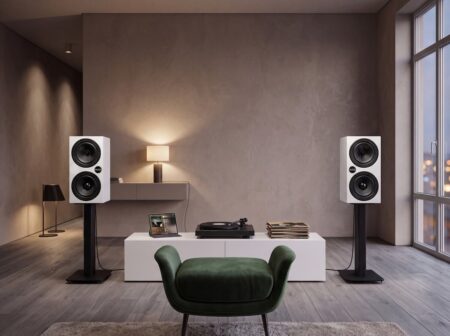
When listening to the Jubilé IO, we thought of many living rooms – mostly large, minimalistically furnished and inhabited by solvent contemporaries – in which the Jubilé IO might be the only compact speaker that plays there at all. So for anyone who has always had acoustic problems with the room, be it booming, hissing or muddy reverberation, the smallest B&M is the best choice from our point of view. And if, like me, you also value a certain aesthetic, a slim compact speaker with a very sleek Z-shaped stand and a small, affordable streamer like the Cambridge CXN100 can replace an entire stereo system, which takes up an entire wall in my home and is banned from playing after 10 p.m. at the latest.
More alternatives in our STEREO GUIDE Hi-Fi Top Picks list
Technical data Backes&Müller Jubilé IO
- Manufacturer’s recommended retail price: 19,990 euros
- Dimensions (W x H x D): 20 x 47 x 52 cm
- Weight: 27 kg (per box)
- Special features: Analog, digital (AES/EBU), BMEasyLink, line sound source, room calibration with built-in DSP and equalizer control unit
- More at backesmueller.de