STEREO GUIDE verdict
The Fostex TH900 Mk2 met the Pearl White Limited Edition of the TH900 Mk2 in the review. With the same enthusiasm for the game, there were small differences that were decisive for some.
Pros
- enormously deep and differentiated bass reproduction
- Very good transparency, especially for closed headphones
- excellent finish, high-quality connection cable
- Stand included in the scope of delivery
- Low impedance for high efficiency
Cons
- Not suitable for mobile use despite low impedance
- Only equipped with 6.35 mm jack
-
Sound: tonal balance / transparency9.3
-
Sound: Bass / Dynamics9.8
-
Practice / Connectivity8.3
-
Price/Performance9.2
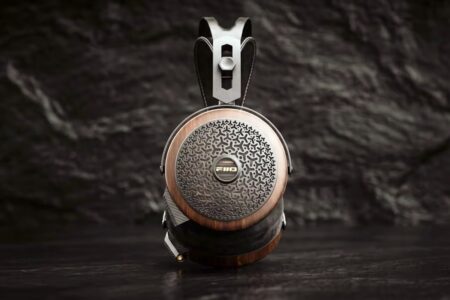
One of the few brands that effortlessly – and successfully – walks between the worlds of each market belongs to Fostex. While in hi-fi circles it is mainly the full-range drivers and loudspeaker chassis that are known, among studio professionals the monitoring loudspeakers and headphones are a bank. With the new Fostex TH 900 Mk2, the Japanese company is launching a product on the market that moves just as effortlessly between the two worlds: The closed-back headphones with the large, metallic red lacquered shells are suitable both as high-end converters and as studio standards – as long as the professionals are prepared to pay a little more for fine ingredients.


The cases are made of Japanese ornamental cherry birch. And this is done even for acoustic reasons, because this wood provides the best possible stiffness and homogeneous density. And the TH900Mk2, like the Fostex TH 900 Mk2 Pearl White Limited Edition used for comparison, is a closed model in which the diaphragm plays on the back of a corresponding volume in the housing shell. The closed construction of the over-ear also provided the best bass reproduction in the review.
The glittering paint on the outside originates from an old Japanese painting technique called “Urushi”. You have to think of it as a natural resin-based, Japanese perfectionist-inspired version of piano lacquer. In the Fostex TH900Mk2, the reflection and color experience is enhanced by incorporating silver foils in the ongoing painting and polishing process.
Nature miracle in red lacquer
Fostex also relies on nature for the functionally crucial parts of the transducer: the membrane of the 50 mm driver is made of a biocellulose. And yet it differs greatly from the usual cardboard or wood-fiber diaphragms we know from loudspeakers. The manufacturer optimized its “Biodynamic” compound with a high modulus of elasticity at a low specific weight for a high propagation speed of the waves and, at the same time, much higher stiffness than usual.
In order not to have to give away the weight advantage again by a massive voice coil, this was wound thinner than usual. A particularly strong neodymium magnet with 1.5 Tesla (not to be confused with the car also named after Nicola Tesla!) provides for compensation in the power generation.
The ear pad is intentionally not made of natural products: It feels almost like leather, but is made of protein leather based on eggshell membranes. Thus the animal protection is served, vegan headphones remain nevertheless outside.


Cable choice
The detachable cable is made of high-purity copper of the 7N OFC class, i.e. with a purity to seven decimal places. If desired, a balanced cable of identical purity is available as an accessory, but it allows firing with appropriately equipped preamplifiers.
This is how the noble Japanese sounds
The least surprising thing about such a lavish closed over-ear is the bass response. Here, the Fostex not only fulfilled expectations, it even exceeded them. He produced a very deep, yet contoured bass foundation. With titles like “Africa” from the live album “XX” by the band Toto or“Unputdownable” by Roisin Murphy, one could savor the fun of the bass with drums respectively electronic beats as it is only possible with a few headphones.
On the other hand, the very good transparency and the feeling of spatial depth provided an extremely positive surprise. These two criteria are usually reciprocally related to the ability to reproduce deep bass in closed headphones. These are the two sides of the coin when it comes to closed construction. If such a construction nevertheless succeeds in resolving the midrange, which is important for natural listening, as finely as in the case of the TH900 MK2, then that speaks for correspondingly high effort in the design of the housing, pads and drivers. This is where the developers from Fostex let their huge wealth of experience shine. And also the treble reproduction seemed very fresh and for a closed cabinet also very open.


Fostex TH900 MK2 vs Fostex TH900 MK2 Pearl White Limited Edition
However, in addition to the TH900 MK2, there is also the Pearl White Limited Edition of the Fostex handset. This differs from the standard version not only in its fresh, pearly white look. According to the manufacturer, it also has a slightly different tuning. Of this announcement STEREO GUIDE could make itself a picture in the sound test, because the Fostex TH900 MK2 Pearl White Limited Edition was likewise to our HiFi magazine at the disposal. First, an extremely practical common feature with the base version stood out. Although the two Fostex over-ears are typical products for the home due to their large dimensions, comparatively high weight and because of the sensitivity of the noble wood surfaces. But with their high sensitivity thanks to low connection impedance, they basically do not place high demands on the amplifier’s headphone output.
Playfulness as a unifying element
To prevent misunderstandings: Of course, it is best to use a high-quality headphone amplifier to catch all the subtleties of the noble over-ears. However, even at the headphone output of an average hi-fi integrated amplifier, which is converted via amplifier IC, both the Fostex TH900 MK2 and the TH900 MK2 Limited Edition produced a handsome level with decent liveliness. The switch to a dedicated headphone amp like the Aune BU2 was particularly beneficial for the latter, because its more powerfully tuned bass in the lowest octaves gained even more contour compared to the Special Edition, which was slightly slimmer and more finely tuned in the treble. Unfortunately, you need a full-size jack adapter to operate on Aune’s mobile headphone DAC, unless you want to swap out the whole expensive cable.
Depending on the drive used, the two fine twins revealed a tendency towards the lighter side of what would be called neutral tuning. This can be unflattering for the corresponding music production in the case of less successful recordings, but it can cause rapture especially for classical music fans with audiophile recordings.
Test conclusion and alternatives to the Fostex TH900 Mk2
Closed, passive over-ears are not as common in the high-end class as open models. However, we always recommend a test listening, because the individual sound perception of over-ears is very different. In our experience, recommended models in this class are the Beyerdynamic T5 (Mk2), the Focal Celestee and the Sennheiser HD 820.
As for the choice between the standard Fostex TH900 MK2 and the Pearl White Limited Edition, regardless of the rather subtle differences in bass and treble, it becomes a decision of personal taste: if you can’t get enough of rich beats, we suggest the red glossy standard version. And for those who like it a bit crisper at the bottom and a bit more filigree at the top, the glossy white version is more recommended. But the bottom line is that both play on a comparable level and the question of taste is thus reminiscent of the choice between red or white wine.
Technical specifications Fostex TH900 Mk2
- Manufacturer’s suggested retail price: 1,940/1,990 euros (Pearl White Limited Edition)
- Type: Over-ear, closed
- Transducer principle: Dynamic
- Weight: 390 g
- Special features: Wooden cabinets