STEREO GUIDE verdict
The Technics EAH-AZ100 features new drivers, better ANC, longer battery life and head tracking. In the review, it shows clear progress compared to the EAH-AZ80 - especially in terms of sound and spatial reproduction.
Pros
- Very powerful, kicking bass
- Natural voice reproduction and fine resolution
- Dolby Atmos Spatial Audio and Head Tracking
- Useful functions such as measurement to find the right ear adapter
Cons
- Dolby Atmos and Head Tracking settings somewhat awkward to access
-
Tonal balance / transparency9.3
-
Bass / Dynamics9.6
-
Usability/ Connectivity9.1
-
Price/Performance9.4
The Technics EAH-AZ100 was launched at the beginning of 2025 as the successor to the EAH-AZ80. The Panasonic subsidiary developed new drivers and introduced two exciting new features in the form of Dolby Atmos and head tracking. According to the list, the in-ears, which are available for 300 euros, are thus positioned as a challenger to the popular Apple AirPods Pro 3, which, as is rarely the case with Apple, actually represent the cheaper offer in this case. However, this also speaks to the Japanese company’s healthy self-confidence. As far as the competition from Sony is concerned, however, the official recommended retail price of the EAH-AZ100 is 20 euros lower, even though the Bluetooth earbuds have two strong arguments in favor of the WF-1000XM5, which we reviewed in 2023, with their head tracking and Dolby Atmos.

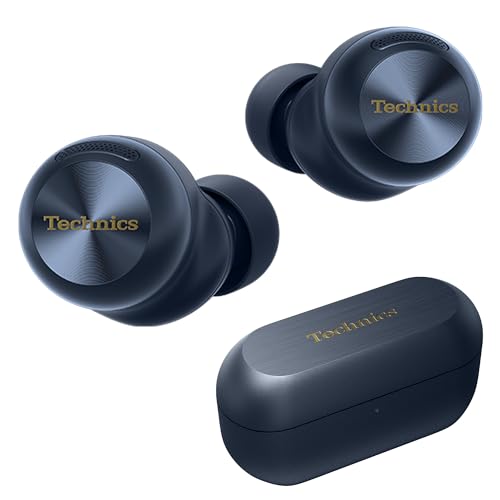

And these new features are not the only improvements that the new in-ears from Technics bring to the table. The Japanese company has also developed completely redesigned drivers for the in-ears, which are available in midnight blue, silver, black or champagne. Instead of relying on the previous 10 mm aluminum diaphragm of the AZ80, the new model uses a lighter and stiffer diaphragm. The move is audibly aimed at more directness in the mid-range and cleaner bass control. With the AZ80, the bass was powerful but occasionally a little soft. The AZ100 appears more structured and traces contours more clearly without losing its silky basic character. The new True Wireless in-ears resolve the higher frequencies more finely, which noticeably benefits voices and acoustic instruments.

Technics also relies on Magnetic Fluid for the drivers of the new in-ears: this refers to a special magnetic fluid that is used in the driver. It is located in the air gap of the magnet and fulfills several tasks at once: It cools the voice coil, dampens unwanted vibrations and stabilizes the movement of the diaphragm. The result is more precise control, less distortion and a clean sound even at higher levels.
With the acoustic control chamber, Technics specifically optimizes the air movement behind the driver. This chamber acts as a defined resonance chamber that dissipates the rear sound in a controlled manner and reduces standing waves. As a result, the driver works more evenly across its entire frequency range. This improves precision, particularly in the bass and fundamental frequencies, while the mid-range gains clarity. At the same time, the control chamber helps to minimize distortion at higher levels.
A ring to control them
The so-called harmonizer ring is a finely tuned component in the driver environment that specifically controls resonances. It acts like a mechanical stabilizer that is intended to smooth out unwanted peaks in the high and upper mid-range. In this way, the developers want to prevent certain frequencies from becoming too prominent or appearing sharp. The result of the harmonizer ring and control chamber is a controlled, balanced sound that remains stable even at higher volumes and is less susceptible to harshness or impurities.


The EAH-AZ100 can establish a multipoint connection to three different devices simultaneously. Technics relies on Bluetooth 5.3 with the codecs SBC, AAC, LDAC, LC3. The Japanese company does not use aptX or aptX-HD.


New features and fine-tuned operation
Technics has made several small but useful improvements to the EAH-AZ100’s range of functions. The adaptive noise suppression reacts faster and can be adjusted in finer steps. Voice quality during phone calls benefits from a revised microphone array that better detects and filters out background noise. Technics relies on a function called Voice Focus AI, which is designed to significantly improve voice quality during phone calls and video conferences.
An AI-supported algorithm continuously analyzes the incoming signal from three microphones per side and specifically separates the human voice from ambient noise. Sources of interference such as wind, traffic noise or voices in the background are effectively reduced, while your own voice remains clear and intelligible in the foreground. Unlike simple noise reduction solutions, the voice transmission does not appear artificial or cut off, but natural and stable.
App updated
The app controls have also been streamlined: settings such as ANC intensity, ambient sound or sound profiles are now more directly accessible in the Technics Audio Connect app for iOS and Android. Nothing revolutionary, but enough fine-tuning to make the user experience more rounded than with the AZ80.
However, there is one exception: the Japanese developers have hidden the much-advertised spatial audio function optimized for Dolby Atmos, including head tracking, deep in the settings. On the overview page, you don’t even notice it. And even in the settings hidden by a cogwheel symbol, you have to scroll down to discover the “Spatial sound” menu responsible for this. Head tracking is designed to make it possible to listen as if you were at a concert or at least in front of stereo speakers and prevent the stage from moving when you turn your head.
Battery capacity and runtime: small gains in the right place
Technics has moderately increased the battery capacity of the EAH-AZ100. This does not lead to spectacular leaps, but to noticeable gains in everyday use. While the AZ80 usually lasted between six and seven hours in realistic mixed mode, the AZ100 adds around an hour. With ANC activated, the difference is somewhat smaller, but still measurable. The charging case also stores a little more energy. For frequent users, this means that a full working day without intermediate charging is now more realistic than before. Speaking of charging: This is faster via the USB-C port, but the case can also recharge wirelessly thanks to its inductive Qi charging function.

Sound test: This is what the Technics EAH-AZ100 sounds like
In the sound test, the Technics AZ100 demonstrates a tonal orientation that seems contradictory at first glance, but in practice proves to be a great strength. Two often contradictory characteristics shape its character particularly clearly: a very natural, self-contained tuning in the mid and treble range and a bass foundation that delivers powerful pressure and energy. This makes the ANC in-ear ideal for audiophiles with a penchant for voices and acoustic instruments, as well as those who want to enjoy rock and pop with a hearty punch in the bass.
The mid-range is clearly the audiophile calling card of the AZ100. Voices are present, cleanly focused and free of coloration. Especially with jazz and acoustic instruments, the earphones impress with a coherent, credible reproduction. Instruments unfold their sound body without artificial warmth or exaggerated closeness, for example on “Flavor Of The Old School” by Berverley Knight “Live At The Royal Festival Hall”. Fine details such as breathing noises, string attacks or the swinging of a cymbal are clearly audible without pushing themselves to the fore.
This balance is also maintained with classical music. The AZ100 resolves finely without appearing analytical. Strings retain their texture, wind instruments their clarity, even complex orchestral passages remain clear and well structured. The reproduction is calm and controlled, with stable, realistic spatial imaging, for example in the overture to Rossini’s “Guillaume Tell” with the Prague Symphony Orchestra.

The in-ear makes bass fun
At the lower end of the frequency spectrum, the Technics shows a second, very dynamic side. The bass reaches deep down, is emphatic and has a clearly defined contour. Kick drums have punch, electronic bass lines have pressure and substance. At the same time, the bass always remains cleanly integrated and tends neither to thicken nor to boom. Especially with rock, pop or electronic music – such as “Ratchets” by Hedegaard from our Qobuz playlist “Extreme Bass Test” – the AZ100 is lively and captivating without losing its tonal balance.
The high-frequency tuning is particularly successful. The AZ100 plays very transparently and with fine resolution, but consistently avoids any form of sharpness. The treble sounds silky and refined, with sufficient air and detail, without becoming tiring in the long term. Even during longer listening sessions, the sound remains relaxed and balanced.
What are the benefits of Dolby Atmos and head tracking?
Naturally, I was particularly excited about Spatial Audio with Dolby Atmos and Head Tracking. Once I had found the well-hidden functions in the settings, I tried them out extensively with all kinds of Dolby Atmos tracks from Amazon Music and Apple Music. Activating Dolby Atmos made the stage wider and gave a slightly increased sense of spatial depth towards the front. However, with some tracks, the music, including the lead vocals, seemed a little more distant. Depending on the recording and taste, the purist reproduction of some tracks with its direct, gripping nature may even be slightly more appealing.
As far as head tracking is concerned, it is one of the best currently available for in-ear headphones. The system responds to head movements with virtually no delay and does a really good job. However, there are limits, because if you look to the side for a little longer, the center of the stage jumps back to the center of the line of sight after a few seconds. In addition, the effect is only suitable for use at the desktop or on the couch. While Bose provides a separate mode for situations in which the user is moving, Technics solves the problem by making the spatial audio effect and head tracking switchable separately.
Spatial audio as a nice add-on
Surprisingly, I think this successful feature also works with normal stereo recordings. I just had the impression that the head tracking didn’t respond quite as quickly and precisely and that the spatial sound wasn’t quite as vivid as with Dolby Atmos tracks such as “Fast Car” in the cover version by Luke Combs. However, the spatial audio function can also be used with normal tracks. Also worth mentioning: You don’t see a Dolby logo in the Technics app when the corresponding tracks are played. All in all, it looks to me as if Technics is working with a virtualizer, especially since the app’s accompanying text only speaks meaningfully of “Optimized for Dolby Atmos”.
All in all, the Technics AZ100 impresses with a sound tuning that appeals to audiophile listeners as well as fans of powerful, modern music. The combination of natural mid-range reproduction, high transparency and powerful, controlled bass makes it one of the most balanced and dynamic true wireless earphones in its class.
Technics EAH-AZ100: Conclusion and alternatives
The Technics EAH-AZ100 is a true wireless in-ear with two particularly interesting features in the form of Dolby Atmos spatial audio and head tracking to detect and compensate for head movements on the stage location. As far as these functions are concerned, as well as the extraordinarily rich bass reproduction, a comparison with the Bose QuietComfort Ultra Earbuds 2, which are also on the official price list at 300 euros, is a good idea.
When it comes to ANC, the Bose doesn’t give the challenger a chance when the going gets tough. They are also more comfortable to wear and don’t require as much pressure from the pads in the ear canal for rich bass. But the Technics has a somewhat finer resolution and sounds more audiophile in the classic sense. In terms of bass, both speakers pack a real punch, with the Bose sounding even more powerful and the Technics even crisper and more contoured. As far as the Sony WF-1000XM5 is concerned, it also sounds precise, but in comparison it is also somewhat less colorful and emotionally appealing.
Technical specifications: Technics EAH-AZ100
- Manufacturer’s Suggested Retail Price: 300 Euro
- Type: In-Ear
- Transducer principle: Dynamic
- Weight: 5.9 g per earbud; charging case: 42 g
- Battery life: up to 7 hours with ANC (28 hours with recharging in the case)
- Special features: IPX4 protection class, charging case, app with equalizer, ANC with transparency mode
- More at: www.technics.com