STEREO GUIDE verdict
JBL has improved the successful Boombox 4 in key areas: The new generation plays louder, delivers more punch, and offers significantly more power reserves, especially when running on battery power. At the same time, it has become lighter. The only less-than-impressive aspect in testing was the bass boost, which tended to be a drawback at high volumes and indoors.
Pros
- Delivers the deep bass you want in a compact design
- Clear, crisp high-frequency response
- IP68-rated protection against water and dust
- User-friendly
Cons
- Bass boost is not well suited for enclosed spaces
- No Aalog input
-
Tonal balance / transparency8.4
-
Bass / Dynamics9.5
-
Usability / Connectivity9.1
-
Price/Performance9.2
The JBL Boombox has been one of the most popular portable Bluetooth speakers around for years. Even the third generation, which we reviewed here at STEREO GUIDE, made a big impression with its powerful bass, enormous volume reserves, and rugged outdoor design. The JBL Boombox 3 wasn’t just a compact companion for casual use, but a full-fledged party speaker in a portable format.
Harman is now following up with the JBL Boombox 4. The standards remain high: more power, better bass control, longer battery life, and even greater suitability for everyday use. At the same time, JBL has revamped a few features that are particularly noteworthy compared to its predecessor. The new Boombox 4 is larger but weighs less. It no longer relies on PartyBoost, but on Auracast. It also features a revised driver configuration, two bass boost modes, USB-C audio, and a replaceable battery.
The JBL Boombox 4 thus remains true to its roots, but in technical terms it has moved significantly closer to the latest JBL models.
Successor to the JBL Boombox 3
In our test, the JBL Boombox 3 proved to be an exceptionally powerful Bluetooth speaker with a true 3-way design. At the time, JBL combined a central oval subwoofer with two midrange drivers and two tweeters. When plugged in, it delivered 180 watts RMS; when running on battery power, the output dropped to 136 watts RMS. The maximum battery life was up to 24 hours, plus it featured IP67 protection, a 3.5mm input, a power bank function, and the JBL Portable app for iOS and Android with a 7-band equalizer.


The Boombox 4 takes a slightly different approach. It does away with the third-generation central subwoofer and instead uses two larger 12.3-cm woofers, two 2-cm tweeters, and a total of three passive radiators. Two of these are round, while the third has a racetrack shape.
Better performance, especially when running on battery power
There’s also a new power output configuration. According to the spec sheet, when plugged in, the Boombox 4 delivers 65 watts RMS per woofer and 40 watts RMS per tweeter. This adds up to a total of 210 watts RMS. In battery mode, it delivers 60 watts RMS per woofer and 40 watts RMS per tweeter, for a total of 200 watts RMS. Compared to the Boombox 3, JBL has significantly increased performance, particularly in battery mode. And JBL has also designed the fourth generation of this bestseller for higher maximum volume levels.
It’s also interesting to compare the weight and dimensions. The Boombox 3 weighed about 6.7 kilograms and measured 48.2 x 25.7 x 20 centimeters. The new Boombox 4 is slightly larger at 50.6 x 26.3 x 21.3 centimeters, but according to the spec sheet, it weighs only 5.89 kilograms. So it has grown in size, yet at the same time become noticeably lighter. In everyday use, this is more than just a footnote, because with a portable speaker in this class, every gram saved counts.

Design and Workmanship
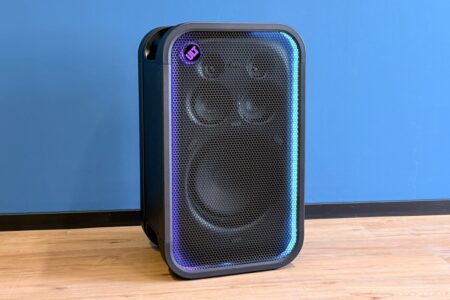
Visually, the Boombox 4 is instantly recognizable as a member of the JBL family. The basic design—featuring a large, tube-shaped speaker front and a sturdy carrying handle—has been retained. It is precisely this design that has given the Boombox series its high recognition value. It still evokes classic boomboxes, but is more modern, more robust, and better suited for outdoor use.
Compared to the Boombox 3, the new generation looks a bit bulkier. At the same time, its lighter weight is immediately noticeable as soon as you pick it up. Of course, the Boombox 4 isn’t exactly a lightweight, but it’s surprisingly portable for its performance class. The large handle makes it comfortable to carry, and the housing gives the impression that it can withstand even rough use at the lake, in the garden, or on the patio.
JBL rates the Boombox 4 with an IP68 rating. This makes it superior to the Boombox 3, which had an IP67 rating. Both models are thus protected against dust and water, but the new generation takes protection a step further. For a speaker explicitly designed for outdoor use, this is a key feature. Rain, sand, or splashes of water shouldn’t faze the Boombox 4 during a typical party.
JBL has also made improvements in terms of sustainability. The housing is made partly from recycled plastic, and the speaker fabric is also made from recycled material. The packaging uses FSC-certified paper and, according to the manufacturer, is printed with soy-based ink. Even more important, however, is the replaceable battery. It is sold separately and can be swapped out in just a few steps. For a high-performance battery-powered speaker, this is a real plus, because the battery is usually the component that starts to fail first after a few years.
Technical structure
The JBL Boombox 4 features an active speaker design with two large woofers, two tweeters, and three passive radiators. The two woofers, positioned in the center of the baffle, each measure 12.3 centimeters. The tweeters have a diameter of 20 millimeters. The bass range is supported by two round passive radiators on either side of the mesh-covered enclosure and an additional oval “racetrack” passive radiator on the back.
This sets the Boombox 4 apart from its predecessor. The Boombox 3 still used a 2.1 system, in which a central subwoofer handled the bass. The new generation distributes the low-frequency range across two larger woofers. In combination with the three passive radiators, this is designed to deliver more bass impact, as well as cleaner and more controlled sound reproduction.
More power
The performance specs are impressive for a portable Bluetooth speaker. When plugged in, the Boombox 4 delivers a total of 210 watts RMS. On battery power, it still delivers 200 watts RMS. The Boombox 3 delivered 180 watts RMS when plugged in and 136 watts RMS on battery power. This means the new generation isn’t just more powerful on paper, but should also perform significantly better—especially when unplugged.
JBL specifies a frequency response range of 37 hertz to 20 kilohertz. For a portable speaker, the lower end is remarkably deep. Of course, a frequency response alone doesn’t say anything about the actual bass quality indoors or outdoors, but it does show that JBL continues to position the Boombox 4 as a speaker with exceptionally powerful bass.
Another new feature is AI Sound Boost. According to JBL, this technology analyzes the music signal in real time and adjusts playback to deliver more power with less distortion. This likely involves dynamic signal processing that monitors the drivers, amplifier power, and distortion limits. Especially at high volumes, this could be a decisive factor—just as it is with the smaller JBL speakers also equipped with AI sound enhancement, from the Flip 7 to the Charge 6 and the Xtreme 4 — as many portable Bluetooth speakers have to significantly reduce bass at high volumes or sound increasingly strained. Whether the Boombox 4 can match the very impressive volume stability of the Boombox 3 remains to be seen in a sound test.
Bass boost with two presets
A key new feature of the Boombox 4 is its two bass boost settings. JBL distinguishes between Deep Bass and Punchy Bass. The feature can be activated in the app or via a button on the top. If the JBL logo lights up orange, Deep Bass mode is active. This is designed to deliver particularly rich and deep bass. Pressing the button twice switches to Punchy Bass mode (“Punchy”), which is indicated by a white icon on the passive radiators on both sides of the enclosure. Here, the bass is intended to sound tighter, clearer, and more dynamic. However, the lighting that pulses in time with the music can also be turned off.


This makes perfect sense in everyday use. Not every situation calls for maximum deep bass. Indoors, too much bass can quickly sound overwhelming or even boomy, whereas outdoors, that extra bit of low-end is often exactly what you want. Punchy mode is likely better suited for music where kick drum, rhythm, and precision take center stage. Deep Bass, on the other hand, appeals to users who expect as much volume and depth as possible.
Compared to the Boombox 3, this direct bass control is an improvement. While the previous model also offered a 3-band equalizer via the JBL Portable app, it didn’t feature this kind of quick-access bass adjustment on the device itself. The Boombox 4 thus allows for easier adjustment to the music, setup, and listening environment.
Wireless Connectivity
For wireless connectivity, the JBL Boombox 4 uses Bluetooth 5.4. According to the spec sheet, it supports the A2DP 1.4 and AVRCP 1.6 profiles. This means the Boombox 4 is designed for standard music streaming and remote control of basic playback functions.
The bigger change, however, concerns the multi-speaker feature. While the Boombox 3 still used JBL PartyBoost, the Boombox 4 relies on Auracast. With this move, JBL is following the current trend in the Bluetooth world. Auracast allows compatible speakers to be connected to each other and play the same stream on multiple devices. With JBL, two Boombox 4 speakers can be paired for true spatial stereo playback, and multiple Auracast-enabled JBL speakers can be integrated to provide sound for larger areas.
However, this change is important for owners of older JBL models. PartyBoost and Auracast are not the same system. Anyone who already owns a Boombox 3 or other PartyBoost speakers should check before purchasing whether and how these can be paired with the new Boombox 4. The Boombox 4 is clearly designed for the new Auracast generation.

Connections
When it comes to connectivity, JBL has taken a modern yet somewhat minimalist approach with the Boombox 4. The new generation features a power port for the AC cable and a USB-C port. According to the manufacturer, music can be played back losslessly via USB-C, provided the source, app, and music files support this. This makes the Boombox 4 suitable not only for Bluetooth streaming but also for users who want to connect a laptop or other compatible device directly.
The Boombox 3’s analog 3.5-millimeter jack input appears to have been omitted. While this makes sense from a modern usage perspective, it may not please everyone. Those who wanted to connect older audio devices, DJ controllers, portable players, or other analog sources still had a simple solution with the Boombox 3. With the Boombox 4, JBL is shifting wired connectivity to USB-C.
The power bank function remains an important practical feature. Especially when on the go, the Boombox 4 can use it to charge a smartphone or other mobile device. This makes sense for a speaker with a large battery and fits well with its outdoor use.
Battery and battery life
Battery life has traditionally been one of the Boombox series’ strengths. The Boombox 3 offered up to 24 hours of playback time. According to JBL, the Boombox 4 extends this to up to 28 hours. It also features Playtime Boost, which is said to add up to six more hours. In total, JBL claims up to 34 hours of playback time.
As always, these figures depend heavily on volume, the type of music, bass mode, and usage. A boombox operated at high volumes with powerful bass will hardly reach the maximum value. Nevertheless, the improvement over its predecessor is remarkable, especially since the performance is significantly higher when running on battery power.
According to the spec sheet, the battery has a capacity of 99.02 watt-hours. This translates to 21.6 volts at 4,584 milliampere-hours. The charging time is about three hours. This is significantly more practical for everyday use than the Boombox 3, which took much longer to fully charge. Charging is done via the included AC power cord, not via a small USB charger. This makes sense for a device in this performance class, as the Boombox 4 requires a correspondingly large amount of energy during operation and charging.
The replaceable battery is a particularly welcome feature. JBL notes that it is sold separately. For users who plan to use their speaker for many years, this can be a significant advantage. Instead of replacing the entire device, the battery can be swapped out when its performance starts to decline.


App and Operation
Like other current JBL speakers, the Boombox 4 can be managed via the JBL Portable app. The app was already a key part of the Boombox 3’s user experience, as it provided firmware updates and an equalizer. It is likely to play a central role again with the Boombox 4.
The app typically allows you to adjust settings, install software updates, and manage multi-speaker features. The app becomes especially useful in everyday life when used with Auracast, particularly when you need to pair multiple speakers or set up groups.
However, direct control via the device itself remains essential. A boombox is often used outdoors, where no one wants to reach for their smartphone for every little adjustment. That’s why it makes sense for JBL to make key functions—such as volume, playback, Bluetooth pairing, and bass boost—accessible directly on the speaker.
The two bass modes are a particularly practical feature. Instead of having to open an equalizer in the app first, you can quickly adjust the settings right on the device. This fits well with the nature of a portable party speaker.
The JBL Boombox 4 in a sound test
The boombox’s high-frequency reproduction immediately stands out for its detail and clarity. This already gives it a hint of hi-fi quality. However, the vocals in songs like “I Live in A Suitcase” (Thomas Dolby, “The Sole Inhabitant”) or “Take It Back” (Pink Floyd, “The Division Bell”) sounded a bit cold. That said, they never sounded harsh or strained, which is why this tonal quality can also be seen as a certain freshness in the context of party-readiness.
For most people, however, what really matters in this Bluetooth speaker segment is what happens at the lower end of the frequency range. And here, fans of speakers in this size class have come to expect a very rich, full-bodied bass. Pulsing beats that created a dance vibe and lifted your spirits. Plus, even in the previous generation, the boombox was known for its solid volume stability.
Be careful with the Bass Boost!
Use the bass boost with caution. Indoors, setting it to level 1 makes the low-frequency response sound a bit boomy. At home, I would especially avoid using the “Low” mode with rock music, because it sacrifices precision and becomes too boomy even just above whisper volume. Outdoors, however, the feature is more impressive, as is the case with electronic dance beats. Level 2 didn’t impress me at all with its somewhat clunky emphasis on the upper bass. But combined with the four equalizer presets—”JBL Signature,” “Chill,” “Energetic,” “Vocal,” and the freely configurable settings of the 7-band EQ—which can be saved as custom presets—everyone should be able to find the right sound for their taste with the Boombox 4.
If you use the PlayTime Boost feature, you can extend battery life by up to six hours—provided you’re willing to sacrifice some bass depth and punch. For background music or podcasts, however, the loss in sound quality is acceptable.
Conclusion and Alternatives to the JBL Boombox 4
JBL has once again succeeded in refining one of its Bluetooth speakers, which has enjoyed success across multiple generations. Compared to its popular predecessor, the Boombox 3, the new model stands out with greater volume stability and punch, while weighing less. Especially when running on battery power, it delivers significantly more power than the previous model. This makes the new generation of the Boombox a standout choice for mobile use. However, the bass boost was underwhelming, particularly in living rooms and at high volumes.
Even in terms of design, the Hama Canton Ultimate Pro stands out as an alternative. But the Hessian speaker specialist, which recently unveiled its new Vento series (aswe reported), set different priorities despite the speaker’s party-ready capabilities. The tuning of this Bluetooth speaker, released in collaboration with Hama, strives for the ideal of perfect balance. It sounds like a compact hi-fi system with a handle for easy portability. So if natural sound matters more than bass thump and volume, the more affordable Ultimate Pro is a real bargain.
You can find more alternatives in our best Bluetooth speaker list
Technical Specifications for the JBL Boombox 4
- Manufacturer’s Suggested Retail Price: 500 Euro
- Dimensions (W x H x D): 50.6 x 26.3 x 21.3 cm
- Weight: 5.89 kg
- Battery life: up to 28 hours (34 hours with PlayTime Boost); charging time: 3 hours
- Special features: Bluetooth 5.4, USB-C audio playback, water- and dust-resistant (IP68 rating), JBL Party Boost, power bank function, equalizer, built-in power adapter
- More at: https://www.jbl.com