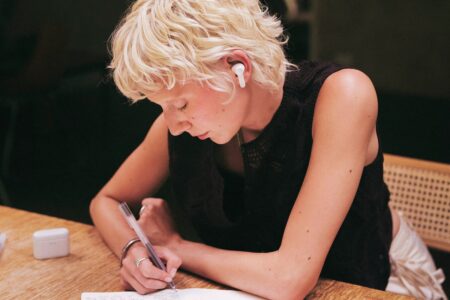
After the test is before the test. As an author, you never get bored. You’re sitting in the café house around the corner with coffee and cake or cappuccino and croissant and in walks Haithem Karoui from Studio 26 in Stuttgart, Germany. The system consultant is listening to the brand new Bang & Olufsen Beo Grace, which we recently announced in a news item. And he gives me the opportunity to try out the headphone highlight at my leisure. It should be noted that, according to the manufacturer, this is an early pre-production model.
For anyone who hasn’t read the news, here’s an overview of what Bang & Olufsen is currently offering for 1,200 euros (1,500 with leather case). The
For scenarios in which ambient noise is to be deliberately let through, a technology called TrueTransparency is used, which realistically integrates external noise into the listening experience. And according to my initial impressions, this works really well. A virtual slider in the Bang & Olufsen app allows you to continuously adjust the transparency.
Another element is EarSense technology, which dynamically adjusts the volume, ANC and sound characteristics to the respective environment in real time. The signal processing can therefore react intelligently to changing conditions.

Sophisticated tubes
The Beo Grace offers NearTap and Force Control: touching the metal surface of the perfectly crafted aluminum tubes in the temple region allows you to control the volume and other functions. The Force Control for playback control, activation/deactivation of ANC/transparency mode, and phone calls can be felt through a small ribbing. The command functions can be assigned to both earbuds. However, based on my initial experience, it takes some practice to get used to the controls.
The free Bang & Olufsen app for iOS and Android, on the other hand, took no time to get used to. Not only does it look clear and concise, it is also intuitive to use and offers many useful functions. This also includes the infinitely variable adjustment of the ANC to the respective requirements. As we were in a café, there were no low-frequency noises to block out, only voices. According to my brief impressions, Bang & Olufsen relies on a moderate effect even in the maximum setting. Even without the remarkably low-noise transparency mode, I didn’t feel completely isolated – a strategy favored by most in-ear providers, with the exception of Bose.

Battery, runtime & interfaces
With noise cancellation (ANC) activated, the in-ears are said to offer an operating time of up to 4.5 hours. In Haithem Karoui’s experience, this can easily be 5 hours in practice. With the extremely high-quality aluminum charging case, this figure increases to up to 17 hours. A quick-charging function is integrated: Just 5 minutes of charging allows for around 2.5 hours of playback. Even inductive chargers can be used thanks to a plastic panel on the back. The manufacturer also claims long-lasting battery technology with a service life of over 2,000 charging cycles.
Best-case scenario
My friend raves about the case, which the aluminum specialists at B&O manufacture in-house in Struer – for example, about the perfectly integrated button on the side for pairing with the smartphone. And there’s another highlight: if you connect the case via cable with its USB socket to a USB audio output, you can use it to establish wireless transmission to the headphones. An adapter cable with a USB-C/3.5 mm connection for dongle mode is even included to connect the Bluetooth earphones to an analog audio output. This considerably expands the in-ear’s range of applications.
For connecting to external sources, the Beo Grace supports Bluetooth 5.3, including multipoint connection to two devices, but only with the AAC and SBC audio codecs. In dongle mode via the charging cradle, LC3 (Low Complexity Communication Codec) is also supported.


B&O Beo Grace sound test
But let’s get down to business: how does the new in-ear from B&0 sound? Paired with Haithem Karoui’s iPhone via AAC, the Danish designer piece delivered a fresh, lively sound with fast, not too thick bass and a rather bright timbre. This tempted me to add a touch of warmth and bass volume to the sound with the unconventional, but immediately understandable sound control. The B&O method is also a very convenient way for professionals to adjust the sound, even if you could manage with a conventional graphic equalizer.
In terms of sound, the Beo Grace is flexible and impresses with its clarity. Of course, I was particularly curious about the surround sound effects. The difference between conventional stereo and virtual surround sound “virtualization” was clearly perceptible. Importantly, it did nothing wrong and took nothing away from the naturalness of the music reproduction. Within the possibilities of surround sound via headphones, this is definitely a successful function. The voices and instruments placed to the side then come out of the head a little and the solo voice in the middle of the panorama also gains contour, even if for physical reasons it cannot be placed in front of you as it would be via stereo loudspeakers.
Dolby Atmos significantly expands the spatial impression
I then played some Dolby Atmos recordings with the “Immersive” setting via the Apple Music and Tidal streaming services. The whole thing created the illusion of a larger room, but the performance then didn’t seem quite as jumping and direct, which could also be due to the recordings I selected in the short listening session.
What I liked were the Internet radio stations integrated into the app, which also produced really appealing sound. However, one thing in particular stood out during the quick check, which, in addition to the acoustic properties, is a top priority for me personally when it comes to headphones: The B&O Beo Grace sits extremely comfortably and yet securely in the ear with its very soft silicone pads. Bang & Olufsen includes four different sizes. The pressure-free but secure fit should also make the Beo Grace attractive for sports enthusiasts. The IP57 protection class for the two earphones and IP54 for the case also match this.
Bang & Olufsen Beo Grace: Conclusion of the short test
With the Beo Grace, Bang & Olufsen remains true to itself: sophisticated technology down to the last detail, high-quality workmanship, lots of aluminum (the Danes even supply German car manufacturers with their in-house aluminum parts production) and a price that underpins the premium claim. After all, this ensures a high level of exclusivity for all those who can afford it and like it. However, in our evaluation scheme, where the price-performance ratio is also included in the overall score, this would mean a certain mortgage, as the price of beauty is difficult to assess.
Technical data Bang & Olufsen Beo Grace
- Manufacturer’s recommended retail price: 1,200 euros (leather case: 300 euros)
- Type: in-ear headphones with Bluetooth
- Charging cradle: 59.5 x 47 x 23.8 millimeters
- Weight: 6 grams per earpiece, charging case: 65 grams
- Battery life: Up to 4.5 hours with ANC, up to 17 hours with charging cradle
- More at: https://www.bang-olufsen.com